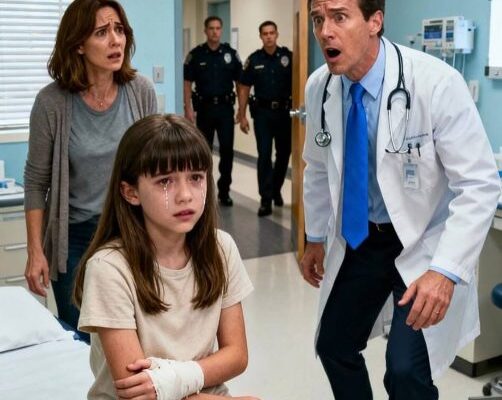
Dr. Jason Hale had treated countless children during his twelve-year career as a pediatrician, yet something about young Mia Reynolds—a silent 8-year-old with big brown eyes—made him feel unusually alert.
She was brought in by her mother, Anna Reynolds, who appeared weary, her hands trembling as she filled out the forms.
Anna explained that Mia had been vomiting for two days, running a fever, and had barely spoken that morning.
The examination commenced routinely. Dr. Hale checked Mia’s vital signs, gently pressed on her abdomen, and inquired about any unusual foods she might have eaten. Mia remained silent.
She only stared at him, her lips pressed tightly together as if fear prevented her from speaking.
Anna stood beside them, repeatedly asserting, “She’s just shy around doctors.”
However, when Dr. Hale leaned closer and gently asked, “Mia, do you feel any pain right now?” the child finally responded—almost inaudibly.
“Please don’t let my mom take me home…”
Dr. Hale felt his heart skip a beat. Tears filled Mia’s eyes, and her small hand clutched the sleeve of his coat as if holding on to life itself.
He maintained his calm demeanor. “Mia, sweetheart, why don’t you want to go home?”
She shook her head vigorously, trembling. Her grip became even tighter.
Dr. Hale glanced at Anna, who suddenly looked pale. “What’s going on?” she asked, her voice shaking.
The doctor stood up, walked towards the door, and spoke in a neutral tone: “I will be right back.”
In the corridor, he pulled the emergency call button.
“I need security in Room 2 immediately. Do not let the mother leave.”
Within moments, two security guards arrived. When Dr. Hale re-entered the room, the atmosphere was thick with fear.
Anna jumped to her feet. “Why is security here? I want to take my daughter home!”
She tried to approach Mia, but one guard gently stopped her.
“Anna, please sit down,” Dr. Hale said. “We need to understand what is happening.”
“I haven’t done anything wrong!” she exclaimed.
Mia looked at her mother, wide-eyed and terrified. The fear etched on her face was too palpable to ignore.
“You are safe,” Dr. Hale whispered to Mia. “No one will take you away until we figure this out.”
Mia struggled to swallow. “She said we have to leave town today… and not tell anyone.”
Anna stiffened. “Mia! Enough. You don’t understand what you’re saying,” she hissed.
Dr. Hale turned to her. “Why are you leaving town today, Anna?”
For a moment, she fell silent. Then her resolve crumbled.
She revealed that she had recently separated from her ex-husband, Daniel Reynolds, after a prolonged custody battle.
Just the week before, she had lost temporary custody due to missed appointments and concerns raised by Mia’s school.
The court had ruled that Mia should stay with Daniel for the time being.
Terrified of losing her daughter, Anna had packed their belongings that morning, planning to cross state lines and disappear.
“I’m her mother,” she cried. “I just wanted to keep her with me. I thought leaving would solve everything.”
Suddenly, Mia’s plea took on a heart-wrenching significance.
She wasn’t afraid her mother would hurt her—she feared being taken away from her father, from school, from everything familiar.
The hospital protocol was clear: when a child expresses fear of returning home with a guardian, Child Protective Services must be contacted.
Dr. Hale did just that.
Social services arrived within forty minutes with crisis family counselor Karen Blake.
She spoke gently with both Mia and Anna.
The truth emerged: Anna was not abusive—she was overwhelmed, unstable, and terrified.
Mia’s fear stemmed from uncertainty, not from a physical threat.
Karen knelt down beside Mia. “Do you want to see your dad today?”
Mia nodded slowly. “He didn’t know we were leaving.”
Anna covered her face, weeping. “I never meant to hurt her. I didn’t know what else to do.”
“You don’t have to run away,” Karen said gently. “You both need help.”
The hospital set up a safe room for Mia to rest while they contacted Daniel.
He arrived an hour later, distressed. Mia jumped into his arms, holding him tightly.
Anna watched, her heartache evident on her face. Daniel approached her silently.
“We need to do things the right way,” he said. “Running away would ruin everything.”
“I didn’t want to lose her,” she whispered.
“You won’t lose her,” he said softly. “But we need help.”
In the following hours, social workers devised an emergency plan: temporary custody for Daniel, supervised visits for Anna, therapy for all three, and a court reassessment.
It wasn’t perfect, but it was safe.
At sunset, Mia squeezed Dr. Hale’s hand. “Thank you for listening to me.”
“You’ve been very brave,” he replied.
Anna approached, her voice low. “Thank you… for stopping us.”
“Sometimes,” Dr. Hale responded, “the scariest moments lead us to the help we need the most.”
Mia left with both her parents—walking together, not running away.