Malcolm Reeves adjusted his navy blazer while walking through Heathrow Airport, securely holding his passport. At the age of forty-three, he had established himself as the founder and CEO of Reeves Global Consulting, a firm located in London that had just initiated a groundbreaking partnership with a Swiss investment group. Countless sacrifices, sleepless nights, and unwavering ambition had led him to this moment. For once, he chose to savor the luxury of a first-class ticket on his flight to Zurich.
While at the gate, several individuals recognized him from a recent feature in a business magazine and extended their congratulations. However, this feeling of triumph quickly faded once he boarded the aircraft.
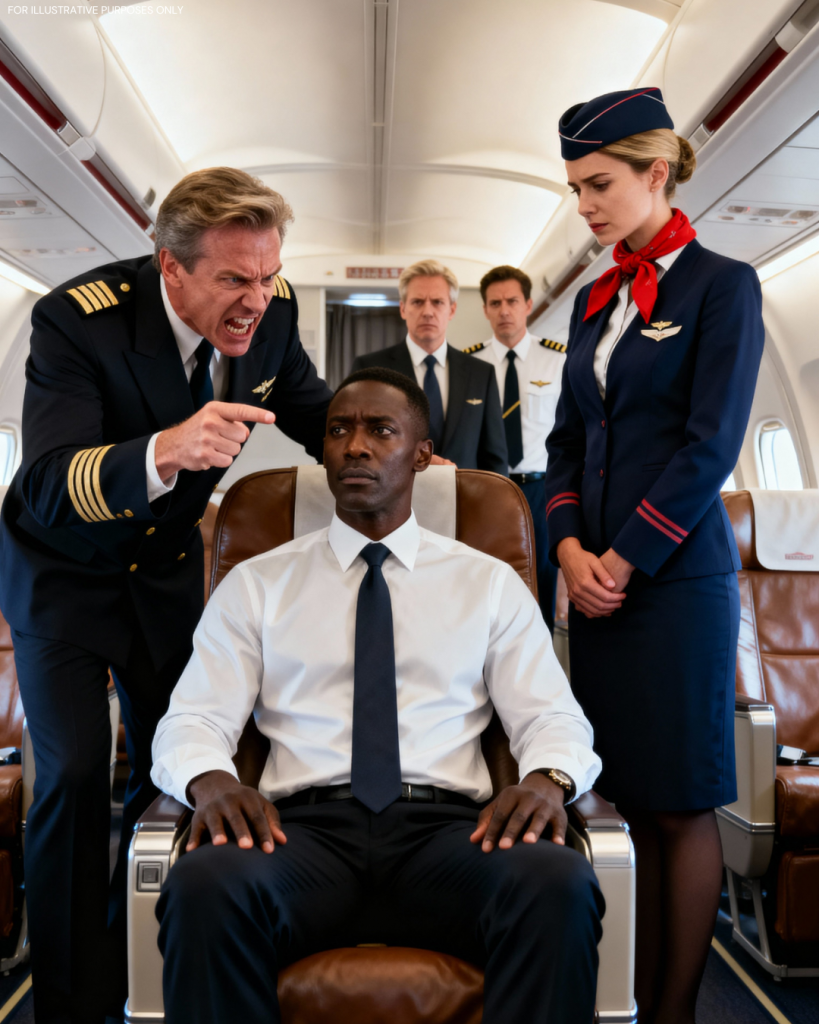
A tall pilot positioned himself near the entrance, greeting passengers with what appeared to be forced smiles. Upon locking eyes with Malcolm, the pilot’s demeanor shifted to one of disdain.
“Sir,” the pilot remarked, glancing at Malcolm’s ticket. “You seem to be in the wrong line. The economy seating is further down.”
Malcolm’s expression darkened just slightly. “No, my seat is 2A. I am in first class.”
The pilot let out a dry chuckle. “Let’s not make this uncomfortable. Typically, individuals seated in first class don’t dress quite like you.” His gaze flicked downwards at Malcolm’s dark skin before tightening up again.
A heavy silence enveloped the cabin. A few passengers exchanged uneasy looks. One attendant stepped forward but faltered, clearly feeling overawed by the pilot’s authoritative presence.
Breathing deeply, Malcolm stated calmly, “I will proceed to my seat now.” His voice maintained a quiet but firm authority.
He moved past the astonished pilot and took his seat, the atmosphere thick with discomfort. For the next two hours, the subtle humiliations persisted in various forms. While champagne was poured elegantly into flutes for the other passengers, he was handed only a sealed bottle of sparkling water. When he requested a blanket, it arrived after a significant delay. Each small gesture screamed volumes.
Malcolm chose silence not out of weakness, but because he understood that sometimes, restraint can be the most formidable weapon of all.
As the flight descended into Zurich, he closed his laptop, bracing himself for what lay ahead.
Once the plane landed and the doors opened, the pilot re-emerged, shaking hands and engaging in banter with the other first-class passengers. However, his smile faltered upon seeing Malcolm still seated, his gaze unwavering.
“Sir, we have arrived. You are free to disembark,” the pilot stated with a clipped tone.
Malcolm stood, buttoned his blazer, and responded with poise, “I will. However, I would like to have a word with you and your crew first.”
A low murmur passed through the cabin. Reaching into his briefcase, he retrieved a sleek black folder. Inside, he revealed an official ID marked with the emblem of the European Aviation Conduct Authority. The pilot’s expression altered dramatically.
“I am not just a consultant,” Malcolm explained, brandishing the badge. “I am also a member of the aviation ethics board responsible for reviewing the behavior of pilots and crew members across European airlines.”
“Today,” Malcolm continued, maintaining steady eye contact, “I faced discrimination that falls under the purview of this board. You examined my ticket yet proceeded to question my right to occupy this seat based on my appearance. You subjected me to humiliation in front of a cabin full of passengers.”
The pilot’s voice trembled. “Mr. Reeves, I—perhaps there was a misunderstanding—”
“No misunderstanding,” Malcolm interjected. “Only bias, the very poison that infiltrates this industry and that we aim to eradicate.”
His tone remained composed; he understood that such restraint carried more gravity than any shouting could achieve.
While the pilot fumbled through an apology, it was far too late. The flight attendants appeared visibly shaken, some standing on the brink of tears.
“This incident,” Malcolm quietly asserted, “will be thoroughly documented. I trust that your company’s leadership will treat this matter with the seriousness it warrants.”
He took his luggage, nodded courteously at the other passengers, and exited the aircraft. An eerie silence filled the cabin.
By the time he arrived at the baggage claim area, social media had ignited with activity. Footage of the encounter was trending under the hashtag #FlyWithRespect. The airline’s headquarters in Frankfurt issued a public apology the following day. The pilot faced suspension during the ongoing investigation, and the airline announced mandatory inclusivity training for all staff.
Nevertheless, Malcolm was determined not to make this into a spectacle. When the airline’s CEO reached out with a settlement offer, he respectfully declined.
“This is not about financial compensation,” he asserted firmly. “It’s about accountability. Ensure that such an occurrence never happens again—to anyone.”
Messages flooded in from across the globe—from Black travelers who felt unseen to allies pledging to voice their concerns in the face of injustice. One email, from a young aviation student in Madrid, resonated deeply with him: “You reminded me that dignity can triumph over fury. Thank you for proving that we belong in every space.”
One month later, Malcolm boarded another flight, this time to Oslo. As he entered the first-class section, a different pilot stepped forward, extending a respectful hand, and sincerely stated, “Welcome aboard, Mr. Reeves. It’s a privilege to have you with us.”
Malcolm offered a faint smile as he settled into his seat. Outside, the sky glimmered softly, and the engines hummed like distant thunder. He understood that a single flight wouldn’t resolve all issues. Yet, it had sparked a change—and sometimes, that alone was sufficient.
