I’m grateful for your presence. Stick around for my story’s end and share the city you’re tuning in from so I can gauge my narrative’s reach.
For three weeks, I meticulously organized my 65th birthday celebration—spending endless hours selecting the ideal menu, adorning the dining space with vibrant flowers, and confirming guest attendance. I even treated myself to an elegant navy blue dress adorned with dainty pearl buttons; Elliot had always complimented how it accentuated my poise.
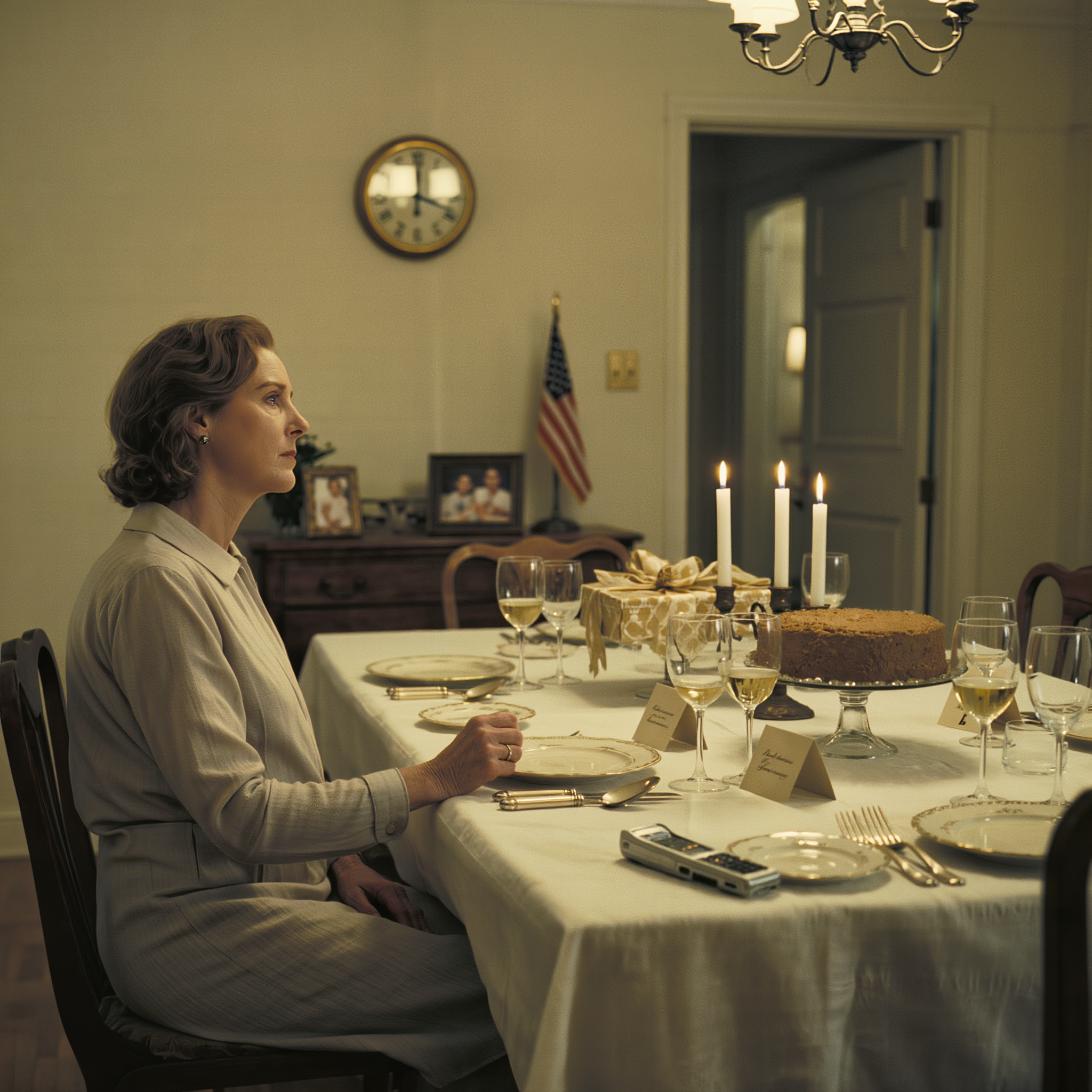
The table was arranged for eight, complete with name cards inscribed in my finest script: Elliot, Meadow, Little Tommy—who had recently turned seven—Sweet Emma, aged five, my sister Ruth, her husband Carl, and finally, myself at the table’s head where I could relish everyone’s expressions during our festive gathering.
Yet, by 6:30, not a soul had shown. I anxiously checked my phone thrice, second-guessing my memory of the time; however, my calendar read, “Birthday Dinner, 6:00 p.m.” I had even sent reminders to all just two days prior.
At 7:00, I reached out to Elliot—straight to voicemail. Meadow’s phone yielded the same result. Ruth’s lack of response was peculiar since she typically answered by the second ring.
Standing in my dining area, I gazed at the untouched plates. Candles lit just an hour ago had melted down to mere stubs. The roast was cooling in the oven, while the chocolate cake I labored over all morning remained untouched on the counter.
Traffic might be to blame. Maybe an unexpected obligation arose. I reassured myself—these things happen, though anxiety tightened my chest, and my hands trembled uncontrollably.
By 8:00, it became painfully evident they weren’t coming. I sunk heavily into my chair, surveying the vacant seats around me. This wasn’t mere tardiness—this felt profoundly different. The silence enveloping my home was profound, not serene but echoing emptiness, as though the house itself withheld breath.
That’s when I regrettably checked Facebook. At the top of my feed, a photo surfaced, sending a chill through my veins.
Meadow—beaming in a flowing white sundress, with Elliot grinning widely beside her. The ocean’s deep blue loomed in the background. The caption proclaimed, “Living our best life on the Mediterranean. Grateful for this amazing family getaway.”
I scrolled further. More images. Tommy and Emma constructing sandcastles on a pristine beach. Ruth and Carl toasting cocktails at what appeared to be a lavish ship’s bar. Everyone I cherished was present—everyone, except for me. The timestamp indicated these images were posted merely an hour ago while I waited, alone. They were enjoying a celebratory toast, laughing together against a sunset backdrop aboard a cruise ship far away.
A fissure inside me opened—not catastrophic; rather, a crack, akin to ice fracturing when an abrupt chill hits. They had plotted this—collectively. Meadow organized a family vacation intentionally excluding me, scheduling it on my birthday, managing to persuade everyone to partake, including Ruth—my own sister—who had assisted me in choosing decorations for this very party just last week.
I fixated on that photo until my eyes ached. Meadow’s smile shone particularly bright, almost triumphant, standing precisely where I should have been—at the epicenter of my family, encircled by those who were meant to love me.
A buzz from my phone startled me. A text from Elliot read: “Sorry, Mom. I forgot to mention we’d be out of town this week. Meadow booked a surprise trip. Happy birthday, though.”
“Forgot to mention”—as if booking a Mediterranean cruise was a detail one could casually overlook. As if the coincidence of doing so on my birthday was incidental.
Carefully, I placed my phone down, wary of hurling it against the wall. The roast had undeniably reached room temperature. I made my way to the kitchen and turned off the oven, my movements robotic and strange. I felt as though I was watching a stranger—this sad figure in her navy-blue dress—as she cleaned the untouched dinner.
I wrapped the cake in plastic and stored it in the refrigerator. I extinguished the remnants of the candles. Each plate clicked loudly against one another as I meticulously removed the china from the table and returned it to the cabinets, a jarring reminder of the deafening silence surrounding me.
Meadow had accomplished something tonight, though I couldn’t quite discern what game we played. I recognized, for the first time in my 65 years, I felt undeniably unseen—not merely overlooked or forgotten, but annihilated.
As I switched off the dining room lights, my reflection caught in the dark window. I appeared smaller, diminished somehow. The woman staring back had dedicated decades serving as the family peacemaker—the individual who quelled disputes and remembered each birthday and anniversary; the one who consistently put family first. Yet on my birthday, they opted to act as if I were invisible.
I ascended the stairs to my bedroom, each footfall heavier than the last. Tomorrow, I would confront the aftermath of this betrayal. The hollow apologies, the excuses about miscommunication, Meadow’s insipid voice rationalizing that the trip was arranged months in advance, leaving no options to amend it. But for tonight, I needed to embrace this sorrow fully, to genuinely process it. Because something told me this was much more than simply missing a birthday celebration. This was rooted in a far larger, more intentional behavior than I had ever anticipated.
That night, sleep evaded me. I stared blankly at the ceiling, replaying every family event from the last five years. The birthday that hadn’t been forgotten but had been sabotaged with intent. As the hours steadily moved forward, a cascade of troubling memories arose.
- Tommy’s fourth birthday party. I had felt ecstatic to witness him blow out his candles, yet when I arrived, Meadow greeted me at the entrance with her signature apologetic grin.
- Emma’s first day of kindergarten. I had sought confirmation from Meadow twice regarding the drop-off time, so I wouldn’t miss it, only to find out she arrived at the usual 8:30.
- Last Christmas, Meadow had phoned just two days prior, feigning concern about Elliot’s work stress and suggesting we keep Christmas dinner small—only for me to discover later that they held a massive celebration.
Every recollection felt like a puzzle piece fitting together, revealing the patterns I had been blind to. This wasn’t merely a series of misunderstandings or innocent scheduling issues; this was calculated.
As dawn broke, I brewed coffee, my hands still trembling—not solely from exhaustion but from an emerging dread. I immediately started scrolling through Meadow’s social media from the year, viewing it all through a newly discerning lens.
“I think you’d better come in,” I said, my voice barely above a whisper.
There she was at Tommy’s school play, spurring my most earnest inquiries about it—yet she had claimed it was canceled due to a flu outbreak. Emma’s dance recital, which Meadow closed off as just a rehearsal—which turned out to be so much more.
Photograph after photograph of familial moments I’d been excluded from emerged, each caption extolling “precious family recollections” and “grateful for these individuals in my life.” The harshest realization was how effortless it all appeared. Meadow’s arm wrapped around Elliot, the children nestled within their parents’ embrace—everyone beaming as if they existed as a complete unit, without me.
Placing the phone down, I gazed out of the kitchen window towards my garden—the last remnant of my time with Elliot as a child. When had I lost him? When had I stopped being vital to his contentment?
The answer materialized with staggering clarity: when Meadow entered our lives. Prior to her, Elliot called me biweekly and we maintained our bimonthly dinner tradition. He shared his work-related troubles, amusing anecdotes from his day—my son, my friend, my bridge to the future I had nurtured.
Slowly but surely, Meadow altered that dynamic. Sunday dinners transformed into monthly gatherings. “Meadow enjoys crafting elaborate dinners,” explained Elliot. “She loves having me to herself on weekends.” Then, the phone calls dwindled further, reduced to obligatory check-ins during holidays. “Sorry, Mom. I can’t chat long. Meadow’s scheduled us tightly today.”
Meadow subtly suggested I was becoming a burden, framing my concerns as excessive and requiring management rather than inclusion.
As I contemplated how Meadow embraced me at family gatherings—always with an air of sympathy, a reminder of fragility rather than an assertion of equal status within the family, it became crystal clear: my own son began to view me through her eyes—with affection coupled with pity. I was now a beloved but increasingly disposable presence.
The phone’s ring jarred me from my reverie, Elliot’s name lighting up the screen.
“Hi, Mom.”. His tone exuded ease—a stark contrast to my internal turmoil. “I wanted to say happy belated birthday. Sorry we missed it, but the trip has been fantastic. Meadow truly outdid herself in arranging it.”
My grip tightened around the phone as I responded, “Yes. I saw the images.”
“The trip came together at the last minute,” he replied, unbothered, “Meadow secured an amazing deal and jumped on it. She’s always been that way—one of the things I adore about her.”
“Elliot—” I began, then hesitated. What could I articulate? That his wife was manipulating him? He’d accuse me of jealousy, bitterness, or failing to grasp that he had matured and moved on. Perhaps I was all of those, but I was also accurate.
“Is everything alright, Mom? You sound off.”
A wave of the past flooded over me, revealing all those squandered instances, all the ways I had been forcibly excised from our family saga.
“I’m fine, sweetheart. Just fatigued.”
“Well, get some rest. We return next week, and I promise we’ll plan something special to make up for missing your birthday.”
Another empty promise from Elliot, one Meadow would undoubtedly find a way to break.
After ending the call, I found myself in the kitchen, reflecting on the day’s events. The morning light transitioned into afternoon as I ruminated on the future. More birthdays spent in solitude. More milestones missed. More family photographs capturing my absence—making it seem as if I had never existed.
In losing my husband eight years ago, I felt orphaned. Not due to death, but something arguably worse—because of the deliberate and purposeful removal of my place within the family.
Yet, as anger whirled within me—fiery and bright—a new realization dawned: I was not going to cease to exist without resistance.
If Meadow wanted to play games, she had unwittingly selected the wrong opponent. I had raised Elliot through his father’s departure. I had juggled two jobs to support his education and had forfeited my aspirations to ensure he seized every opportunity. I had earned my place within this family, and I was not about to relinquish it without a confrontation.
However, discernment of what I was fundamentally opposing remained elusive.
On Tuesday morning, precisely one week after my deserted birthday, the doorbell rang. I was still in my robe, savoring my second cup of coffee while staring at the stack of thank-you cards I had prepared for a celebration that never occurred. The unexpected sound caught me off-guard; I wasn’t anticipating visitors. My carefully curated isolation had rendered surprise visitors unusual.
Through the peephole, I spotted a man I didn’t recognize—perhaps in his mid-40s, dark-haired, with deep lines of concern etched into his features. Though dressed impeccably, he appeared disheveled, as if he’d just come off a long journey. He kept glancing around, seeming uncertain he should be standing at my door.
Initially, I hesitated to respond. Following the cruise incident, I had little patience for solicitors, missionaries, or whatever this stranger might desire. Yet, something in his demeanor—the way he seemed to be mustering the courage merely to be present on my porch—piqued my intrigue.
“Can I assist you?” I called through the door.
“Mrs. Patterson?” His voice bore caution and hesitance. “Loretta Patterson—Elliot’s mother?”
A tightness gripped my chest; how could this stranger know my son’s name?
“Who inquires?”
He hesitated, then stated something that sent a chill through me. “My name is David Chen. I need to talk to you about Meadow.”
I cautiously opened the door, ensuring to keep the chain latched.
<p“What’s going on regarding Meadow?”
David Chen’s unease intensified upon closer proximity. His hands trembled slightly, shadows underlying his eyes suggesting sleeplessness.
<p“This might sound unbelievable, Mrs. Patterson, but I believe… my son may be residing in your son’s home.”
<p“I don’t follow—what are you implying?”
<p“Tommy,” he replied with urgency—the name striking me with incredible force. “The young boy—seven years old, brown-haired, with a scar on his chin from a bicycle accident when he was four.”
Shock overtook me; I swam through memories of Tommy—yes, he did have that scar. Elliot had recounted the harrowing rush to the emergency room after the incident. But how could this stranger possess such knowledge?
<p“I think it would be best if you came in,” I suggested softly.
David Chen sank into my couch as though he might leap at any moment. I offered coffee; he declined, hands clenching tightly in his lap.
<p“I’m unsure where to begin,” he breathed. “This is going to sound crazy.”
<p“Go on. I have dealt with much stranger things in the past week.”
My coffee cup felt cumbersome; I cautiously set it aside, fearing I might drop it.
<p“I was greatly elated,” he shared, sentiments tinged with lingering sorrow. “I intended to propose immediately—start planning our life together. However, Meadow continued to postpone, claiming she required more time. Then, one day, I returned home to find her gone—her belongings disappeared as if she had never existed.”
<p“Did you search for her?”
<p“Absolutely. For months, I filed a missing report, employed a private investigator, scoured every conceivable social media avenue. Each attempt yielded no results—she had seemingly vanished into thin air.” He sighed. “The investigator ultimately advised me to abandon the search, stating that ‘some people simply don’t wish to be found.’”
I began to feel ill.
<p“What does this relate to Tommy?”
<p“Three months ago, I was in Sacramento for a conference—strolling downtown during my lunch break—and I spotted them. Meadow… and a little boy who resembled me at that age—same eyes, same chin, even the identical tilt of his head while he concentrated. I trailed them for three blocks. Mrs. Patterson, I observed that lad, and I was certain of it—he was my son.”
The realization felt overwhelming.
<p“You’re asserting that Tommy is your child?”
<p“I believe he is. Meadow was roughly two months pregnant when she departed, so following through to term, he would indeed be the correct age now.”
David retrieved his phone, displaying a childhood photo that distinctly mirrored Tommy’s likeness, features unmistakably aligned with the boy.
Despite the tenuous connection, I felt my hands quiver as I regarded the evidence. “This may simply be coincidental. Many children bear resemblances.”
“That’s what I initially believed,” he replied, “however, I grew concerned and hired another investigator—one more proficient. ‘Meadow Martinez’ isn’t even her actual name—her real name is Margaret Winters. And she’s enacted this previously.”
“What do you mean?”
<p“She vanished just as previously. When relationships grew complicated, she left. Apart from me, there are two other men who held similar experiences with her—relationships that concluded with the same abruptness, as if she never existed at all.” David continued, his tone slowly turning serious. “One of those men thinks she might’ve been pregnant when she left him as well.”
My head spun from the mounting implications.
<p“Why are you divulging this now?”
<p“Because I’ve been monitoring quietly for three months, attempting to ascertain how to navigate this—trying to identify if I held the right to disrupt a child’s existence based solely on intuition and coincidence. But after seeing your cruise photos, I recognized that something monumental was at risk.”
<p“What do you mean?”
<p“You were excluded from those images,” he said firmly, his gaze unyielding. “I examined thousands of their social media posts—gatherings, celebrations, special occasions. Tommy and Emma were frequently present, as was your son Elliot most of the time. Yet you barely appeared; it was as if you were being excised from your own family’s history.”
Enlightenment crashed over me—it all suddenly made sense. All those snubbing instances, each last-minute alteration, every missed event and unexpressed apology had accrued to perform a calculated erasure of my essence from my own family.
<p“I grew increasingly concerned for my own relationship with Meadow,” David elaborated. “During the last phases, she distanced me from my friends and family—cultivating a narrative that I was the issue and everyone else failed to appreciate our connection.”
Meadow’s strategy pulled upon Elliot as well—her manipulations influencing his perception of me. I had merely been a burden, an inconsequential factor.
<p“The truth lies here,” I expressed haltingly. “Meadow severed bonds to isolate you when you posed a threat, as she’s done with me.”
<p“I fear she’ll eventually execute the same maneuver with Elliot. Just as she has with everyone before him.” David’s tone shifted to a steely determination. “She’ll ensure he has no stake in social connections; he’ll be wholly dependent on her.”
<p“My heart aches for Tommy and Emma,” I replied, dreading their inevitable separation from Elliot. Each child remained blissfully unaware of their mother’s machinations or her abandonment’s impending consequences.
<p“What course of action lies before us?” I asked him, dreading the answer further.
<p“I wish for you to help me preserve our families—both of us. You, Mrs. Patterson, are Tommy’s grandmother in every respect; I’m ravaged by the truth that the fabric of love could be refashioned through the complexities of our existence.”
With a sudden jolt, David produced a business card, extending it towards me. “Consider this, but don’t dwell for long. They’ll return from the cruise shortly, and when they do, Meadow will be attentive to any indication you may prompt discord again.”
David’s departure left me with the weight of the DNA results and the business card. The sunlight waned, and my house echoed a quiet empty; resolution settled within me for the first time. I had not vanished despite Meadow’s intent to erase my existence from my own family story.
Three days post their return from the cruise, I reached out to Elliot. My tone remained calm and rehearsed, having envisioned this dialogue meticulously. “Hi, sweetheart. I was hoping we could gather for dinner this weekend. I have something of significance to discuss with you and Meadow.”
A pause followed, and I sensed the tension. “Mom, is everything alright? You sound serious.”
<p“All is well. I simply believe a fundamental family discussion is essential regarding us and our future. I’ve done some pondering while you’ve been away.”
Meadow’s voice crackled through in the background, my intuition sensing her worry. “She’s concerned about why I’m talking about serious matters.”
“Reassure her that I’m not upset. I just value the need for family transparency—wouldn’t you agree? Saturday evening suits me perfectly; I will prepare dinner.”
After Elliot conferred with Meadow and approvingly called me back, we had our dinner set for Saturday at six.
Friday arrived, and my preparations for the consequential conversation weighed on me. David and I had convened twice since his initial visit, mapping out carefully how to unveil the truth that protected Tommy while unveiling Meadow’s deceptions. I organized Elliot’s cherished meal—pot roast, garlic mashed potatoes, and his beloved green beans.
Saturday evening delivered typical October gloom; I set the dining area with my fine china, echoing the irony of the empty birthday celebration planned just weeks prior. They arrived promptly at six: Meadow cloaked in flowing cream hues, presenting a figure of innocence, her hair styled impeccably and make-up flawless—a perfect embodiment of devotion. Bright-eyed and brimming with excitement, Tommy rushed in first, his youthful exuberance infectious.
“Grandma Loretta! I learned swimming techniques on the cruise! Wanna see me do the doggy paddle?”
Heart swelling with love, I embraced him administratively. “Perhaps after dinner, sweetheart. Go wash your hands so we can begin.”
Emma timidly followed, grasping a doll with matted hair, cautious but willingly accepting my embrace. Finally, Elliot took me in a warm hug, and for a moment, I concealed the impending reality of our conversation beneath the facade of normalcy. “Something smells delightful, Mom. I’ve missed your cooking.”