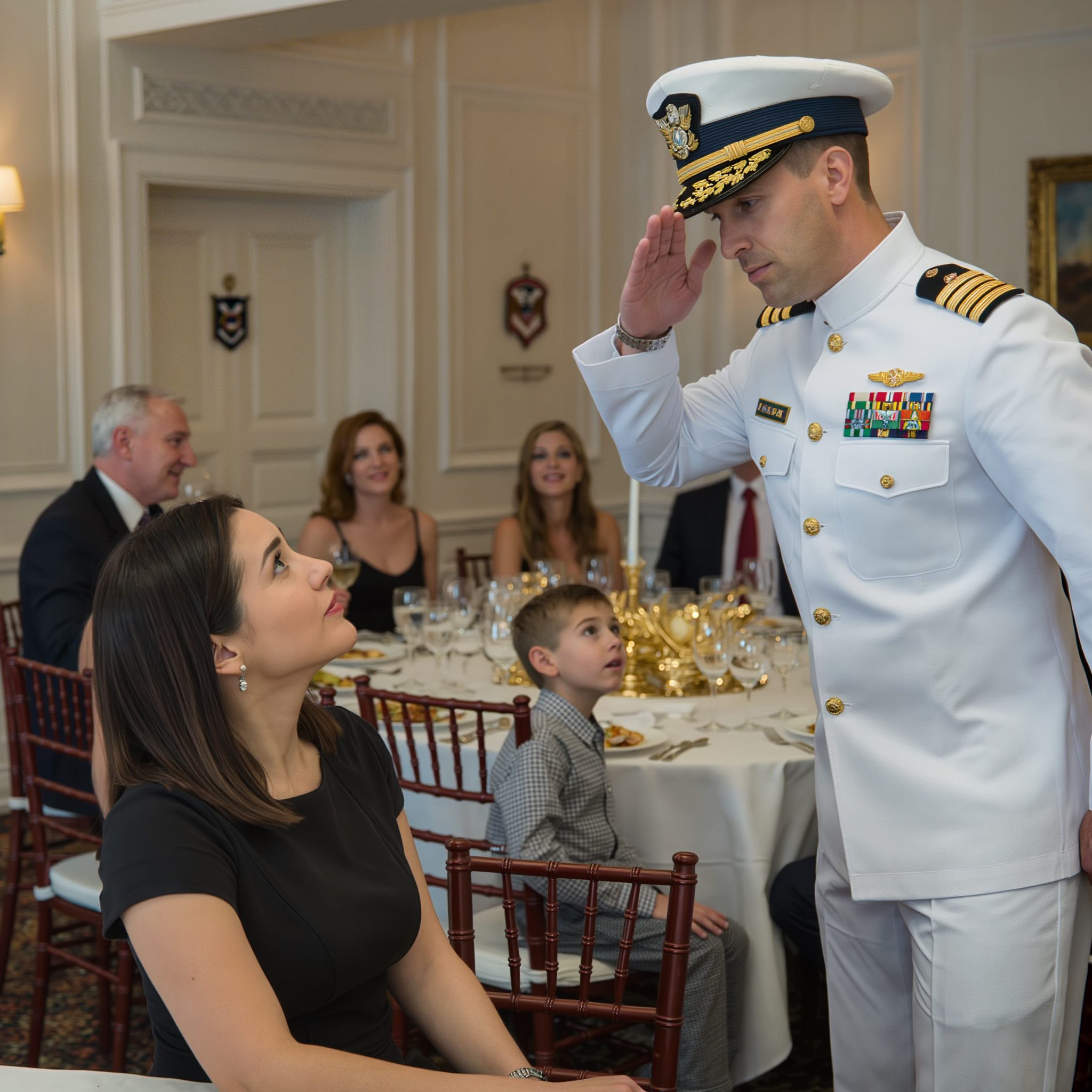
My family branded me as a failure for many years. They whispered behind my back and shook their heads in disbelief at my choices. Everything changed the instant my brother-in-law, an esteemed Navy officer, approached me. He looked directly at me and gave me a salute. The room became hushed. Gasps filled the air. That one act dismantled every label they had placed on me and revealed a truth none of them were prepared to confront.
My Family’s Perception of Me Changed After My Brother-in-Law Saluted
This poignant family narrative revolves around Eliza Rowen, a gifted but unrecognized systems advisor engaged in confidential defense work. For years, her relatives labeled her as a “failure” since her career did not involve visible awards or uniforms. She silently financed their needs, cheered on their achievements, and bore their taunts—until one evening at her sister’s birthday celebration, a distinguished Navy officer shattered the facade with a simple word: “Ma’am.”
The ensuing events were not about vengeance; rather, they embodied silent justice. This tale extends beyond mere recognition; it explores the delineation of boundaries, the erasure of emotions, and the restoration of one’s voice when the people closest to you fail to recognize your value. If you’ve felt overlooked in your family’s narrative, this family drama will strike a chord with you.
Follow Eliza as she rewrites her story—not through loud arguments but by standing firm, empowered, and complete.
My name is Eliza Rowan, and I am 33. Throughout most of my adult life, I’ve been the person everyone forgets to inquire about. It wasn’t that I disappeared. I consistently attended family dinners, celebrations, and hospital visits, always smiling, always present, always helpful, yet never noteworthy—at least not according to my family’s criteria. They favored success that was tangible, achievements prominently displayed on walls or celebrated at podiums.
My siblings embodied this mold perfectly. One wore a uniform, while the other pursued public policy—both easily brag-worthy. As for me, I navigated complex systems no one could articulate and signed NDAs that outlasted friendships. To them, I was the one who worked from home, the unambitious sister in stylish clothes. And I never contested their assumptions—not until my sister’s husband, Commander Marcus Wyn, walked into a room filled with those who thought I was unnoticeable and saluted me with a clear, resounding gesture, for I had truly earned it.
A subtle hierarchy always existed within my family, though none would openly acknowledge it. It lingered in how our parents introduced us at gatherings, in the arrangement of photos on the mantle, and whose accomplishments took precedence at family dinners. My father, who had retired after 23 years in the Navy, would don his military blazer for every formal event. He had a way of standing with his arms crossed—not as a defense, but as if he had predetermined who merited his attention. My mother, a former school principal, rarely smiled, but her smiles were always reserved for those who reminded her of her younger self—composed, organized, and quick-witted.
Luke, my younger brother, joined the police force at 20 and proudly wore his badge. He wasn’t particularly exceptional but fit the familial narrative: solid jaw, firm handshake, and an authoritative demeanor. They revered him. Dad called him dependable, and Mom said he made her feel secure. Talia, our youngest, was born with an instinct for diplomacy—straight A’s, student body president, Model UN. She received a scholarship to Georgetown, wed a Navy officer with an impressive record, and now worked in foreign affairs.
Each of her decisions was meticulously planned. She never raised her voice, wore anything without a belt, or entered a room without checking her posture.
In contrast, I studied computer science and engineering. Instead of the Ivy League, I opted for a boutique cybersecurity firm and transitioned to black contract defense work by my 30s. I handled threat simulations, critical infrastructure audits, and secure communications—tasks requiring heightened clearance levels and minimal public exposure. I briefed federal organizations and drafted protocols to prevent issues before they arose. Yet, none of that sounded impressive enough for a holiday card.
When I mentioned consulting, they dismissed it as insignificant. When I spoke of federal contracts, they interpreted it as unemployment. My mother once suggested I consider going back to school for a “real specialization.” I merely smiled, knowing that some jobs come with confidentiality that doesn’t lend themselves to casual conversation.
They didn’t mock me openly—not initially. Instead, it was more of a slow decline, like being quietly written out of the family story year after year. During Thanksgiving dinners, they would question Luke about his precinct and Talia about her embassy rotations. When it was my turn, the conversation typically shifted to refilling wine glasses.
At times, I consoled myself, convincing myself it didn’t matter. I wasn’t in this life to earn recognition. However, the reality chipped away at something deep within, and over time that silence warped into a narrative they accepted as truth.
I was oblivious to the weight I carried until one night, while staring at the ceiling fan, I mentally cataloged it. When Luke faced DUI charges in a neighboring county, I quietly transferred the bail funds, electronically, long before our parents even checked their message notifications. No one expressed gratitude. Two weeks later, he shared a selfie in his uniform, captioning it, “The grind never stops.” I simply observed the truth vanish beneath the algorithm’s haze.
When Talia experienced a panic attack during her final semester of graduate school while Marcus was deployed, she called me in tears at midnight, asking if I could help her rewrite two papers she hadn’t begun. Clearing my schedule, I stayed up for three nights in a row. She graduated with honors and delivered a speech on resilience. My name was never mentioned.
When Mom required a cardiac procedure that her insurance wouldn’t cover, she called me in tears for the first time in nearly a decade. I was already opening my banking app as she spoke. Assuring her I could handle it, I told her not to worry. She never revisited the topic again but did send Luke a framed photo of her recovery. He posted it with the caption, “Glad to be there for her.”
I didn’t perform these actions seeking recognition. I did them because I could, because they were family. For reasons I still don’t understand, I thought that love meant showing up even when unnoticed.
Yet they didn’t simply overlook me; they redefined my existence. To them, I wasn’t a systems analyst, threat auditor, or defense contractor. I was the accommodating one, the one with free time, the one who could be introduced casually. They constructed a version of me that catered to their comfort—easy to belittle, easy to minimize, easy to forget.
At times, I pondered whether they genuinely didn’t perceive the extent of my burdens. Other times, I speculated if they did but preferred the romanticized version of me. The narrative where I was the unmotivated sister in fashionable attire, assisting with technology, enhancing their success.
Still, I attended celebrations, baby showers, and holiday gatherings. I brought gifts, inquired about their careers, and laughed at suitable moments. Whenever comments arose about how some of us actually worked for a living, I swallowed the remarks, changing the topic. I thought that was strength. I assured myself that silence equated to grace.
But silence carries weight. It accumulates. Then one day, you glance up and realize it is suffocating you.
I began detecting subtle alterations. First, a missing group photograph, then conversations I was excluded from. My mother’s casual mention of “just the three of us kids” during brunch felt casual, leading me to question my hearing. I hadn’t misheard.
When Talia held her bridal shower, I wasn’t extended an invitation. I was told it was just for friends. Later, I saw pictures including cousins, neighbors, her entire office team, and Marcus in uniform toasting. I sent her a thoughtful gift nonetheless, something understated and practical. It went unacknowledged.
Luke’s promotion to sergeant was celebrated with a grand cookout—banners, speeches, and even a photo booth. He took the stage and expressed gratitude to those who believed in him, naming Dad, Mom, Talia, and even his old football coach. I lingered at the back, near the recycling bin, clutching a nearly empty plastic cup. He didn’t glance my way even once.
That night, I drove home with the windows down, hoping the cold air would ease the pressure in my chest. It didn’t.
Then came Dad’s birthday dinner. I received the invitation just two days prior; it had been sent to an old email address. Mom called it a mix-up. I still arrived punctually, gift in hand and dressed with consideration. They seated me at the far end of the table, next to a cousin I hadn’t seen since high school. At one point during the meal, Luke leaned over and asked loudly for others to hear, “So, are you still working from your couch, or is that classified information also?” A few chuckles erupted. No one stopped him—not even Marcus. Not even Talia.
I remained silent. Taking a sip of my drink, I observed them continue the conversation as if I was invisible. That’s when I recognized it wasn’t merely a phase or misunderstanding. They had entirely rewritten who I was, editing me out of the family narrative as if I were an unnecessary footnote. And even worse, I had allowed it to happen.
They failed to see me because I consistently stepped back, made room, and prioritized peace over clarity. But a peace established on erasure is fleeting. After countless dinners and dismissal of pivotal moments, a stir within me began—not anger, but a cooler, quieter resolve.
I realized the invitation wasn’t intended for me. I received it in error—an email from a catering service confirming headcount for Captain Wyn’s promotion dinner. It addressed someone else—a coworker of Talia’s with a similar name. I stared at it for a full minute before realization dawned. A formal dinner was scheduled for Marcus, and I wasn’t included. It was no surprise. I hadn’t been invited to Talia’s baby shower, her housewarming, or the Christmas brunch—two years in a row. Every time, there were justifications: wrong address, short notice, limited capacity. But this was overt, precise, silent.
I didn’t respond to the caterer. I didn’t text Talia. I didn’t ask why.
On the Saturday of the dinner, while they dressed in tailored outfits, posed beside flags and plaques, I sat at my kitchen counter, still in my hoodie, reviewing a classified report on cybersecurity vulnerabilities in naval communications—protocols and systems Marcus and his team would eventually implement. The irony was almost amusing.
When the photos appeared online two days later, I allowed myself to glance. Marcus in full uniform. Talia in a sharp navy dress, standing close enough for the headlines. My parents on either side of them, all smiling as if posing for a magazine. Luke in the back, casually holding a red plastic cup, already mid-toast. The caption read, “Proud moment for the family. Captain Wyn. Honor. Courage. Commitment.” I wasn’t mentioned.
By that time, I should have been accustomed to it. But there was something about that particular exclusion—so thorough, so polished—that struck differently in my chest. It wasn’t merely neglect; it was careful narrative control. They weren’t just disregarding me; they were erasing me.
Yet oddly, it didn’t shatter me. It didn’t hurt the same way anymore. It felt clinical, like reading a report about your life from a detached third-person perspective. I closed my laptop and sat in silence—not angry, not sad—just present. That’s when I realized something had shifted. They could pretend my existence didn’t matter, but reality has a way of asserting itself silently, preparing to take action.
Talia’s birthday dinner took place at a private banquet hall just outside the city—elegant floors, golden centerpieces, the sort of lighting that made everything appear pricier than it was. I received the invitation only two days prior, this time with my name included. I almost decided against attending. I had a deadline, a deliverable for a government client that couldn’t afford delays. Yet something stirred within me—not curiosity or pride; it felt colder, sharper—compelling me to go.
Arriving early, I parked in the back corner and wore black—simple yet sophisticated. No jewelry, no excuses. Upon entering, the room buzzed with energy. I spotted Mom first, flitting between tables as if hosting a fundraiser. She noticed me, blinked once, and approached with a prim smile. “You made it,” she remarked as if it was unexpected. “Just don’t make it about you. Okay? It’s her night.”
Then came Luke. “Well, look who emerged from her apartment,” he chimed as he gestured with an already filled glass. “The deadbeat showed up after all.” A few heads turned, and some smirks followed. No one interjected on my behalf, not even Talia.
I held my tongue and took a seat towards the back, against the wall, allowing myself to fade into the background of military uniforms and curated success tales.
Dinner commenced. Laughter mingled with toasts. I ate in silence. Suddenly, the door swung open.
Marcus entered—dressed impeccably in whites, adorned with gold trim and ribbons meticulously aligned. He surveyed the room once. Then his gaze locked onto mine—and he halted. Instead of approaching the head table, he walked—slow, purposeful—towards the back where I sat. Conversations hushed. Upon reaching my table, he paused just short of my seat and rendered a salute. Clean, textbook, formal.
“Ma’am,” he pronounced, his voice projecting enough to carry across the room.
A fork clattered to the floor. Someone inhaled sharply. My father froze in disbelief. Talia’s confident demeanor faltered. I slowly stood and returned the salute with a nod.
<p“Lieutenant Commander,” he lowered his voice. “I didn’t expect to see you here.”
<p“Neither did I.”
He motioned to the seat beside me. “May I join you?”
I nodded. Just like that, the entire atmosphere shifted. They didn’t quite grasp who I was but suddenly comprehended that I was not the person they had presumed. For a full minute after Marcus settled down, no one uttered a word. Conversations gradually resumed, but they were softer, more cautious. Glances were exchanged but quickly averted. The overall vibe had altered—less laughter, more whispers exchanged behind napkins.
Talia approached, her usual composed demeanor faltering slightly. She placed her hand on Marcus’s shoulder as if to reclaim him. “You made it,” she acknowledged.
Marcus remained seated. “Wouldn’t miss it.” His eyes stayed focused ahead.
She didn’t glance at me, merely squeezed his shoulder before returning to the front table. My parents didn’t speak with me for the remainder of the evening. My mother avoided my gaze entirely, while my father seemed confused, attempting to solve a puzzle that had unraveled. Luke kept stealing glances our way, the confidence he often displayed had evaporated. He jokingly quipped about the cake being dry—“Like government work”—but no one found it humorous this time.
Marcus didn’t feel the need to explain the salute. He didn’t need to. His presence beside me conveyed everything. As dessert was served, I remained seated while others navigated around me as if recalibrating. I felt none of the burdens I previously bore at such gatherings. No need to prove myself, no compulsion to shrink—just a profound sense of stillness.
I departed before the cake was sliced and walked out alone, braving the crisp night air against my arms. The parking lot was almost deserted. Settling into my car, I sat for a moment—not crying, not shaking—just inhaling deeply. For the first time in years, I had been acknowledged. Not explained. Not defended. Just recognized. And the family that had established a myth about my invisibility—now perplexed.
Later that week, I received a text from Talia. No greeting, just a line: What do you do exactly? I stared at it for an extended period. Then I locked my phone, pushed it aside, and resumed my meal. She wasn’t ready for the truth, and I wasn’t inclined to give it.
Messages continued to arrive after that. A few days later, Talia sent another: Adam won’t disclose details, but I think I made an error. Just… if you ever wish to talk. It wasn’t exactly an apology, but it wasn’t a deflection either. I read it twice before deleting it—not out of spite—just clarity.
Years went by where I adapted myself to meet their comfort, dimming my own light so others wouldn’t squint, chuckling at their jests, assisting them without request, and showing up even when unwelcome. That night, following Marcus’s salute, something unlatched within me. This wasn’t fueled by anger, but comprehension. I had permitted them to perceive me as small because it made their lives easier. I allowed space, remained silent, avoided confrontations—all to facilitate their familiarity with my identity. But silence is a form of consent, and I was finished granting it.
The next invitation arrived for Easter brunch. A group text. Mom included a winking emoji and signed it “from the real adults,” as if it were all a jest, as if I hadn’t spent a decade supporting their shortcomings while they labeled me unemployed. I opted not to reply. Three days later, Talia followed up: I hope you can attend. It would be nice to move beyond everything. I locked my phone again—no interest in progressing past issues they refused to acknowledge.
On Sunday, I meandered through the older section of town, past the river trail and the aging federal complex where I had initially submitted my first threat-response protocol. The building bore no signs or flags, just three armed guards and reinforced glass. No one was aware of what transpired within, but I did. That’s the distinction.
Acknowledgment didn’t need to accompany applause, explanations, or family photographs. Sometimes it appeared in how someone dropped their fork. In the hushed room, in the manner a man in uniform locked eyes with you and communicated, without needing to spell it out, “I know who you are.” In that moment, everyone else had to confront the reality they had spent years denying—the truth.
I never clarified the salute. Not to my colleagues, nor to the junior analyst who once questioned if I ever felt invisible. Not to Talia. Not to my mother, who later left a voicemail inquiring if things had escalated. I listened to the message once before deleting it, for it no longer mattered.
Months rolled on. The family chat remained silent until a cousin reached out with a simple photo from another gathering. Luke manned the grill. Dad delivered a speech. Naturally, I remained unmentioned. Then she added, “Marcus shut down a joke—said, ‘You do real work.’ No one had anything to counter that.” I read it twice and chose not to respond. Not out of resentment—just certainty.
For years, I allowed them to depict me in a manner that enhanced their stature—simplistic, quieter, uncomplicated. I played along, believing love involved fostering their comfort. However, comfort rooted in erasure is not love. It’s confinement.
When Marcus saluted me that night in the banquet hall, he did not grant me power; he acknowledged it. That moment did not require explanation. It stood resolute.
Now, I eschew environments where I’m tolerated. I no longer feel the need to justify myself in spaces that thrive on my diminutive role. My life is serene, not invisible—filled with systems I meticulously uphold, teams that rely on me, and silence that no longer extracts anything from me.
Some legacies are whispered, some are witnessed, and others stride into the room, extend a hand, and say nothing except, “Ma’am.”
The day after the salute, my apartment held an unusual quietness—no phone calls, no crises—only the stillness subsequent to a tremor when the dishes no longer trembled but the foundation had not settled. I brewed coffee robust enough to support a spoon and watched as steam created tiny silhouettes against the kitchen window. My phone vibrated discreetly—set on silent by those aware that noise signifies trouble. I didn’t recognize the number, but the area code belonged to a base town familiar by instinct.
“Rowan,” I answered.
A pause ensued. Then a firm voice responded, “Commander Wyn.”
I allowed silence to test him. He matched it. “Eliza,” he softened. “I’m reaching out to convey two things I didn’t express last night because that room wasn’t designed for honesty. First: I apologize for not intervening sooner. Second: that salute wasn’t theatrical.”
<p“I understand,” I replied.
We exchanged breaths across three states and a web of secrets. “You didn’t owe me that call,” I affirmed.
I did,” he insisted. “She’s my wife. They’re your family. I stepped into a room where everyone profited from the narrative that kept you comfortable. I forced them to confront the version that protects people they’ll never know. That’s my responsibility.”
<p“That’s also my responsibility,” I countered. “I equipped them. Each time I resolved an issue quietly, paid the bills, or exited before the photos, I conditioned them. You simply disrupted their ingrained behavior.”
He exhaled—a mix of amusement and sorrow. “Fair.” A moment passed. “I’d like to send you a note through official channels. There’s a working group I believe you should review. No pressure—just know your contributions are already embedded in some of it.”
<p“Send it,” I responded.
After hanging up, I lingered at the kitchen counter, watching morning light spill golden on the sink. I reflected on the times I permitted comments to slide because the truth was classified or because the night had already worn long. I contemplated the multitude of minor edits that had led to becoming a ghost in my own family.
Retrieving a legal pad, I documented a list titled Things I Do Out Loud:
- I attend only when invited with genuine intent.
- I respond to questions posed in earnest.
- I don’t provide context to those who weaponize it.
- I financially support causes, not negative patterns.
- I exit rooms that necessitate me to diminish myself.
I affixed the list inside my pantry door, near the spot where the good olive oil resides. Rituals, much like security, function best when aligned with daily routines.
There comes an exit ramp your heart navigates when you cease auditioning for a role you never desired. The world doesn’t celebrate. It merely quiets, slightly, as if waiting to observe the next move.
The workplace recognizes when you’ve made room again. Just two days after the dinner, a request arrived on the secure line: a weekend war-game focused on coastal communication. Simulate a failure, rectify it before it manifests in reality—the sort of exercise that hardly makes it past the driest paragraph in congressional reports but determines whether someone can bid goodnight to their kids via FaceTime from a vessel distanced from both time and space.
I prepared a go-bag and, while on the train down the corridor, I watched winter transition into fields awaiting orders. My badge provided access past the initial gates, the subsequent ones, and the third. In the windowless room, the fluorescent lights banished any semblance of romance, and the coffee machine seemed to have given up long before the previous administration.
“Morning,” I greeted the kid stationed at the far terminal. He couldn’t have been older than twenty-two. You always recognize the novices by their upright postures when a door opens.
“Morning, ma’am.” He glanced at the nameplate on my lanyard, blinked, and then returned his focus to the screen as relief washed over him, the kind that comes from recognizing the pilot in turbulent skies.
We constructed the problem, then dismantled it. We built it once more. By the second hour, my shoulders had remembered the rhythm my lips forgot how to enunciate—map the dependencies, eliminate single points of failure, route everything through an architecture that stares chaos in the face and boldly states—“not today.”
At 0300, the room filled with the aroma of black coffee and the inside of a server cabinet. “Rowan,” my deputy remarked, “if we launch the patch now, we can operate in real-time with minimal handshakes.”
“What’s your minimum?” I inquired, without glancing up.
“Thirty-six seconds.”
“Grant me twenty-four,” I requested, “and don’t provide seconds you can’t substantiate.”
He didn’t argue. Competent individuals don’t dispute the number that preserves a life.
Once executed, the wall of screens performed their function—the simulated breach encountered and fizzled like a match in rain. The youthful analyst at the terminal smiled as realization dawned upon him—the world might not collapse every time the clock stutters.
“Who developed the original protocol?” he queried.
I watched the data settle into a stable hum. “Many contributors,” I answered. “My hands were just two among them.”
Afterward, I stood in the hallway, allowing the cold air from the vent to wash over my face. That silence wasn’t emptiness; it was hard-earned.
A week later, Talia reached out: Coffee?
I fixated on the word until it blurred before me. Then I concurred and proposed a venue devoid of corners where old disputes could hide. Bright, lively, filled with families pushing strollers and individuals who, that morning, faced no greater risk than enjoying a pastry they might regret.
Upon her arrival, she donned attire reminiscent of a briefing—crisp, neutral, refined. Spotting me, her expression mirrored the shock of encountering a memory that recalled years of certainty.
“I didn’t know,” she opened, bypassing the usual exchanges.
“You weren’t meant to,” I replied. “That’s how the job functions.”
“I comprehend the job,” she said. “I just didn’t recognize it belonged to you.” Taking a steadying breath, she continued, “I regret our easy version of you. I regret appreciating it.”
I stirred my coffee, observing the spoon find its rhythm. “I regret assisting you,” I replied.
She blinked. “Assisted—”
“Assisted in constructing it,” I clarified. “Each time I allowed a jest to slip by, every time I quietly paid for something or claimed to be busy consulting, I penned captions beneath your pictures.”
We indulged in the silence that didn’t inflict pain. Shouldering her burdens, she squared her stance as if bravery had its demeanor. “I can’t amend what we constructed,” she confessed. “But I can cease doing it.”
“Good,” I affirmed. “Here’s where I stand. I owe nobody a performance, and you owe me no audience. We’ll retire the old script. If you desire me in your life, treat me like a person—not a mere accessory. And cease inviting me into settings where Luke exploits my name as entertainment.”
Her mouth formed a surprised shape. “Yes.” The word landed naturally, suggesting authenticity.
She traced the edge of her cup, as if reading braille. “He informed me that you were unemployed,” she said out of the blue, anger simmering beneath her composed facade. “For years. He described you as someone who earned a good living ‘assisting wealthy individuals with technology.’ I accepted it, believing it was simpler to celebrate the narrative we were already living.”
“Stories are profitable,” I remarked. “Truth has a price.”
She nodded. “He won’t treat you that way again.”
“That’s not your duty to ensure,” I replied. “It’s mine. But thank you.”
We exchanged no hugs. No photos were taken for social media with captions celebrating sisterly bonds. We settled the bill and offered a generous tip before venturing outside into a crisp morning that felt less like a closed door and more like a corridor with possibilities.
Luke approached me three days later, the way cowards often stumble into courage—at the parking lot amid other people’s errands.
He leaned against my car as if it were his own. “I heard you and Talia are back on good terms,” he stated, using the term good with a connotation of compliance.
“I heard you received a write-up last month,” I replied. “Are we trading updates on performance?”
His jaw tightened. “What made you let him salute you?” he asked, bypassing grief and shame to assert control. “That should have been my wife’s night.”
I unlocked my car. “That was the choice of your wife’s husband. My existence isn’t an event you schedule.”
“Mom is upset,” he mentioned.
“Mom is frequently upset,” I countered. “She can contact me when she’s ready to be specific.”
He let out a short, harsh laugh. “You think you’re superior because you conceal yourself behind secrecy and acronyms?”
“I believe I’m done remaining in spaces where you drink your insecurities and regurgitate them onto women,” I stated. “Luke, I handled your DUI because I didn’t want Dad’s health issues to worsen. I covered Mom’s medical bills because they were essential. I composed Talia’s papers because she reached out in distress at midnight. None of that obligates me to endure jests from someone who confuses authority with character.”
He opened his mouth, only to shut it again. “You think you’re the heroic figure,” he asserted finally.
I replied, “I believe I am the boundary,” as I got into my car. “Understand the distinction.”
In the rearview mirror, he stood leaning against my vehicle, a man witnessing the only map he ever relied upon catch fire.
My father refrained from calling. Eventually, my mother did, in a tone that had learned to navigate sensitive topics. “Is everything alright?” she asked far too early in the discussion.
“We have yet to ascertain that we’re a ‘we,’” I replied.
“Eliza,” she spoke, her veneer cracking into earnestness. “You understand what I’m implying.”
“I do,” I acknowledged. “That’s the dilemma. I’ve always comprehended what everyone means. Nobody ever inquires about what I mean.”
<p“What do you mean?” she quickly pried, as though providing the correct answer could keep me engaged.
“I mean I refuse to barter my self-respect for a place at your table,” I stated. “I’ll join you when invited, as your daughter—not as support. I won’t be the punchline for Luke’s jokes. I won’t remain silent so Dad can thrive in a story he recognizes. If that’s excessive, then no—we’re not okay.”
Her breath trembled. “I don’t want to lose you.”
<p“Then stop displacing me,” I asserted.
We concluded the call neither content nor reconciled but honest. That counts for something.
A week later, the note from the working group arrived—navigating through so many channels that it appeared like a river refusing to be contained. It wasn’t glamorous—that much confirmed its importance.
When the truth seeks to transform the world within my professional sphere, it seldom flaunts fireworks. Instead, it is unveiled in dated diagrams bound in folders with incorrect fasteners, or as a line of code that is perfectly punctuated yet deceptively malicious. It presents itself as a map where the borders align until you flip it, revealing that every route leads to a precipice.
We constructed another solution. We breached another lock. We adjusted the hinges on an entrance that no one outside that room will traverse, and that’s the essence. Silent justice is not defined by court verdicts. It is reliant systems that endure.
At 2100, I stepped outside to contact Talia. I didn’t owe her that courtesy, yet I offered it nonetheless.
“Marcus instructed me to request a date when your phone wasn’t a potential bomb,” she said as an informal greeting.
<p“Now works,” I responded, as “now” is the only moment I trust.
<p“I want you to join us for Sunday dinner,” she invited.
<p“No,” I declined.
A pause ensued. “That was quicker than I anticipated.”
<p“I’ll meet you for a walk,” I replied. “No table, no audience. You can share insights on the latest at Georgetown, and I can discuss spotting a man who utilizes respect as currency.”
Methodical. Precise. She understood that we weren’t reconstructing a reunion; we were establishing a truce with parameters in place.
I initiated the practice of maintaining a small notebook detailing signs that indicated I was on the right path. Not the grand signs. Only the minute ones only I could perceive because of inhabiting my own body. My shoulders released some tension. My jaw relaxed. I could navigate a budget meeting without the habitual urge to contribute so others wouldn’t confront their shortcomings.
On Thursdays, I taught an introductory hour on scripting at the community center on Oak and Fifth. Six eager girls and one boy, all between the ages of eleven and fourteen, none of whom cared that their instructor wielded a clearance capable of accessing windowless rooms, all of whom were immensely concerned about the quality of snacks.
“Why do we need to understand loops?” one proclaimed, assertive and confident, showcasing her pink hair tips like someone unaware of how vital her voice would become one day.
“Because,” I explained, “everything that operates smoothly involves a disciplined loop. You execute the action, verify its success, and then proceed to the next step. Without loops, you’re merely tossing wishes toward a wall.”
She contemplated this, feigning disinterest, then proceeded to write a flawless ‘for’ statement as if it were no grand accomplishment. If the world doesn’t fail her, she would be leading an operation by nineteen.
I bought them a whiteboard the following week. On the bottom left corner, in font small enough to remain unnoticed unless one approached closely: Quiet ≠ Small.
Spring arrived as per usual in this region—its onset so rapid that you briefly ponder the possibility of winter being a mere fabrication.
Ultimately, my father rang on a Tuesday. The phone emitted one chime, bringing back a smell: Old Spice, shoe polish, and the scent of ceremonial programs.
“Eliza,” he proclaimed, his tone formal, as though attempting to invoke memories of a role we both no longer embrace.
“Dad,” I responded.
“I’m struggling with this,” he admitted, his words breaking through barriers. “I’m unsure how to discuss you without referencing myself.”
“Then refrain from referencing me,” I suggested. “Ask me.”
He hesitated. “What do you… desire?”
“A Sunday where you don’t don the blazer,” I stated. “A dinner during which Luke limits his alcohol intake to one, without speaking my name. A conversation without Mom opening with a critique of my failures, only to conclude with genuine curiosity.”
He emitted a deep sound that could have easily been humor. “Reasonable,” he concurred.
“Additionally,” I added, recalling the importance of laying the foundation before erecting walls, “stop labeling Talia’s husband a hero as if the rest of us are just volunteers. If you desire to label someone a hero, direct it towards the public school nurse enduring RSV all winter on a meager salary. Acknowledge the youth at the armory learning to make choices devoid of accolades. Appreciate the woman delivering fries to a man stuck on a twelve-hour shift on Christmas without sharing it on social media.”
He exhaled slowly. “Understood,” he replied, and that old rhythm of understanding brought a smile to my face despite myself.
We didn’t resolve everything. We merely organized our tools on the bench. Sometimes that suffices.
Talia insisted we meet on the river trail near the old rail bridge for a walk. She expressed tales of midnight feedings, policy papers, and the mathematical elegance of sleep deprivation. I shared narratives about the girl with pink hair and ‘for’ loops.
“I wished you were uncomplicated,” she admitted.
“I hoped you would be kind,” I countered.
“I can be,” she affirmed. “It just extracts power from me in spaces where I believed I needed to impress.”
“You don’t,” I confirmed. “But you won’t grasp that until you cease attempting.”
We traversed beneath the bridge as our dialogues echoed in tandem. Somewhere above, a train made its presence known—steel against steel, resolute. I reflected on the years I spent using my spine as a track for others’ schedules. Of the singular word—Ma’am—that prompted a crowded room to consider the possibility that a woman without any accolades might still carry a strong foundation.
“Marcus mentioned you saved him twice and his pride once,” she disclosed, a hint of a smile breaking the formalities.
“Marcus tends to be imprecise,” I replied. “Systems safeguard lives. Pride only tends to drown.”
She nudged my shoulder as we descended into a familiar camaraderie fostered through shared experiences. “I’m relieved you’re still here,” she confessed, avoiding eye contact.
<p“I share that sentiment,” I noted.
Easter passed without a brunch. Instead, I drove towards the community center, my trunk laden with donated keyboards and cables that echoed of old Saturdays in the attic. The director greeted me with a grin wide enough to hang signage.
<p“We named the lab,” he announced, bouncing slightly with excitement.
<p“What lab?” I questioned, genuinely intrigued; he chuckled, recognizing the way I carried funds—small, consistent checks rather than grandiose displays of generosity.
<p“The room you keep refilling,” he said. “We placed a plaque on the door. Come see.”
<p“My gratitude isn’t necessary,” I said honestly.
<p“I’m aware,” he responded. “We desired to do it.”
<p“We can establish a loop,” I replied. “Games merely comprise well-structured loops.”
<p“Ma’am?” Pink Hair queried with a tone I had rightfully earned. “Is it meant to behave that way?”
Summer subtly slipped into our lives—gradual, a touch suspect, and then encompassing us entirely. One afternoon, my father knocked on my door carrying a carton of blueberries from a cherished farm, his posture signaling a deliberate approach.
<p“I’m worse at this than I am at golf,” he remarked upon seeing me.
“That’s surely uplifting,” I retorted, smiling, “You truly are terrible at golf.”
He chuckled, a genuine sound reminiscent of our past encounters. “You always were the one to recognize when I was lying to myself,” he said. “I failed to reward you for it.”
“You essentially punished me for it,” I corrected gently, noting his flinch. “Because truth made it challenging to narrate everyone else’s story.”
He nodded, acknowledging my observation. “I’m working towards being proud of the correct things,” he expressed candidly. “I aspire for grandchildren who perceive ‘helpful’ and ‘hero’ as interchangeable.”
<p“They can be,” I affirmed, “but only if you cease treating ‘helpful’ as if it’s inconspicuous.”
Despite his traditions, he wore his blazer to Sunday dinner. Some habits persist long after their owners depart. Yet, when Luke launched into a joke, Dad raised his hand, calling for silence like one would at muster and declared, “Not this one, son.” It wasn’t a shout; it was a man establishing rules at his table.
Luke held his tongue. The chicken proved delicious. We shared a meal without referencing my existence merely as filler between others’ achievements. It felt akin to replacing a deteriorating joist. Although you may not notice the change immediately, the floor refuses to sag.
Unexpectedly, the call we dread emerged in a façade of normalcy. Marcus, aboard a ship with a balanced tone, stated, “We’re fine, but your solution held significant weight.”
“I have no interest in a report,” I interrupted, realizing we were collectively rediscovering the value of rest.
“I’m aware,” he replied, leaving it unelaborated.
After our conversation ended, I sat on the bench outside the Quiet Room as the day waned. I no longer felt invisible. In my absence, the city undertook small, heroic tasks—garbage trucks preventing chaos, children experimenting with skateboarding, a woman hurrying home in scrubs, fatigued yet pristine.
I couldn’t help but think of the banquet hall, that singular syllable that had shifted the dynamics of my family. I envisioned my mother’s tone on the phone, reaching out for something she couldn’t quite grasp, and my father’s hand suspended between his son, the star, and his daughter who had learned to become a stage.
My phone resonated once more. Talia: Sunday, 3 PM. No blazers. Luke can attend only if he can behave as a human. Are you in?
I typed: I’ll attend if you’re sincere.
Her response included a photo—Marcus at the stove, a baby cradled in his arm, adorned with an apron declaring WORLD’S OKAYEST COOK. Beneath it, just two words: We mean.
A laughter escaped me. A young boy in the corridor glanced up from his homework, grinning as he recognized joy when he saw it—dressed in business attire.
When fall’s first cool day arrived, we transitioned the old folding table from the Quiet Room and replaced it with proper desks. I remained late, ensuring minor details like placing felt pads on the legs to prevent screeching wood. It’s such subtleties none notice until they’re absent, at which point everything becomes uncomfortably jarring.
Talia arrived bearing coffee and a collection of laminated maps. “For the kids,” she said. “Geography, not politics.”
“Everything is politics,” I countered smoothly, noticing her eyeroll, the gesture of someone forced to elucidate nuance within spaces that prefer avoidance.
As we collaborated in comfortable silence, she shared that Luke had apologized to her—just not to me, which felt accurate, given that some men can only express regret in contexts where the target isn’t present. “He assured me he would tell you when he’s in earnest,” she informed.
“We’ll see,” I answered, which in our familial context represented love dressed in pragmatism.
Before leaving, she pressed a small envelope into my palm. Inside was a card with a succinct note written in Marcus’s precise hand: Thank you for helping my wife grasp the distinction between peace and appeasement.
I placed the card within a drawer filled with other receipts—photos of children at new desks, the first perfect for loop, and a non-audited tax letter indicating a donation labeled Anonymous intentionally.
As I exited, I secured the Quiet Room and traced my thumb along the engraved plate. Where the loudest thing is the learning. For a fleeting moment, I envisioned my younger self standing outside a door devoid of signage, awaiting clearance without clarity. I briefly wished I could return and assure her that rooms lacking signs aren’t always empty; at times, they brim with individuals that teach you not to need applause to uphold a city.
Ultimately, I chose not to return; I moved forward. That’s the singular direction that yields results.
Upon arriving home, I noticed how the pantry door swung slightly, and the list of Things I Do Out Loud rustled in the air I carried inside. Meticulously, I checked each line, as scrupulously as I would inspect a system after a push. Then I poured myself a glass of water and lingered at the sink, allowing the mundane to remind me of my purpose for all this struggle.
I am not invisible. I am not a prop. I do not exist as a mere caption beneath others’ narratives. I am a woman who prevents loops from collapsing, teaches young girls the art of being bold in beneficial ways, and enjoys my meal warm and undisturbed in a kitchen I own.
If anyone seeks me, they can locate me in the Quiet Room. Or on the trail where the bridge spans the relentless river. Or at a table where the chicken tastes delightful, the beer is limited to one, and the blazer finds its rightful place—hanging neatly. Not due to someone’s timely applause, but because I learned the critical lesson my family never penned on a mantle: life doesn’t amplify when you minimize others; it expands when you remain steadfast, assert your presence, and allow others to decide if they’re prepared to observe.
And if they are not? Silent justice doesn’t slam doors. It secures them from within while opening a window across town with a sign that reads: We’re hiring. Bring your unique loop. Bring your authentic self. No salute needed.