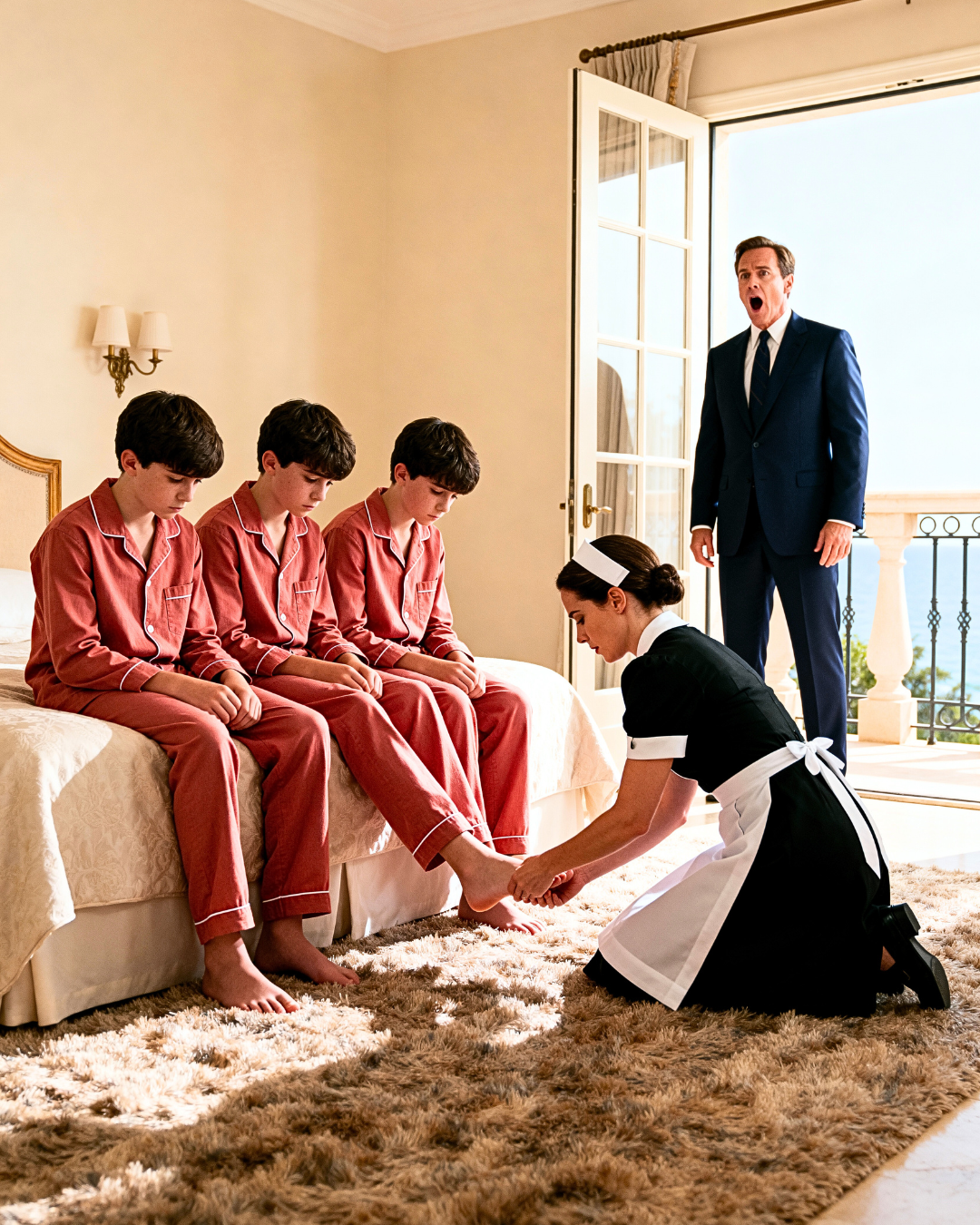
Daniel replayed snippets of Emily Parker’s movements multiple times. He compared her actions to recordings of licensed therapists stored on his tablet.
While the techniques bore similarities, her application appeared more fluid and instinctual, in contrast to a mechanical approach. She effortlessly modified positions, tuning in precisely to each child’s breath and muscle tension. Her voice was soft and steady as she guided them, urging focus and a vision of regained control.
At precisely 12:22 a.m., Noah’s toes twitched.
Just a minute movement. It was barely noticeable.
Yet, Daniel noticed it.
The following morning, Daniel refrained from addressing Emily directly. Instead, he reached out to Dr. Andrew Collins, the neurologist responsible for the care of the triplets, requesting he assess the recorded material. Collins observed intently, his arms crossed and gaze focused.
“This is no coincidence,” the doctor eventually remarked. “Who instructed her?”
Daniel had no answers.
According to Emily’s application, she only had basic caregiving experience—no medical background or certifications provided insight into what he had witnessed.
That evening, Daniel stayed in. At 11:30 p.m., Emily followed her usual routine—moving quietly, offering whispered reassurance, and carefully taking off the braces.
This time, Daniel entered the room.
Emily paused, holding herself still but remaining composed. She gradually rose, ensuring her hands were visible to him.
“You shouldn’t be doing this,” Daniel stated, his tone firm. “You are disregarding medical directives.”
“I am aware,” Emily replied.
“Then clarify your actions.”
She glanced toward the children. “Not while they can hear.”
They continued their discussion in the hallway.
Emily recounted her younger brother’s paralysis at eight due to a spinal infection, and how years passed without financial means for specialists. She spoke of an elderly neighbor—a retired physical therapist—who quietly taught her various methods without formal records or contracts. Emily had witnessed professionals give up on children too soon.
“The braces are significant,” she explained. “But not necessary every night. Their muscles yearn for movement. They’re frustrated. They possess more strength than you realize.”
Daniel’s jaw clenched. “You went behind my back.”
“Yes,” she said calmly. “You would not have permitted it.”
That night, he made the decision to let her go.
The next morning, security escorted Emily from the premises. The children were visibly upset. Grace turned down breakfast, and Noah averted his gaze from Daniel.
Two days had passed when Dr. Collins contacted him.
“I revisited the scans,” he said. “There’s measurable improvement. It’s minimal yet significant—more than we’ve observed in months.”
Something bitterly twisted in Daniel’s chest.
He attempted to reach Emily.
No response.
He drove to the address provided in her files—a modest apartment in Redwood City. When Emily cautiously opened the door, he spoke straightforwardly.
“I want you back,” Daniel stated. “Under supervision, with doctors involved, and appropriate compensation.”
Emily shook her head in disagreement. “That’s not how I operate.”
“What do you desire?” he inquired.
“To be trusted,” she replied. “Or else, nothing at all.”
Daniel had meticulously crafted his success by commanding every aspect.
Yet, this situation resisted that control.
For the first time in years, he yielded.
He suggested a probationary period. Emily would return—not simply as a caregiver but as a rehabilitation aide-in-training. Dr. Collins would oversee the sessions. There would be no covert monitoring or hidden agendas.
Emily accepted one condition: the children would be informed of the truth. No illusions about their progress being mere luck.
Therapeutic activities shifted to daytime schedules.
Emily collaborated with licensed therapists. She modified the sessions whenever they became too rigid, encouraging the children when they felt like giving up, and pausing when efforts turned painful. Initially, the doctors exhibited resistance.
Then, they started documenting the sessions.
Three months elapsed, and Ethan managed to lift his leg six inches off the mat.
Grace managed to balance between the parallel bars for twelve seconds.
Noah discovered how to transition from chair to bed with only minimal assistance.
Daniel ceased observing through screens. Instead, he positioned himself within doorways, or at seats drawn close. He ventured into a space he had long evaded—uncertainty.
Emily never brought up her dismissal, nor did she request an apology.
One evening, as the children bickered over a board game, Daniel murmured softly.
“I thought wealth would safeguard them,” he admitted. “I believed in relying on systems.”
Emily remained unfocused on him. “Systems lack emotional connection,” she commented. “It’s people who provide that.”
No legal action ensued. What Emily had done was not illegal—merely unauthorized.
Daniel financed a pilot rehabilitation initiative based on her methods. Emily contributed to its design but refused to accept public acknowledgment.
She simply sought progression.
A year later, the triplets attended school part-time. Though they still utilized wheelchairs, they also incorporated braces and walkers, demonstrating determination. Progress was gauged not through miraculous recovery but through real, tangible achievements.
Daniel finally removed the last camera from the house, placing it in a box.
He no longer required proof.