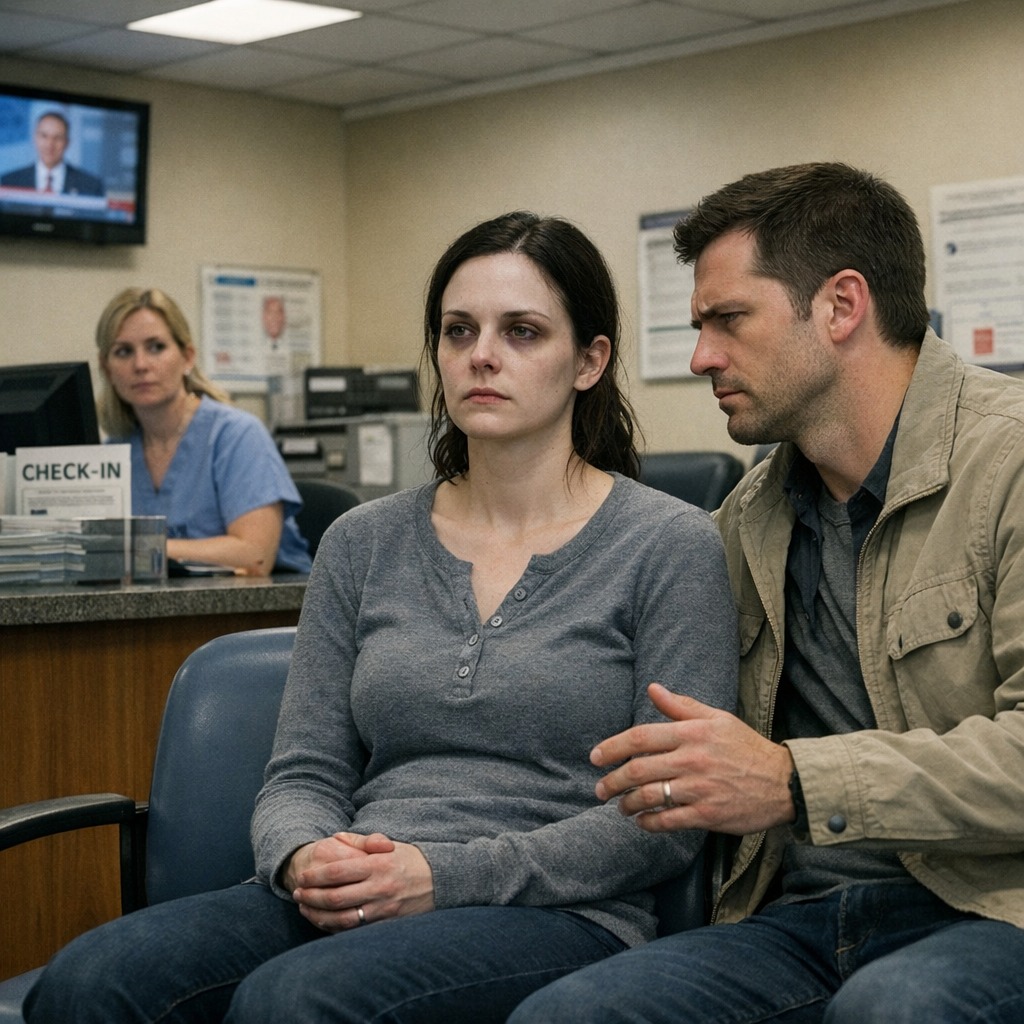
I first realized Sarah wasn’t fully “with me” anymore on a night that should’ve been ordinary. The microwave chirped, the kind of harmless noise you stop noticing after years of routine, and she didn’t even twitch.
Sarah used to respond to everything—a dog barking somewhere below, a car door outside, my keys clinking into the little bowl by the entrance. She’d glance up, crack a small joke, and look at me like we were sharing a private moment. She had that bright, quick energy that made our apartment feel alive.
But that evening she sat on the couch with her hands neatly folded, as if she were waiting for a service to begin. Her gaze hovered above the television—close enough to seem normal at a glance, yet fixed on a spot that didn’t mean anything. It felt as though she was seeing something I couldn’t.
- The coffee I’d made her cooled untouched.
- The show kept playing, but it felt like no one was watching.
- When I said her name, her blink didn’t bring her back—it only proved how far away she’d gone.
“We need to go,” I told her, keeping my voice gentle.
“Go where?” she asked, and the words came out too carefully—like a line she’d practiced.
“To the doctor,” I said. “You promised.”
She hesitated a beat too long, then nodded once. The movement looked stiff, almost automatic.
In that tiny pause between my question and her answer, something chilled in my chest—less worry for her, and more a quiet, confusing fear of what I couldn’t understand.
Who I Am, and Who Sarah Used to Be
My name is Daniel Foster. I’m thirty-four, living in the Chicago area, working in IT consulting—meaning I spend my days fixing problems people ignore until their screens go dark and everyone suddenly decides it’s an emergency.
Sarah Carter—my wife—has been my person for two years. She’s a freelance graphic designer. At least, that’s what her site said, what her invoices showed, and what her small circle of friends repeated with absolute certainty.
We met in a downtown coffee shop, one of those cozy places with brick walls and plants that always look healthier than anything you can keep alive at home. She accidentally spilled a latte on my laptop bag, apologized like she’d committed a serious crime, and insisted on buying me lunch to make up for it. Then she teased my button-up shirt and joked that my shoes looked like a committee had approved them.
I fell for her fast—faster than I admitted to anyone. I was in my thirties, and I thought I’d outgrown that kind of head-over-heels feeling. Turns out I hadn’t.
- We moved into a third-floor apartment with a view of a parking lot and a slice of sky.
- We bought mismatched furniture because we called it “quirky.”
- We argued about dishes and made up in the kitchen.
- We kept planning a trip to Michigan and kept pushing it back.
For a long time, life felt steady. Not perfect, but good.
The Slow Disappearance
About six weeks ago, Sarah started vanishing in a way I can’t explain. She didn’t leave the apartment. She didn’t stop coming to bed. She still answered questions.
Yet the spark behind her eyes faded like someone slowly lowering a dimmer switch.
It started small. She stopped eating breakfast. Then she stopped pretending she had. She’d sit at the table with her mug held between both hands, staring out the window as if the street below held an unsolved mystery.
Then she began waking up at 3:00 a.m.
The first night, floorboards creaked and pulled me out of sleep. I found her in the hallway, pacing barefoot. When I spoke her name, she startled like she hadn’t expected another human to exist.
“Can’t sleep,” she whispered.
“Come back to bed,” I said.
“I will.”
She didn’t.
By the third night, she wasn’t pacing at all—she was standing by the front door, listening as if something might call to her from the other side.
Three days ago, I woke early and found her sitting on the bathroom floor, knees drawn close, eyes locked on the tile lines as if they formed a message only she could decode.
“Sarah,” I asked, crouching beside her. “What’s going on?”
“Nothing,” she said, though her voice wavered. “I just… needed air.”
“In the bathroom?”
That’s when she looked at me—really looked. And what I saw wasn’t the usual stress or sadness people talk about. It was a sharp, calculating fear, the kind that makes someone measure a room for exits.
- I told myself it was burnout.
- I told myself it was a difficult season.
- I told myself love meant patience and time.
But then came the long sleeves.
The Details I Couldn’t Ignore
It was July—warm enough for short sleeves, open windows, and evening walks. Sarah started dressing like it was winter, tugging sleeves down to her wrists. When I tried to lighten the mood—asking if she was bringing turtlenecks back—she’d give me a small smile that didn’t reach her eyes and say, “I’m cold.”
One afternoon she passed me in the kitchen and I reached out for her wrist. It wasn’t grabbing, not forceful—just that casual touch couples share without thinking.
She recoiled.
Like my hand had become something dangerous.
“Sorry,” she blurted, too quickly. “I’m just jumpy.”
Then she tucked her arm behind her back, hiding it the way someone hides a bruise they don’t want discussed.
That was the moment I stopped soothing myself with explanations and started admitting I was scared.
That morning, I finally set a firm line.
“We’re going to urgent care today,” I told her. “No debate.”
“I’m fine,” she answered, but it sounded thin—more like a script than a truth.
“You were on the bathroom floor staring at tile like it was going to answer you,” I said. “That isn’t fine.”
She opened her mouth to argue, then shut it again. Her jaw tightened. One muscle ticked in her cheek.
I hated that I’d begun noticing tiny signals like I was diagnosing a computer virus. I wanted to be her husband, not her investigator.
When I said I’d call an ambulance if she refused, she finally gave in.
“Okay,” she said. “Let’s go.”
- She dressed in jeans and a gray long-sleeve shirt.
- Her sleeves stayed pulled down, covering her wrists.
- Her face looked washed out, like she hadn’t truly rested in weeks.
The Drive That Felt Too Long
We drove to Lakeside Urgent Care on Ogden Avenue in Naperville. It should’ve been about twenty minutes. Instead, it felt like we were traveling through a whole year of worry.
Sarah stared out the passenger window, fingers twisting together in her lap as if she were wringing out invisible fabric.
I tried to talk normally, to keep her anchored to everyday life.
“How’s that logo project going?” I asked.
“Fine.”
“What do you want for dinner?”
“Whatever.”
“Do you still want to go to Michigan next month?”
“Sure.”
At a red light I reached over and rested my hand on hers.
She jerked away so quickly she bumped the door.
“I’m sorry,” she said, breathing fast.
“Sarah—”
“I said I’m sorry.” Her tone sharpened, then smoothed out again. “Just… don’t.”
It wasn’t just distance anymore. It was avoidance—like touch itself had become a threat.
Inside Urgent Care
The waiting room smelled like disinfectant and old coffee. The lights hummed overhead. Across from us, a child sat with a tissue pressed to his nose while a parent tried to soothe him. A news channel played silently above the reception desk, captions scrolling like a running commentary no one wanted to read.
Sarah filled out the intake paperwork with slow, careful strokes: name, date of birth, insurance, medical history. Each letter looked deliberate, as if she had to concentrate to keep her hand steady.
When the receptionist asked for her ID, I watched closely—not because I suspected the staff, but because I’d started noticing everything.
The receptionist looked at Sarah’s license, typed something into the computer, and then paused. Her fingers hovered over the keyboard as if she’d hit an unexpected result. A moment later, she started typing again—faster, as if choosing not to linger on whatever she’d seen.
She handed the ID back with a professional smile. “The nurse will call you shortly.”
Sarah sat beside me and stared at the news ticker.
But her eyes didn’t track the words.
“Whatever this is,” I whispered, “we’ll figure it out.”
“Okay,” she said, and nodded once—still that same careful, mechanical motion.
About fifteen minutes later, a nurse opened the door and called, “Sarah Carter?”
Conclusion: That morning began as a simple decision to get help, but every small detail—Sarah’s distant responses, her flinches, the receptionist’s brief hesitation—made it clear we weren’t dealing with ordinary stress. Whatever was happening, it had already changed our lives, and walking through that clinic door was the first step toward facing it together.