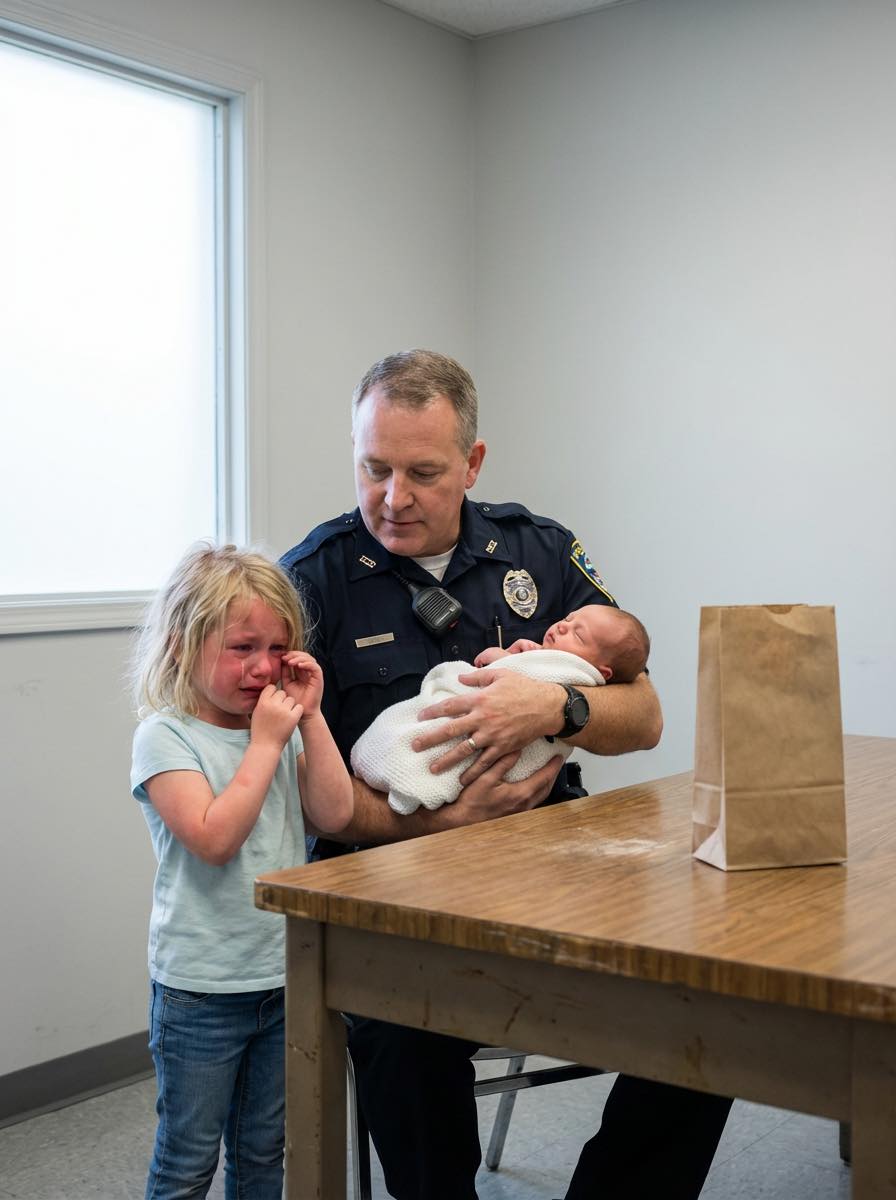
The front desk clock at the Cedar Hollow Police Department glowed 9:47 p.m. when the glass entrance door swung open and chimed softly. Officer Nolan Mercer looked up from his paperwork, already preparing the gentle “come back tomorrow” explanation officers often give after hours.
But the person standing in the doorway made every routine thought disappear.
A little girl—around seven—stood just inside the station, small enough that the door handle sat near her shoulder. Her shoes and socks looked as if they’d carried her too far, over ground that was rough and cold. Dirt clung to her feet, and her clothes hung loose, like hand-me-downs meant for someone else.
What stopped Nolan most was her expression: tear tracks cutting clean lines through the grime, eyes too alert for a child her age, and both arms wrapped tightly around a brown paper bag pressed to her chest as if letting go might be unthinkable.
“Please,” she whispered, voice thin and shaky. “He isn’t moving. My baby brother… he isn’t moving.”
Nolan rose slowly and stepped from behind the counter with care. Quick movements can scare adults; for a frightened child, they can feel like a threat.
“You’re safe here,” he told her, keeping his tone calm. “Are you hurt? Can you tell me where your brother is?”
Instead of giving an address or pointing outside, she inched forward and held the bag out with trembling hands. The paper crinkled as if it were struggling to stay together.
Nolan accepted it gently, supporting the bottom like it was fragile. That’s when he noticed dark stains along one seam—uneven patches that made his throat tighten.
- He didn’t rush, even though his instincts screamed to.
- He didn’t question her choices, because panic helps no one.
- He focused on the next right step: find out what the child needed.
He opened the top carefully.
Inside, wrapped in old towels that had once been white, lay a newborn—so tiny the cloth seemed oversized. For a frightening moment, the baby looked impossibly still. Nolan touched the infant’s cheek with the back of his finger and felt skin that was far too cool.
Then—barely, almost like a whisper—he saw it: a faint rise and fall of the baby’s chest, a fragile movement that proved there was still time.
Nolan turned toward the hallway and called out, his voice breaking despite his effort to stay composed.
“Call an ambulance now! Newborn in critical condition!”
The quiet station jolted into motion. Phones rang, chairs scraped, and radios crackled. Nolan lifted the baby from the bag and held him close to his uniform, sharing what warmth he could in the only way available at that second.
The girl gripped his sleeve with surprising strength, as though she feared that if she let go, help might vanish.
Through tears, she tried to explain in rushed, guilt-heavy fragments.
“I tried,” she said. “I used the towels. I rubbed his hands like they do on TV. I tried to give him a little water with my fingers… and then he got so quiet.”
“You did the right thing,” Nolan told her firmly. “Bringing him here was the right thing.”
Within minutes, the ambulance arrived, its lights washing the station windows in bright flashes. Paramedics moved with focused speed—placing a tiny oxygen mask, checking pulses, speaking to each other in short, practiced phrases.
One paramedic glanced up, expression serious but steady.
“He’s holding on,” they said. “But he’s extremely dehydrated and very cold. We need to go—now.”
Nolan didn’t hesitate.
“I’m coming,” he replied. And when the girl’s face tightened with fear that she might be left behind, he added, “And she’s coming with us.”
- In a crisis, speed matters—but so does keeping a child from feeling alone.
- Warmth, oxygen, and rapid medical care can make all the difference for a newborn.
- Reassurance isn’t just kindness; it helps people keep going.
Conclusion: That night, a small chime at a station door turned into a life-or-death emergency—and a powerful reminder of what courage can look like. A seven-year-old didn’t have the right words or the right resources, but she had determination, and she brought her baby brother to the one place she believed might help. In the middle of panic and uncertainty, one clear choice mattered most: she asked for help, and help answered.