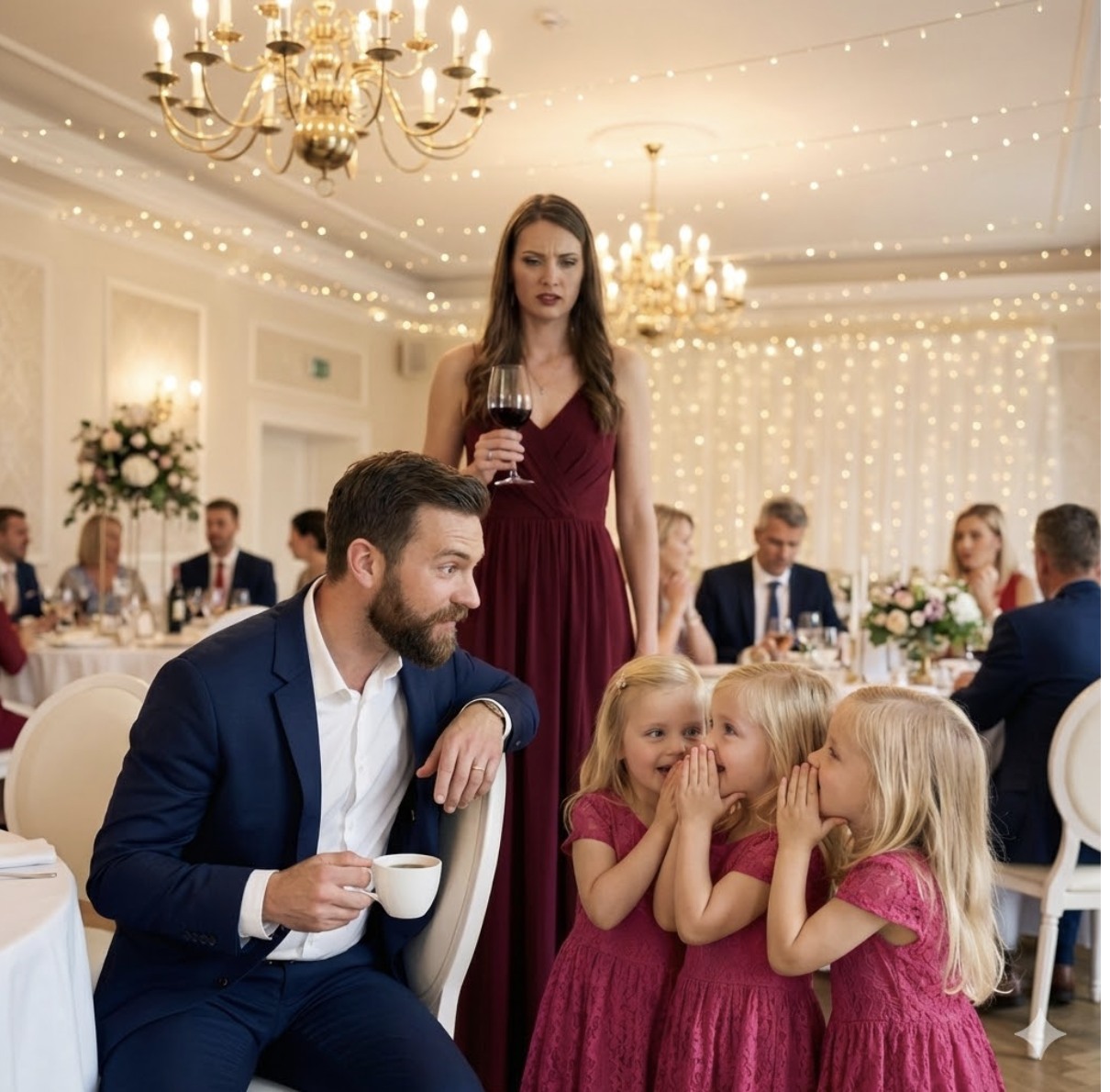
At the far edge of the reception hall—where the music softened, the lights dimmed, and the noise felt less sharp—Jonathan Hale sat by himself at table seventeen.
A cup of tea rested in front of him, long past warm. Its surface looked untouched and still, as if even the heat had decided it wasn’t worth trying anymore. The scene matched the way evenings had gone for him for years: he would show up, do what was expected, and leave before the quiet inside him grew too loud.
Across the room, the wedding moved forward with confident happiness. Laughter burst in waves, glasses clinked without rhythm, and the DJ called out another tradition with the bright certainty of someone who had never had to make friends with silence.
Jonathan watched it all like it was happening on the other side of glass.
He had learned how to attend celebrations without truly being in them.
Nearly four years had passed since his wife, Mara, was suddenly taken by an unexpected medical crisis. One moment life was ordinary—morning routines, silly disagreements, the comfort of knowing someone would reach for his hand in the dark—and the next, that steady world had vanished.
Since then, Jonathan had perfected a careful routine for public events: arrive on time, congratulate the couple, sign the guest book, offer a measured smile, and disappear early. Not because he disliked people, but because he knew what came after: that hollow feeling that started to ache when the party went on without him.
His fingers tightened around his car keys under the table. He was already halfway to leaving.
Three Matching Ribbons
“Excuse me, sir.”
Jonathan looked up, expecting a confused guest or an apologetic server.
Instead, three little girls stood in a neat row beside his table. It took him a moment to register that they were three separate children, not some trick of tired eyes. They looked about six years old, with light curls tied back by identical dusty-pink ribbons. Their dresses were crisp, their posture unusually careful, and their expressions carried a seriousness that didn’t belong on faces that young.
“Are you looking for someone?” Jonathan asked gently, glancing around as if their mother must be calling for them.
“We picked you on purpose,” said the one on the left, with surprising confidence.
“We’ve been watching you,” added the one in the middle, as if this were perfectly normal.
“And you’re exactly what we need,” the third concluded, nodding like she’d just solved a puzzle.
- Three girls.
- One request.
- A decision Jonathan hadn’t expected to make.
Jonathan hesitated between smiling and apologizing. “Exactly what you need… for what?”
The three leaned in together, close enough that he caught the sweet scent of strawberry shampoo. In a single urgent whisper, they said:
“We need you to pretend you’re our dad.”
The words landed hard, stealing the breath from his chest.
“Just for tonight,” the first one rushed to add.
“Only until the party ends,” the second promised, pulling a crumpled bill from her pocket with the proud seriousness of a tiny negotiator.
“Please,” the third murmured, her eyes bright. “Mom is always by herself. People look at her like she’s… broken. But she isn’t. She’s just… tired.”
Something shifted inside Jonathan—like a door that had been shut for a long time and suddenly, quietly, opened. He recognized that kind of tired. He had worn it himself.
“Where’s your mom?” he asked, before he could overthink it.
Three small arms lifted at once, pointing the same direction.
The Woman in Red
Near the bar stood a woman in a deep red dress. She looked composed, elegant without trying to be noticed—yet somehow she still was. The dress was modest and carefully chosen, and she held her glass of wine like a shield. Her posture was straight, her smile practiced, stopping just short of her eyes.
“That’s our mom,” the first girl whispered. “Her name is Evelyn Carter.”
“She works at the hospital,” said the second. “Really long shifts.”
“Even when she can barely keep her eyes open, she still reads to us,” the third added softly. “But at parties… nobody talks to her.”
Sometimes loneliness isn’t loud. Sometimes it’s a smile that doesn’t reach the eyes.
As if she sensed the attention, Evelyn turned her head. Her gaze found her daughters standing beside an unfamiliar man. Surprise flickered across her face, then worry—followed by a weary sort of acceptance, as if life had trained her to handle unexpected moments alone.
She set her glass down and walked toward them, the sound of her heels ticking like a clock counting down a choice Jonathan hadn’t planned to make.
He had seconds to decide.
He thought of Mara—of how she used to tell him that merely surviving wasn’t the same as living. That even the smallest step toward joy could be brave. He looked at the girls again, at the hope they weren’t trying to hide.
“Okay,” Jonathan said quietly. “But first, I need your names.”
Their faces lit up, as if someone had turned on the brightest chandelier in the room.
“I’m Lily,” said the first.
“I’m Nora,” announced the second.
“And I’m… June,” the third whispered, brushing her cheek with the back of her hand.
In that moment, Jonathan didn’t feel like a man trapped behind glass. He felt like someone standing at the edge of a new door—one he hadn’t known was there.
Conclusion: What began as a small, simple favor—helping three children so their mother wouldn’t look alone—became something bigger: a chance for connection, kindness, and the possibility of belonging again, even after loss.