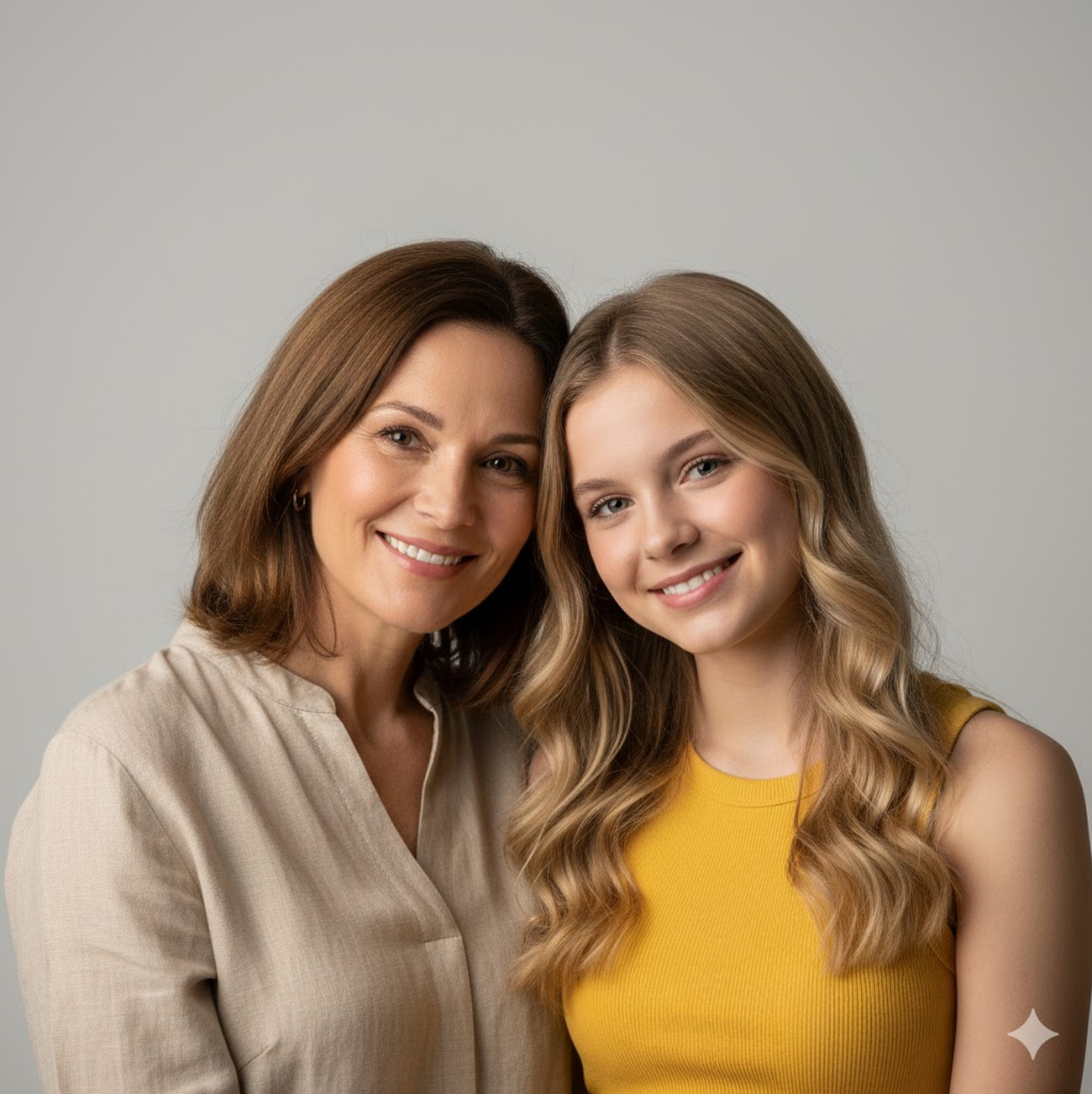
My biological mother passed away when I was born. That single fact was the beginning and end of what I “knew” about her for most of my life.
For the first few years, my world was small and simple: just my dad and me. My memories are scattered, like snapshots. I can still see myself perched on the kitchen counter in our modest apartment in Guadalajara while he moved around cooking, smiling, and telling me I was “his whole world.”
When I was four, everything began to shift. My dad met Verónica, and in what felt like no time at all—six months later—they were married. Not long after, she adopted me legally. I started calling her Mom, and somehow it felt natural, as if my heart had been saving that word for the right person.
- My earliest home was quiet: just my dad and me.
- Verónica entered my life when I was four.
- She didn’t just marry my father—she chose me, too.
Two years later, an ordinary afternoon turned into one of those moments that splits life into a “before” and an “after.” Verónica came into my room looking unusually pale, as if she’d forgotten how to breathe.
She knelt in front of me, held my hands, and spoke softly, like she was trying not to startle my childhood apart.
“My sweet girl… your dad isn’t going to come home.”
I remember the funeral at our neighborhood parish. I was six, too young to understand the permanence of goodbye, old enough to feel the weight in the air and the hush in people’s voices.
As I got older, Verónica explained what she believed to be the truth: there had been a car accident on the highway toward Tepic. There was nothing anyone could do. I accepted it because I needed an answer, and because she said it with the kind of steadiness that made pain seem manageable.
Years moved forward the way they always do—quietly, stubbornly. Four years after my father passed, Verónica remarried and later had two more children. I braced myself for the possibility of becoming “the extra” in my own home, the leftover piece from her first life.
- She built a new chapter, but never erased the old one.
- My little siblings didn’t replace me—they joined me.
- In our house, belonging wasn’t something you had to earn.
But that fear never came true. Not once did she make me feel like I was outside the circle. She raised me with the same patience she gave everyone else, and in the ways that truly matter—care, guidance, protection—she was my mother.
By the time I turned twenty, I thought I understood my story. I had a timeline, an explanation, a neatly folded narrative I could carry without it spilling everywhere.
Then, recently, a new kind of restlessness showed up. I’d catch myself staring into the mirror, tilting my face to the light, searching for evidence—my father’s eyes, his smile, the shape of his jaw. I found myself wondering, maybe for the first time as an adult, who I resembled and what pieces of him I’d been carrying all along without noticing.
Grief doesn’t always shout. Sometimes it returns as curiosity.
That curiosity pulled me toward the attic, where old things go when a family decides they’re not ready to deal with them. I went up there looking for a photo album—something that would show my parents before I existed, before my life started reshaping theirs.
I found it inside a dusty box, tucked among yellowed papers and small keepsakes that seemed to have been asleep for years, waiting for someone brave—or simply ready—enough to wake them.
And as I stood there holding that box, I had no idea I was about to learn that the past isn’t always finished speaking. Sometimes, it leaves a letter behind—quietly—until the right hands finally open it.
In the end, what stays with me most isn’t only the mystery of what I might discover, but the certainty of what I already know: I was loved fiercely by my father, and I was raised faithfully by the woman who chose to become my mother. Whatever truths the attic holds, they will be held by that love.