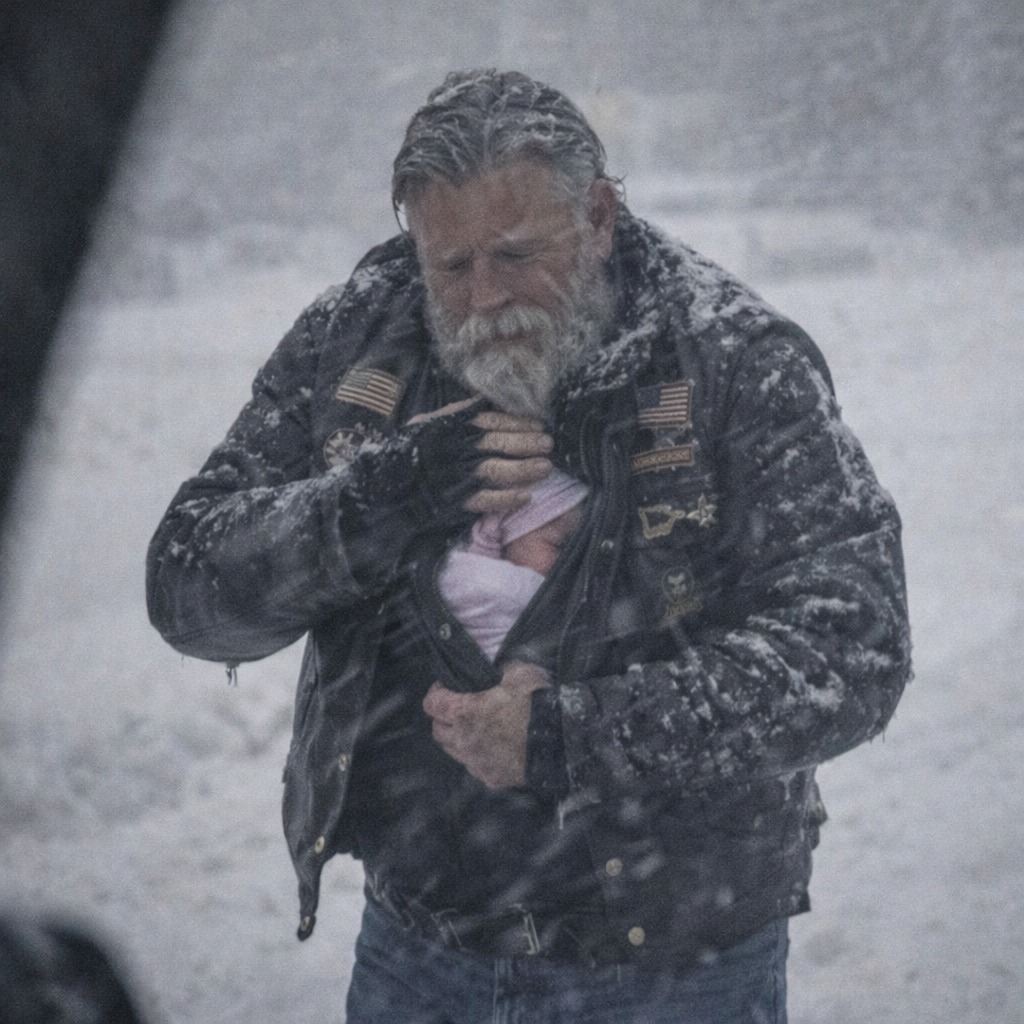
The night I met Tank Morrison in the worst kind of weather, common sense had already surrendered. I’d stopped for fuel at the Flying J outside Billings, where the cold sat heavy at fifteen below and the wind shoved ice across the lot like handfuls of needles. You could barely see past the next pump.
Then Tank rolled in on his Harley anyway—seventy-one years old, stubborn as a fence post, and apparently immune to advice.
He didn’t even kill the engine right away. He pulled up, reached for the nozzle, and that’s when I noticed something odd: his jacket bulged slightly, and his left hand stayed pressed against his chest like he was shielding a secret.
I started to ask what he was doing out in weather like that, but he cut me off.
“No time,” he rasped, voice rough from the freezing air. “I need you to make calls. Every station between here and Denver. Tell them Tank Morrison is coming through with a baby who needs help. Formula, blankets—anything warm.”
- Subzero temperatures
- Roads closing and reopening without warning
- Nearly zero visibility
- An infant who couldn’t afford to wait
He unzipped his jacket just enough for me to see the tiniest face I’d ever laid eyes on. A newborn—only days old—bundled tight and breathing fast, like every breath was hard work.
“Found her half an hour back,” he said, fueling up one-handed. “Truck stop bathroom in Laurel. Someone left her in the sink. A note was pinned to her blanket.”
He handed me a wrinkled scrap of paper. Under those harsh fluorescent lights, the message felt even more desperate:
Her name is Hope. I can’t afford her medicine. Please help her.
Tank nodded toward the baby’s wrist. “Medical bracelet. Congenital heart defect. They told me she needs surgery fast—within days. I called for help, but dispatch said the highways are shut down. Maybe tomorrow. Maybe later.”
He stared at me with eyes that looked like they’d seen too much and kept going anyway.
“She doesn’t have later,” he said.
“Denver?” I asked, already knowing the answer.
“Denver,” he replied. “That’s where the pediatric cardiac unit is. It’s the only shot.”
I did the quick math in my head and felt my stomach drop. Hundreds and hundreds of miles through a blizzard.
“Tank,” I said, “this storm will swallow you.”
He didn’t blink. “Then it swallows me. But I’m not leaving her to fade away in a bathroom like she doesn’t matter.”
That was the thing about Tank: once he chose a direction, the rest of the world could argue with the wind.
He looked at my truck, then at me. “You coming?”
I stared at the warm cab, the safe seat, the easy option. Then I looked back at a newborn tucked inside an old biker’s jacket, fighting to stay here.
“Give me two minutes,” I told him. “I’ll grab my bike.”
A Call Spreads Faster Than the Storm
News traveled the old-fashioned way—through CB chatter and quick phone calls. By the time we pulled out, a few more riders had shown up, layered in gear and determination. A trucker watching us tighten straps and check gloves shook his head like he couldn’t decide if we were brave or foolish.
“You’ll freeze out there,” he warned.
Tank’s answer was simple. “Maybe. But she won’t be alone.”
The first stretch was the hardest riding I’ve ever done. Gusts slammed us sideways. Ice crusted on helmets until the world turned into a blurry tunnel. Even with layers, the cold hunted for any gap it could find.
Tank never rode carelessly, but he didn’t slow the mission down either. He kept one hand on the bars and one hand protecting Hope under his jacket. Every so often he’d pull over just long enough to check her face and listen.
“Stay with me, Hope,” he’d whisper. “We’re getting you there.”
- Short stops to check the baby
- Quick refuels to minimize exposure
- Riders positioning themselves to block wind
- Everyone watching the road for black ice
Warmth, Formula, and a Reason No One Expected
In Casper, we found a gas station owner who didn’t hesitate. She cranked the heat high and gathered what she could—formula, extra blankets, even a small oxygen tank from home supplies. No speeches. No questions first. Just help.
Tank fed Hope with hands that trembled from the cold. The bottle tapped softly against her tiny mouth, and for a moment we all held our breath.
Then she drank.
She fought.
The woman behind the counter stared at the sight: ice-caked bikers clustered close around a newborn as if she were the most valuable thing in the building.
“Why would you do this?” she asked quietly. “Why risk yourselves for a baby you don’t even know?”
Tank lifted his face, and I could see tears frozen along the edge of his helmet liner.
“Because years ago,” he said, voice cracking, “my little girl died while I was overseas. Heart trouble. I wasn’t there. I couldn’t do anything.”
He swallowed hard, eyes fixed on Hope.
“I couldn’t save my Sarah,” he said. “But maybe I can save her.”
“I couldn’t save my Sarah. But maybe I can save Hope.”
After that, nobody had much to say. We geared up, checked fuel, and moved back into the storm.
A Growing Shield of Strangers
At stop after stop, more riders joined. Some came from nearby towns, others from farther down the route. A few were members of different clubs; others rode solo and simply heard what was happening and refused to stay home.
By the time we neared the Colorado line, we weren’t a small group anymore—we were a moving wall, riding in formation around Tank to cut the wind and give him the best chance of keeping Hope stable.
Not everything went smoothly. A couple of riders slid on black ice and went down, but they got up and kept going. One bike couldn’t handle the cold and gave out; the rider climbed onto another seat without a complaint.
- Riders rotated positions to block the harshest gusts
- Stops were timed to keep Hope warm
- Anyone who could help did—no questions asked
- The goal stayed the same: reach Denver
When the Convoy Became a Community
Hours in, Tank eased onto the shoulder. My heart dropped—those were the moments you dreaded.
He stayed upright, but his voice had changed. “Something’s not right. Her breathing’s getting weaker.”
A paramedic riding with us listened carefully and looked up, grim but focused. “Her heart’s working overtime. We can’t waste minutes.”
Tank’s jaw clenched. “I can’t ride faster. Not on this ice.”
That’s when a semi rolled up behind us with hazard lights flashing. The driver leaned out his window, shouting over the wind.
“Heard about you on the CB! Get behind me—I’ll break the wind and pull you through.”
Tank yelled back, “You could get in trouble for this.”
The driver didn’t flinch. “I’ve got grandkids. Save that baby.”
Tank tucked in behind the semi, and we formed up along the sides like a protective fence. The truck’s trailer carved out a calmer pocket of air, and for the first time in hours, it felt like the storm loosened its grip—just enough.
In that last stretch, it wasn’t a biker story anymore—it was a strangers-helping-strangers story.
More vehicles joined at intervals: other trucks, a few cars, and even emergency units that couldn’t officially escort but could help clear space and slow the chaos. The final miles became a rolling promise made by people who’d never met Hope, yet acted like she belonged to all of us.
Denver at Last
The last twenty miles felt endless. Tank leaned forward, making his own shelter with his body as best he could. We rode tight, blocking gusts, watching the lanes, keeping him steady.
When we finally hit the hospital, we came in like a rumble of thunder and brakes. Tank was off his bike before it fully settled, moving as fast as stiff legs and frozen gear would allow.
Nurses rushed out with a warmed gurney. Tank carefully handed Hope over, breath coming in ragged clouds.
“Eight hours and forty-three minutes,” he managed. “Please… please help her.”
The doors swung shut behind them.
Tank sank down in the snow outside, shaking hard—cold, fear, relief, all tangled together. I pulled him up by the arm.
“You got her here,” I told him. “You did it.”
He nodded once, staring at the hospital entrance. “Now we pray.”
- Dozens of riders waited together
- Leather vests sat beside hospital chairs
- Rough hands held paper cups of coffee
- Every heart in that room beat for one tiny heartbeat
Six Hours That Changed Everything
The surgery took a long time. No one slept. Tank paced like a man trying to outwalk the past, checking the clock as if time could be negotiated.
Near morning, a surgeon finally stepped into the waiting area. Exhausted, but smiling.
“She made it,” the doctor said. “The surgery was successful. She’s going to live.”
The room broke open with relief—grown men hugging, shoulders shaking, faces wet with tears they didn’t bother to hide.
Tank stood still, like he needed a second for the words to settle into his bones.
“Can I see her?” he whispered.
They brought him to the NICU. Hope lay in an incubator, her tiny chest rising and falling in a steadier rhythm. The monitors traced a heartbeat that looked strong and consistent.
Tank pressed his hand against the glass.
“Hey, fighter,” he murmured. “I’m the guy who gave you a ride.”
What Happened Next Was Just as Important
A few days later, Hope’s mother came to the hospital. She was only seventeen—scared, worn down, and clearly expecting anger. Life had pushed her into a corner, and she’d made a desperate choice to leave Hope where someone would find her.
Instead of shouting, Tank sat across from her and spoke gently.
“You didn’t give up on her,” he told the young mom. “You put her where help could reach her. That took courage.”
Then he added something that changed the tone of the room.
“She needs you,” he said. “And you need support. Let us help you both.”
“Let us help you both.”
The biker family that had carried Hope through a blizzard didn’t stop at the hospital doors. They helped the mother find stability—practical support, a safer place to live, work resources, and a path toward healing.
Three Years Later
Hope is a toddler now—curious, bright, and full of life. Tank visits like an honorary grandpa, the kind who shows up consistently, not for attention, but because he promised himself he would.
She calls him “Gampa.” During charity rides, she sometimes sits safely secured in a special child seat, waving at people as if she’s always belonged to the road community that rallied around her.
What started as one man’s impossible ride grew into something bigger: a fund that has helped other children get the care their families couldn’t afford, and an annual ride where motorcycles roll out with stuffed animals strapped to handlebars, traveling for kids still waiting on hope.
- A newborn was found and protected
- A community formed in real time
- A young mother received support instead of shame
- A tradition was born from one night’s decision
Tank still insists he didn’t do anything special. He’ll tell you any rider would’ve done it. Maybe that’s true in the world he believes in.
But I was there, and I watched him kick-start a Harley in brutal cold with a newborn tucked against his heart—then ride into a storm because leaving her behind wasn’t an option.
Some nights show you who people really are. That night, Tank Morrison showed us the best a person can be.
Conclusion: In the middle of a blizzard, when systems stalled and roads closed, a handful of ordinary strangers chose to act with extraordinary care. Hope’s story didn’t end in a truck stop—it continued because people decided she mattered, and then kept proving it long after the snow stopped falling.