Briar Glen, Ohio used to move to the rhythm of its paper mill and the steady flow of travelers cutting through town. Then the mill slowed, and the new highway swung wide around Main Street, leaving local businesses to compete with silence instead of headlights.
Willow Creek Diner—still called “The Creek” by longtime locals—held its corner at Maple and 3rd like it was determined not to be forgotten. Even in daylight, its neon sign flickered and buzzed, as if it needed extra effort to stay lit.
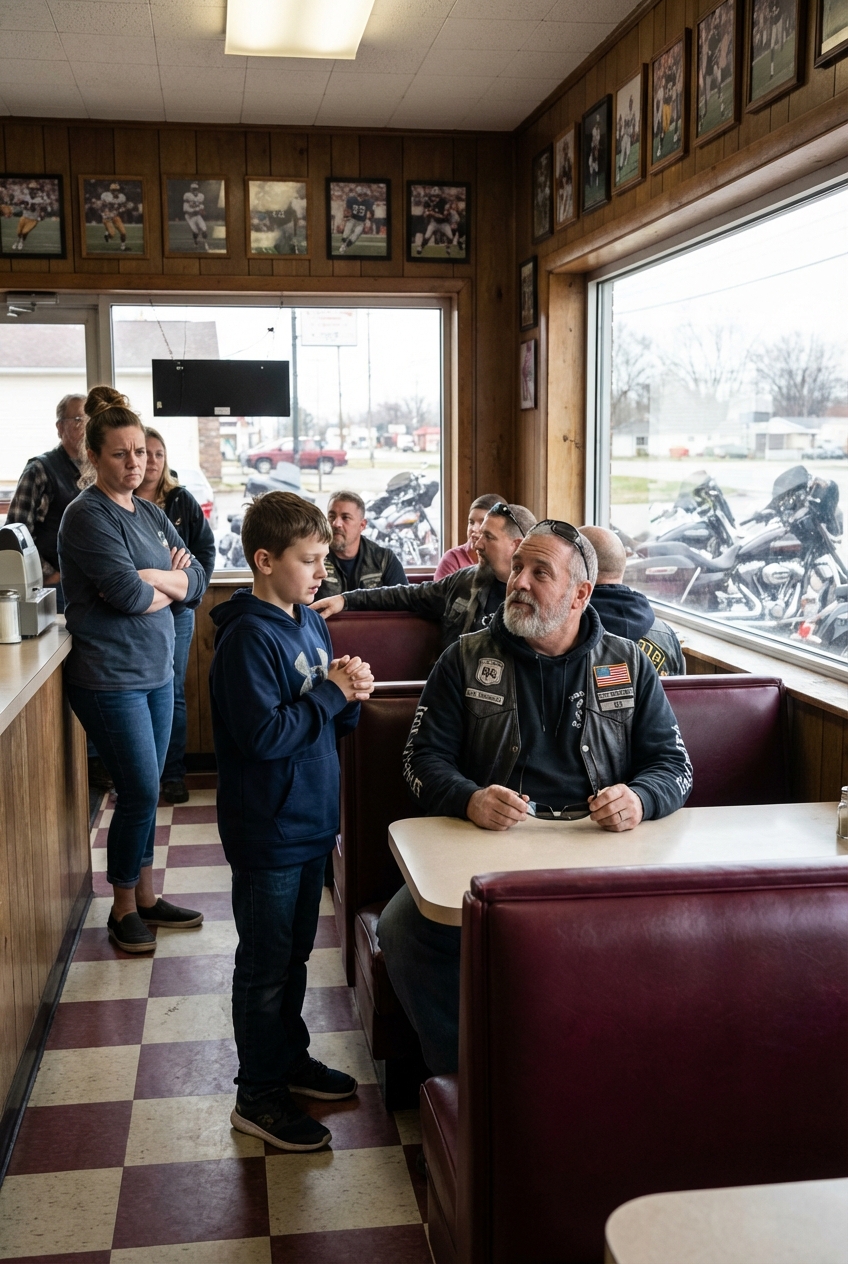
Inside, time showed everywhere: cracked maroon vinyl booths, a scuffed checkerboard floor, and the mixed smell of bacon, overcooked coffee, and lemon cleaner. Old sports photos and yellowing clippings lined the walls—snapshots of parades and seasons many residents barely remembered.
A boy, a glass of water, and a long wait
At 12:47 on a Thursday, the lunch rush thinned into a few scattered conversations and the soft clink of plates. Near the soda fountain sat Owen Calder, twelve years old, all elbows and growth-spurt angles. His hoodie cuffs were faded, his sneakers worn but neatly cleaned, and his hair looked like it had been cut at home—then abandoned mid-job.
In front of him stood a tall glass of ice water. The cubes had melted down and tinkled faintly whenever he lifted the glass for another careful sip. He hadn’t asked for a menu. He hadn’t ordered anything. Just a quiet, polite request: “Water, please.”
He’d been there almost an hour.
- A small-town diner trying to survive
- A kid taking up one booth and asking for nothing
- A room full of adults noticing, then looking away
The manager’s patience runs out
Behind the counter, Denise Halbrook kept an eye on him. At forty-nine, with her hair pulled into a tight bun and tiredness settled into her posture, she looked like someone carrying more worry than a diner should require. The Creek used to belong to her brother—until a sudden medical crisis changed everything. Now Denise watched every table like it mattered, because it did.
She told herself she’d been generous by letting the boy sit so long. But generosity felt expensive when profits were thin and bills didn’t wait.
“You’ve been here a while, honey,” Denise said as she approached, arms folded. “Are you going to order something?”
Owen looked up without attitude, only caution. “No, ma’am. I don’t have any money.”
His voice didn’t beg. It simply stated what was true.
Denise replied louder than the moment required. “This isn’t a free waiting room. We need paying customers.”
A fork paused at the counter. Someone near the window stared down at their phone a little too intensely.
Sometimes the harshest part of a moment isn’t the words themselves—it’s the volume they’re delivered with.
“I’m waiting,” Owen said, hands knit together.
“For who?” Denise asked.
“My dad.”
“And where is he?”
“He’s coming.” This time, a small tremor slipped into the answer.
Denise pointed toward the door. “Then you can wait outside.”
The diner went quiet in that familiar way people get when they don’t want to pick a side in public. The soda machine hummed. Ice shifted in the glass like a tiny metronome.
Owen slid out of the booth slowly, as if moving too fast might make things worse. “I’m sorry,” he said—an apology that sounded like it had been practiced too many times.
The bell over the door—and the shift that followed
The bell above the entrance rang as the door opened. That sound was ordinary. What followed wasn’t.
A man stepped inside with the kind of calm that makes a room pay attention. He wore a black leather vest over a faded gray T-shirt. Patches covered the vest, including an American flag, “Iron Sentinels MC,” and a smaller one that read “Veteran.” Weathered tattoos—dates, coordinates, an eagle, and a name near his wrist—peeked from sun-tanned skin. His beard was touched with gray, and dark sunglasses hid his eyes.
He paused just long enough to take in the scene: a boy standing by an empty booth, a manager stiff with frustration, and customers frozen in that uncomfortable middle space between concern and silence.
He didn’t raise his voice. He didn’t announce himself. He simply walked forward.
- Bootsteps crossed the tile, steady and unhurried
- The empty booth became occupied without a word
- The room held its breath, waiting to see what he’d do
He slid into Owen’s booth like it belonged to him—like it was a familiar table and he’d been expected.
Denise bristled. “Sir, I’m handling this.”
“Looks like it,” the man replied evenly, and then he removed his sunglasses. His gaze was calm, not heated—steady in a way that made arguing feel pointless.
Engines outside, silence inside
Then came the rumble—low and distant at first. One engine. Then another. The sound grew until it was unmistakable.
Through the windows, motorcycles rolled into the lot. One after another, they arranged themselves around the building with deliberate care, then shut off nearly together. The sudden quiet afterward didn’t feel accidental. It felt coordinated.
Denise’s shoulders tightened. “If this is meant to scare me—”
“It’s not,” the man said, still calm. “We’re here for lunch.”
He turned his attention to Owen, not Denise. “You waiting for your dad?”
Owen nodded once.
Then the man reached into his vest.
A soft gasp came from near the counter. Denise took a step back on instinct—because when engines have just surrounded a building and someone moves like that, people’s imaginations race ahead of the facts.
Fear fills in blanks quickly—especially when nobody has the courage to ask a simple, gentle question.
But whatever he was reaching for, his posture remained composed, as if the goal was never to escalate anything—only to change what happened next.
Conclusion
In a struggling town and an even more strained diner, a child’s quiet need collided with an adult’s mounting pressure. One sharp exchange turned a booth and a glass of water into a public lesson about dignity. And when a calm stranger arrived—followed by the unmistakable presence of others—everyone in The Creek was reminded that kindness can be enforced not by shouting, but by showing up, staying steady, and refusing to let a kid feel alone.