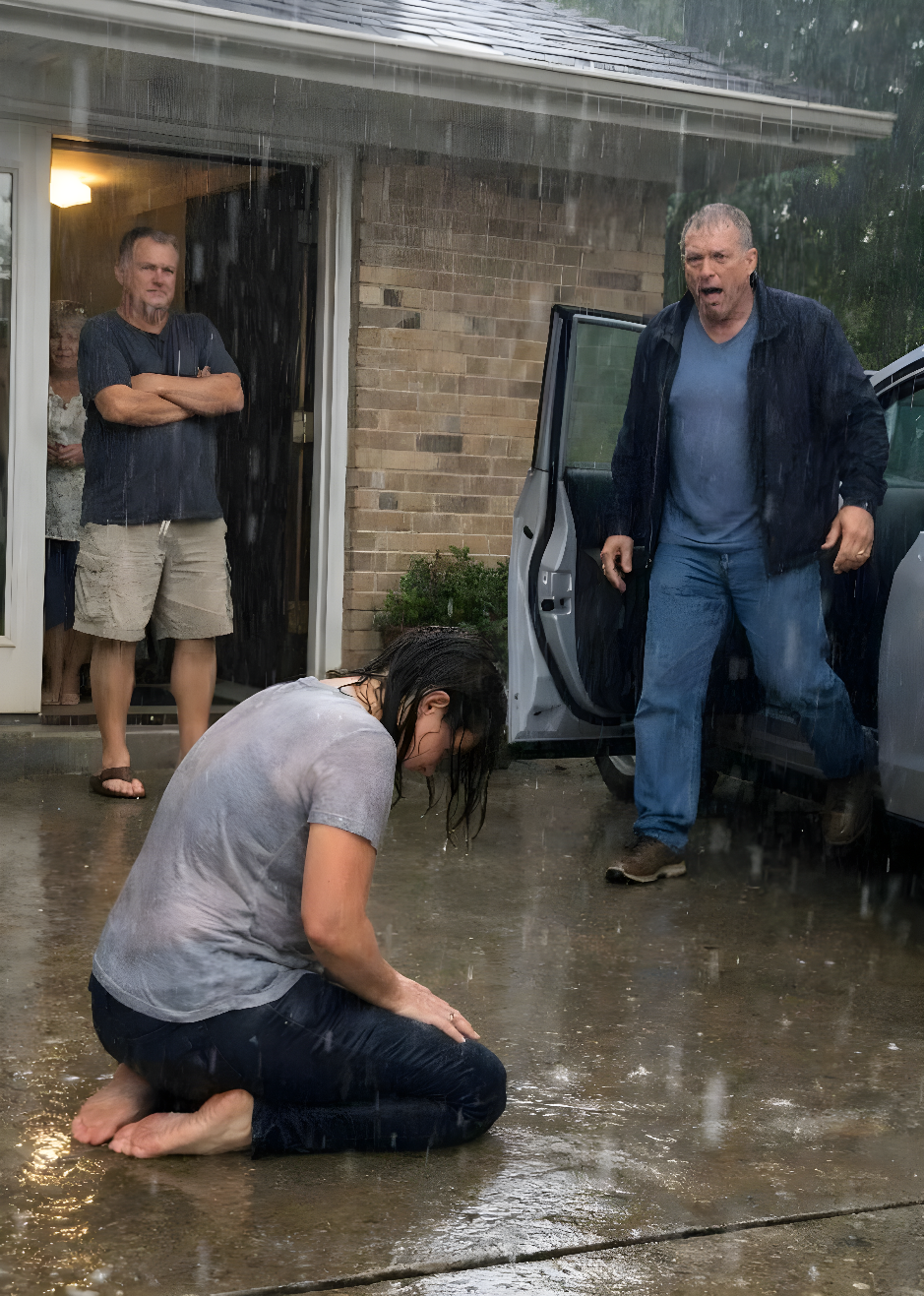
The rain had been falling for hours, soft but stubborn, soaking everything it touched and turning an ordinary evening into something heavy and unforgettable. I was driving down Maple Ridge Drive with my mind on errands and appointments when I saw her at the end of the driveway.
My daughter, Claire, was on her knees in the rain.
For a moment, I could not make sense of what I was seeing. No parent expects to find their grown child standing outside like that, lowered by fear and shame while water ran through her hair and down her face. I slammed on the brakes, got out, and ran to her.
“Claire?” I said.
She looked up quickly, startled and embarrassed, as though she had been caught doing something wrong. “Dad, please,” she whispered. “You should go. I’m okay.”
That word had followed her for years. Okay when she was hurt. Okay when she was afraid. Okay whenever telling the truth felt too dangerous.
I took off my jacket and placed it over her shoulders. She was shaking.
“You’re not okay,” I said, keeping my voice steady. “Tell me what happened.”
Her eyes drifted toward the house.
“I bought a dress,” she said in a tiny voice. “Just one. For a charity dinner. Mark said I was being disrespectful. His mother said I was spending money that didn’t belong to me. They told me to stay outside until I learned my lesson.”
Inside the house, laughter floated through the doorway. Easy laughter. Careless laughter. The kind that only exists when people believe they hold all the power.
Something inside me changed. Not into rage, but into clarity.
I lifted Claire into my arms. She protested weakly at first, then clung to my shirt as if she were afraid I would disappear if she let go. I carried her up the steps and straight through the front door.
The laughter stopped.
Mark stood near the couch with a drink in his hand, surprise flattening his expression. His mother sat rigidly in her chair, her chin raised. His father looked irritated, as if the interruption itself had offended him.
I stepped fully inside and stood between them and my daughter.
Then I said the five words that changed everything:
My daughter is leaving. Now.
Mark recovered first. “You can’t just come in here and do this,” he said. “This is between my wife and me.”
“No,” I replied. “This is about control, humiliation, and cruelty. And it ends tonight.”
Silence filled the room, but it was not peace. It was the sound of power beginning to break.
His mother frowned. “She needed discipline,” she said. “Some women require structure.”
Claire stood behind me, trembling.
“It was my money,” she said quietly. “I didn’t take anything from him.”
Mark snapped her name like a warning. But I did not need to raise my voice. I only needed to be firm.
“You did not disrespect him,” I said. “He disrespected you by treating you like property.”
His father rose slowly, trying to sound reasonable. “You don’t understand how marriage works,” he said. “A family needs order.”
That one word made Claire shrink even more. And in that instant I understood that this was not an argument. It was a pattern. A system. A life built on fear.
I turned to my daughter. “Claire, look at me. Do you want to stay here?”
Tears ran down her face as she shook her head. “No,” she said. “I can’t anymore.”
I nodded once. “That’s all I needed to hear.”
They still thought this was a scene they could explain away. A temporary conflict. A daughter being dramatic. But they had no idea what was ending that night.
Some doors, once opened, never close the same way again.
Summary: In a single rain-soaked moment, a father saw through the excuses, carried his daughter to safety, and ended a cycle of control with one clear decision: she was leaving, and her freedom mattered more than their power.