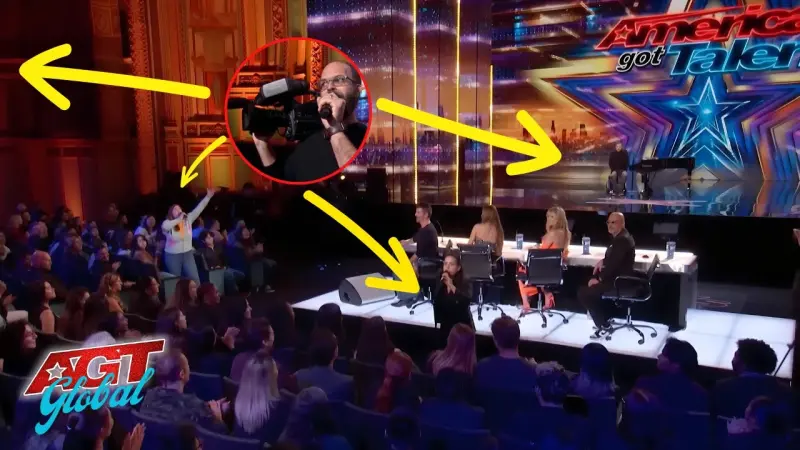
A performance that started small and ended in chaos
The audition opens in a fairly ordinary way. A man named Wesley steps up to the piano and introduces himself as someone who works in tech, even though his real ambition is to make music his full-time path. He begins a cover of Take a Chance on Me, and at first everything seems a little shaky.
What looks like a weak start is actually part of the plan. The nervous pauses, the awkward silence, and the apparent mistakes are all carefully staged. Then the room changes completely, because the performance suddenly expands into a huge flash mob that surprises everyone watching.
Key Insight: The entire setup is designed to mislead the judges before revealing the real spectacle.
People who seemed unrelated to the act step in one after another. A woman in the audience joins the song, followed by a security guard and even a cameraman. Their timing, vocals, and comic reactions make the whole theater feel alive. Rather than a simple solo audition, the number becomes a tightly organized production built to look spontaneous.
- The apparent struggle is intentional, not accidental.
- The hidden performers enter from different parts of the venue.
- The audience reaction grows as the routine becomes bigger.
The group behind the concept is Improv Everywhere, and the UCLA choir is also part of the presentation. Together, they create a scene that feels unpredictable while still being carefully rehearsed. The contrast between the false failure and the real talent is what makes the act memorable.
Even though the crowd responds with enthusiasm, the judges do not agree on how far the group should go. Simon Cowell and Heidi Klum appreciate the originality and the sudden twist. On the other hand, Howie Mandel and Sofia Vergara feel the number fits a one-time event better than a long-running competition act.
For the judges, the act raised a simple question: was this a great surprise, or was it too dependent on shock value?
The reason the performance spread so widely is easy to understand. It took a familiar talent-show format and flipped it upside down. Instead of a standard audition, viewers got a lively, playful celebration that blurred the line between failure and triumph.
In the end, this audition stands out because it turned uncertainty into entertainment and expectation into delight. What first appeared to be a collapsed performance was actually a polished, crowd-pleasing reveal that redefined what a stage audition could look like.