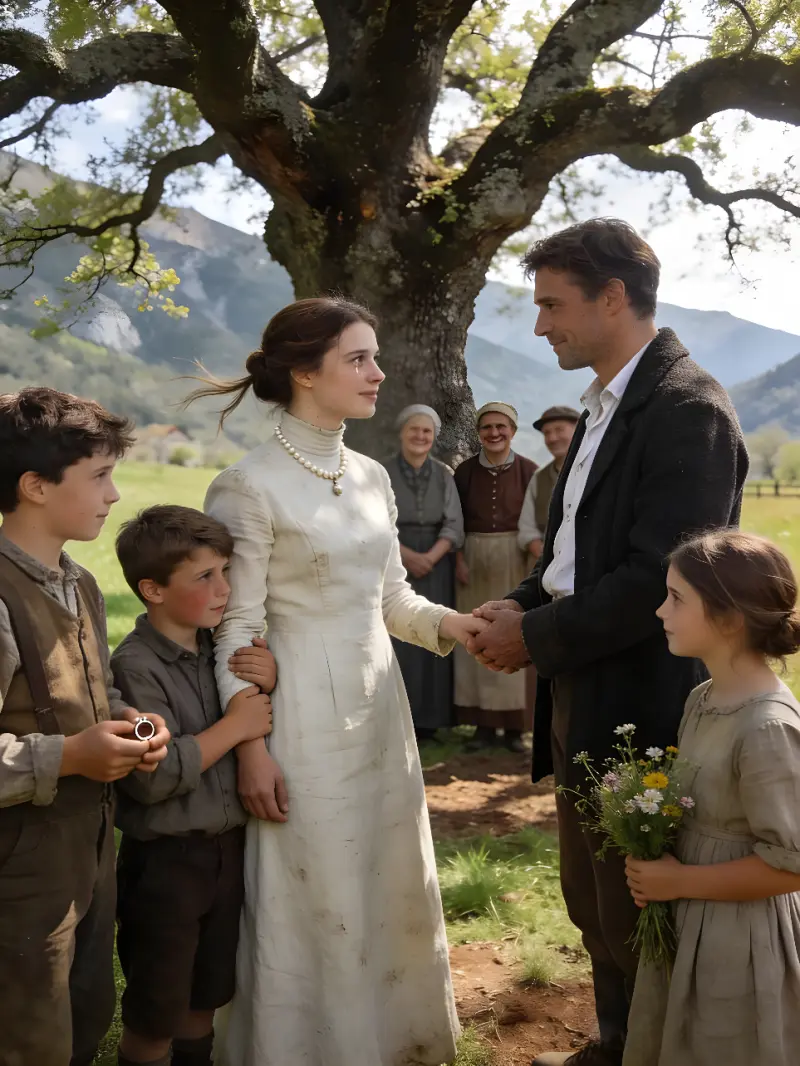
At eighteen, in the winter of 1878, Élise Martin was given in marriage to a widower with three children in a remote part of France’s Massif Central. In those mountain farms, a woman’s future was often decided not by desire, but by necessity.
The wind moved between the fir trees like an old sorrow. Snow covered the dirt roads, erasing footprints as though it wanted to erase the lives that walked them too.
Élise stood on the doorstep of her uncle Henri Martin’s house, holding her mother’s gray shawl close to her chest. She did not cry. Since her mother’s death six years earlier, she had learned that tears do not change the path of a cart.
Inside, by the hearth, the bargain was being sealed.
“She is healthy,” her uncle said without shame. “Strong. She knows how to work. She is not delicate.”
The man listening was tall and broad-shouldered, his hat held in one hand. Jean-Baptiste Morel was thirty-six, a farmer, widowed three years earlier. His gray eyes were not cruel, only tired.
On the table landed a pouch of silver francs, along with a document proving the sale of a young bull of good stock.
Élise did not object. At that time, women were not asked for their opinions; they were moved from one life to another.
She climbed into the wagon without looking back. Snow began covering her footprints before the horse even started, as if the world had already decided she no longer belonged there.
A Home That Did Not Yet Feel Like Home
The Le Chêne farm, near a small village in the Cantal, stood in a pale stretch of winter light. The house held itself against the wind with tired dignity. In the barn, the tools Marguerite, Jean-Baptiste’s late wife, had once cared for still hung in their places.
The children watched her from the hallway.
- Lucie, three years old, hiding behind her brother Étienne.
- Étienne, the eldest, eight years old, arms folded and eyes hardened by too much loss.
“Good evening,” Élise whispered.
Étienne turned away.
So her new life began.
The first days were full of small failures. The stove would not cooperate. The pan burned the cakes. Well water stung her hands with cold. She did not know how to braid Lucie’s hair or calm Étienne’s night cries. But she did not give up.
And Jean-Baptiste watched.
He did not raise his voice. He did not praise her either. Yet every morning, a small note appeared near the hearth:
- “Use oak wood. It burns longer.”
- “Étienne likes lentil soup with thyme.”
- “You do not need to be perfect. Do not quit.”
Those words warmed her more than the fire ever could.
Then illness came, as hardship often does in the countryside: without warning. Lucie stopped eating. Fever burned through her little body. In her sleep, she called for her mother.
Élise did not hesitate. She made mint infusions, changed damp cloths, and slipped into bed beside the child to share warmth through the night. Three sleepless nights passed. On the third morning, Jean-Baptiste stood at the door of the room that had once belonged to Marguerite.
He saw Élise singing softly, holding Lucie as if she had given birth to her.
He said nothing when, at dawn, Lucie murmured, “Thank you… Mama Élise.”
That was not a small moment. It was a silent turning of the earth.
Later, Élise found Marguerite’s simple grave behind the house. She did not seek to replace her. She only wanted to honor her.
She placed wildflowers there and whispered, “I am not here to take your place. I only want your children to never feel alone again.”
That night, Étienne asked quietly if she had spelled his mother’s name correctly.
“Yes,” she answered.
He nodded. It was not affection yet. But it was no longer rejection.
Still, wounds do not vanish without leaving marks. One night, Élise overheard Jean-Baptiste speaking in the barn:
“I married her out of necessity. I needed someone to care for the house.”
It did not wound her like an insult. It wounded her like a truth.
At dawn, she left a note on the table:
“If I am only a shadow, let me go before spring arrives.”
She wrapped herself in her coat and walked into the cold.
When Jean-Baptiste found the letter, something broke inside him. He followed her tracks through the fading snow and found her beside a frozen stream, small and trembling, as if the world were too large for her.
He knelt in front of her and spoke at last from the heart.
“I do not know how to love well,” he admitted. “When Marguerite died, I shut my heart away. I thought silence was safer. But with you, I learned silence can hurt too.”
Élise looked at him, hurt and hopeful at once.
“I never wanted you to love me,” she said. “I only wanted to matter.”
Jean-Baptiste’s voice shook.
“You matter more than you know.”
They returned home together.
Sometimes forgiveness is not the ending of the story. Sometimes it is the beginning of the hardest part.
The snow had not managed to break them. Now life itself would try. And when spring finally arrived at Le Chêne, no one was ready for what would come next.
Summary: What began as a marriage of necessity slowly became a story of trust, healing, and quiet devotion—one that was only just beginning.