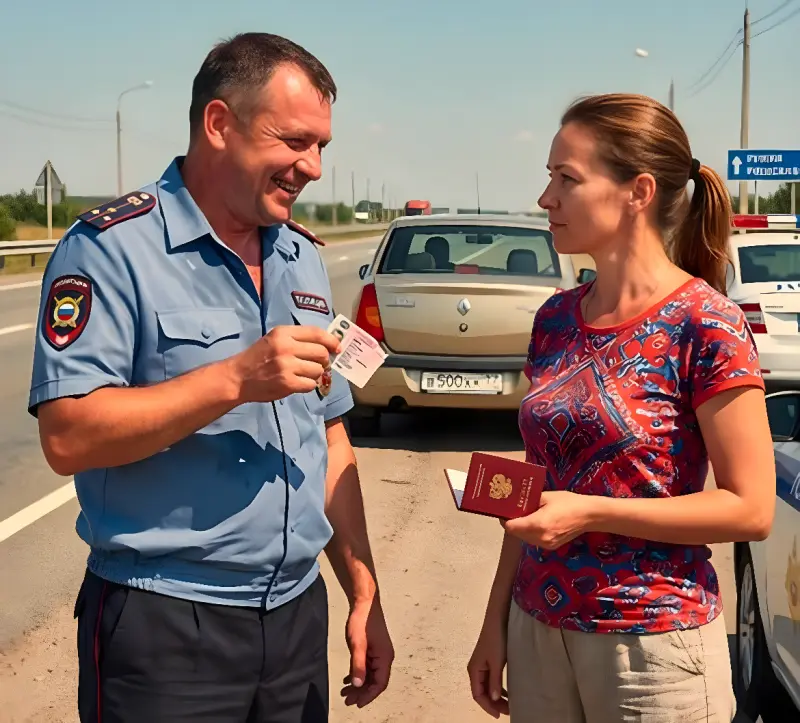
A routine stop that wasn’t routine at all
“Cut the engine. And hand over your documents. Now.”
The inspector’s heavy palm struck the open window frame of my service Renault Logan so hard the old glass rattled in the door. The air inside the car felt like an oven. The dashboard was hot enough to sting my fingers, and the broken air conditioner had given up in May. I had chosen this unremarkable car on purpose. It was the best disguise for a quiet drive back from an unscheduled inspection in the neighboring district, where a thick file on one overconfident official was lying on the back seat.
The roadside smelled of scorching asphalt, dust, and the sharp mint of chewing gum coming from the man in a traffic police uniform standing beside me. He looked about forty. His face was red and puffy, with dark circles under his eyes, and sweat ran down his forehead. Behind him, a patrol car blocked part of the road, and another officer was visible inside.
I was forty-six years old and had spent twenty years in internal security. My job was to identify the kind of people who treated public service like a private business. I knew their habits, their posture, the way they avoided direct answers. That day I looked like nothing more than a tired woman in plain clothes: linen trousers, a gray T-shirt, no makeup, hair tied back carelessly. To him, I was an easy target.
“You think rules apply to everyone except you?” he snapped, leaning into the window with a smug grin. “That’s not how this works.”
He demanded my documents again, tapping impatiently at the door. I asked for the reason for the stop and whether he was conducting an official operation. My calm clearly irritated him. He expected nervousness, excuses, maybe even a polite offer to “settle things quietly.” Instead, he got a level voice and a steady stare.
Then he tried the oldest trick in the book. He sniffed the air dramatically and accused me of drinking the night before. I knew exactly what was coming next: a threat to take me for a medical test, an expensive delay, a few carefully chosen words about solving the matter without paperwork.
I refused to play along.
- I told him to draw up an official sobriety check.
- I asked for two witnesses and a certified device.
- I said everything should be recorded on video.
That was when his confidence began to crack. There were no witnesses on that empty, sun-baked road, and he knew it. His face darkened, and he spat onto the asphalt near my front wheel, muttering about towing my car and sending me to the district hospital for testing. He sounded less like a law enforcement officer and more like a man losing control of a script he had used many times before.
So I reached for my phone, opened the camera, and placed it on the dashboard with the lens pointed toward the window. The red recording light came on instantly.
“What are you doing?” he barked.
“Documenting the interaction,” I said clearly, so every word would be captured. “You have refused to identify yourself, made unsupported accusations, and threatened vehicle removal without a protocol. Please state your name and rank.”
That was the final straw. In a flash of anger, he reached into the car and snatched the driver’s license from my hand.
I leaned forward, ready to insist he return it, but the story was only beginning to shift. In his mind, he had just humiliated a harmless driver. In reality, he had made one very serious mistake.
What happened next made all of them stop laughing.
When the red security card came into view, the inspector’s expression changed in an instant. The man who had been so confident a second earlier suddenly went silent, and the patrol car behind him seemed to freeze with him.
Summary: What looked like a routine roadside intimidation attempt quickly turned into a moment of exposure. The inspector thought he had found an easy victim, but he had actually stopped someone who knew exactly how to answer him.