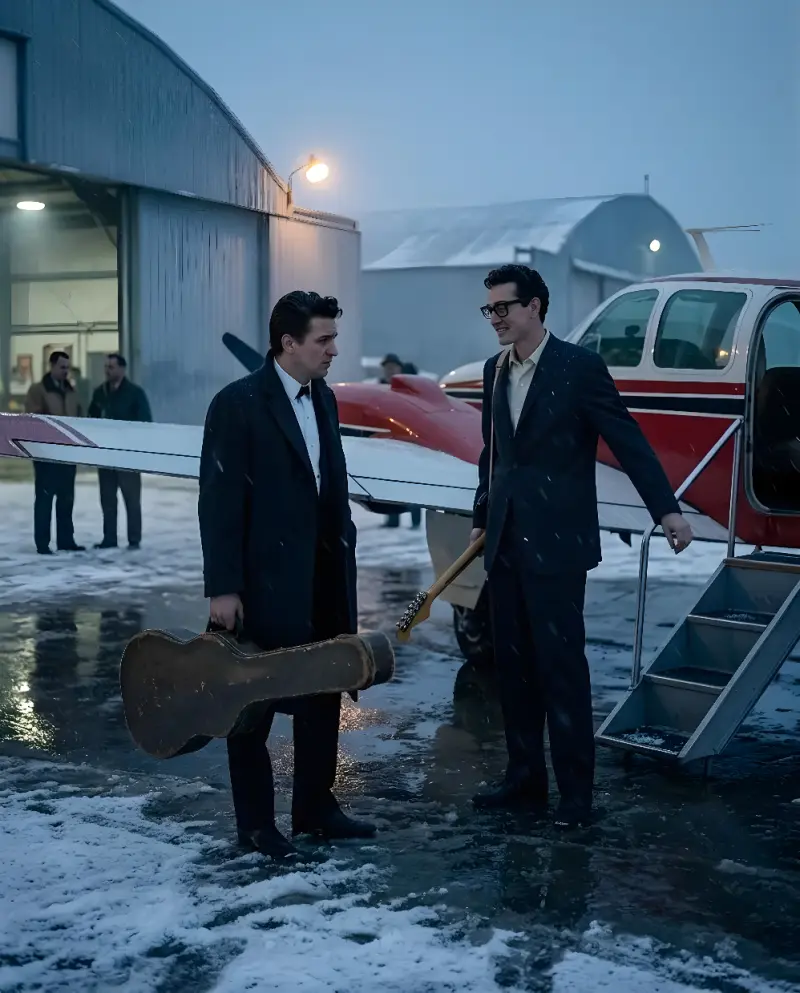
A Fateful Flight on a Bitter Winter Night
On February 3, 1959, the Winter Dance Party tour was moving through the frozen Midwest under brutal conditions. The musicians had been traveling by bus in freezing weather, and everyone was exhausted. In an effort to avoid another miserable overnight ride, Buddy Holly decided to charter a small plane to get to the next stop more quickly. What happened next would become one of the most famous and heartbreaking moments in music history.
Waylon Jennings, just 21 years old at the time and playing bass in Buddy Holly’s band, had a seat on that plane. But when J.P. “The Big Bopper” Richardson, who was feeling ill with the flu, needed a seat, Waylon gave his up without hesitation. That small act of kindness would save his life, but it would also leave him carrying a memory he could never fully escape.
A Joke That Became a Lifelong Burden
Before the plane took off, Buddy Holly teased Waylon with a lighthearted jab: “I hope your old bus freezes.” Waylon answered in the same joking spirit: “I hope your plane crashes.” It was a careless exchange between friends, the kind of remark that would normally be forgotten almost immediately. But only hours later, the plane went down in an Iowa cornfield, killing Buddy Holly, Ritchie Valens, and The Big Bopper.
“I hope your plane crashes.” A joke spoken in passing became a sentence Waylon Jennings would remember for the rest of his life.
Buddy Holly was only 22 years old. The tragedy stunned the music world and later became known as “The Day the Music Died.” For millions of fans, it marked the end of an era. For Waylon Jennings, it marked the beginning of a private grief that lasted decades.
The Weight of Survival
Waylon Jennings survived the crash because he had given away his seat, but survival did not bring relief. Instead, it left him with a deep sense of guilt and sorrow. He later admitted that what haunted him most was not simply the loss of Buddy Holly, but the last words he had spoken to him. He carried those words quietly, turning them over in his mind for years.
- He gave up his seat so a sick bandmate could travel safely.
- He made a joke to Buddy just before the flight departed.
- He lived with the memory of that joke for the rest of his life.
Waylon never publicly let himself off the hook. Even though the comment had been made in jest, he treated it like a personal burden he could never fully set down. The pain stayed with him until his death in 2002, and he kept that memory mostly private, as if speaking it aloud might make it heavier.
Some words are harmless in the moment, but unforgettable when fate turns them into something else.
Waylon Jennings’ story is not only about a famous tragedy. It is also about chance, guilt, friendship, and the painful way one small moment can shadow an entire life. In the end, a joke meant for a laugh became a reminder that some words never truly disappear.
It is a story of survival, regret, and the lasting power of a single careless sentence.