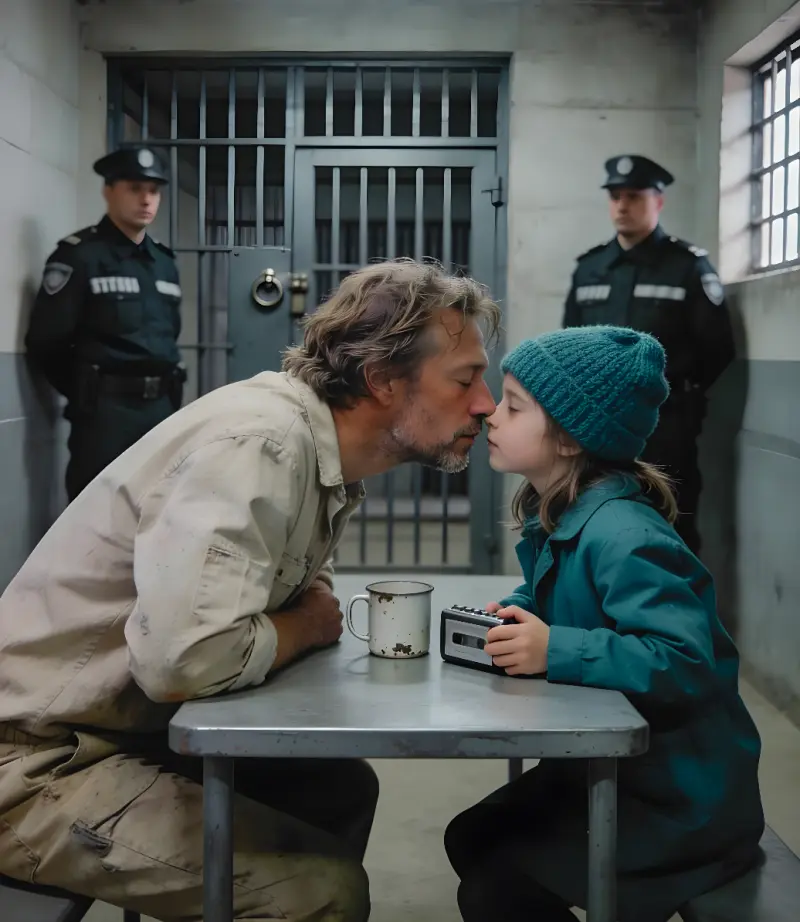
An hour before the execution, a guard bent down to listen to an eight-year-old girl. A moment later, his hand began to shake. By the next day, the entire case that had quietly marched a man toward death for five years suddenly stopped moving at all.
What makes stories like this so unsettling is not only the sentence that hangs over them. It is the silence before the truth breaks through—the moment when everyone has accepted a verdict, and only a child still believes something terrible has gone wrong.
A case that seemed already decided
Danil Fyodorov had spent five years on death row near Minsk. Year after year, he heard the same accusations repeated until they sounded final: fingerprints on a knife, blood on his jacket, a neighbor who claimed to have seen him near the house on the night of the murder. For the court, that was enough. For the system, it was enough. But for his daughter, it never was.
When only hours remained, Danil did not ask for comfort, food, or prayer. He asked for one thing only: to see the daughter he had not held in three years. Since his arrest, the little girl had been taken to live with an aunt in another city, where she was taught not to ask too many questions and to prepare herself for a father who would not return.
The detention center director, Viktor Andreevich Lazarev, was not a sentimental man. He understood procedure, duty, and the limits of both. Still, something about the Fyodorov case had nagged at him for months. The file had closed too quickly. The evidence had seemed too neat. And the pressure to stop looking any further had been unusually strong.
That morning, against expectations, he approved the meeting.
The visit no one expected
The girl arrived before dawn in a gray official car. She wore an old blue coat, a knitted hat, and a scarf that clearly had been made by hand to keep out winter wind, not to look pretty. In her hands she held a small worn toy. She did not cry. Somehow, that made the air around her feel even heavier.
She walked through the corridor in complete silence. The prisoners behind the doors said nothing. Later, a young guard would say the hallway had been so quiet that even the walls seemed to be listening.
In the visiting room, Danil sat chained to a metal table. He looked thinner than she remembered, with a pale face and a faded uniform hanging off his frame. When he saw his daughter, his expression changed at once, as if the sight of her had brought him back to life for a single breath.
“Mashenka…” he whispered.
She did not rush to him. First she looked carefully, as though matching this man to the one she remembered through small details: the smell of tea, an itchy sweater, cold hands after being outside. Then she stepped close enough for him to lean toward her as far as the handcuffs allowed.
Everyone expected tears, a child’s question, or at least a trembling voice. Instead, Masha leaned in and whispered a few words into his ear.
The room changed instantly. One guard heard a name—one that had never been spoken aloud in that detention center. It was the name of a man linked to the disappearance of a key witness five years earlier, and to the sudden silence of two investigators who had been digging too far.
Viktor Andreevich went pale. Danil lifted his head as if he had just been given a second chance to breathe. And then Masha quietly placed a small cassette tape, sealed in a clear sleeve with a rubber band, on the table.
- She had not come to say goodbye.
- She had come to bring proof.
- She had come to finish what the adults had been too afraid to begin.
That is what makes the story so unforgettable: sometimes a child is the first person brave enough to speak the truth. And sometimes the truth arrives in the smallest voice in the room.
What was recorded on that tape, and whose voice opened it, would stop the case cold. By the next day, the machine that had moved so confidently toward an execution had frozen in place. Summary: a little girl’s whispered words uncovered the doubt everyone else had chosen to ignore.