A Quiet Return to a Familiar Town
I came home with one simple plan: sit quietly in the back row, applaud my father, and leave before anyone could turn the evening into a spectacle. No speeches. No explanations. No reason for Gladys, my stepmother, to get the satisfaction of seeing me uncomfortable.
But small towns never keep anything quiet for long. By the time I reached the house, people were already speaking in half-finished sentences and careful smiles, as if my life had become something they were entitled to discuss.
At the counter in town, I heard it first.
“She already left the Navy.”
The words were spoken lightly, but they were meant to travel. A moment later, I heard Gladys laughing as if the rumor had been a joke she approved of.
“She never gets anything right,” she said.
I said nothing. That was always my mistake in her eyes: I refused to fight where she wanted me to. Gladys loved attention, especially the kind that came from creating tension in front of an audience. I had learned long ago that silence could be stronger than defense.
Gladys Was Already Performing
When I got to the house, the front door was wide open, as if the whole evening had already been arranged for public consumption. The place smelled like lemon cleaner and fresh baking, neat and controlled, like every detail was meant to look effortless.
Gladys looked me over with a quick, critical glance.
“That’s what you’re wearing?” she asked.
“I just got here,” I replied.
She pressed her lips together, then reminded me that the night was “important.” Donors would be there. The pastor. Council members. People who mattered, at least to her. What she really meant was simple: do not embarrass us.
Then she leaned in and said, with a thin smile, “I heard you left the Navy.”
I did not answer. Her smile widened, as if my silence confirmed whatever story she wanted to tell.
Inside the kitchen, my father stood over programs and seating charts, looking older than I remembered. He was still the same man in one way: when things became difficult, he hid inside the details.
“Andrea,” he said quietly.
“Hi, Dad.”
Gladys moved in before the conversation could become real. “She’ll sit quietly in the back,” she said brightly, like she was announcing a fact instead of issuing a warning.
I simply nodded. That had been my plan all along.
The Hall Was Full, and So Were the Whispered Judgments
By evening, the Veterans Hall was crowded with neighbors, old friends, and people who always seemed to know where to stand and what to say. Folding chairs filled fast. Flags lined the walls. The room carried the warm scent of coffee, wood polish, and familiar small-town pride.
I headed toward the back row, just as I had intended. But even there, the whispers followed me.
- “That’s Robert Montgomery’s daughter.”
- “Heard she left the Navy.”
- “What a shame.”
Across the room, Gladys stood beside my father, smiling as if she had every right to shine in his place. She spotted me and approached with a tray of drinks.
“There you are,” she said sweetly. “We need help.”
I looked at the tray and then at her.
“If you’re not sitting with family,” she added in a low voice, “you might as well make yourself useful.”
So I took the tray. “Sure,” I said.
I moved through the room, handing drinks to people who either recognized me or pretended not to. One woman offered me a polite, sympathetic smile and asked what I was doing now.
“I work in Virginia,” I said.
Before she could ask more, Gladys was already watching from across the hall, keeping score in the only way she knew how.
Then the emcee stepped to the microphone and announced a special guest.
The back doors opened.
And the entire room changed.
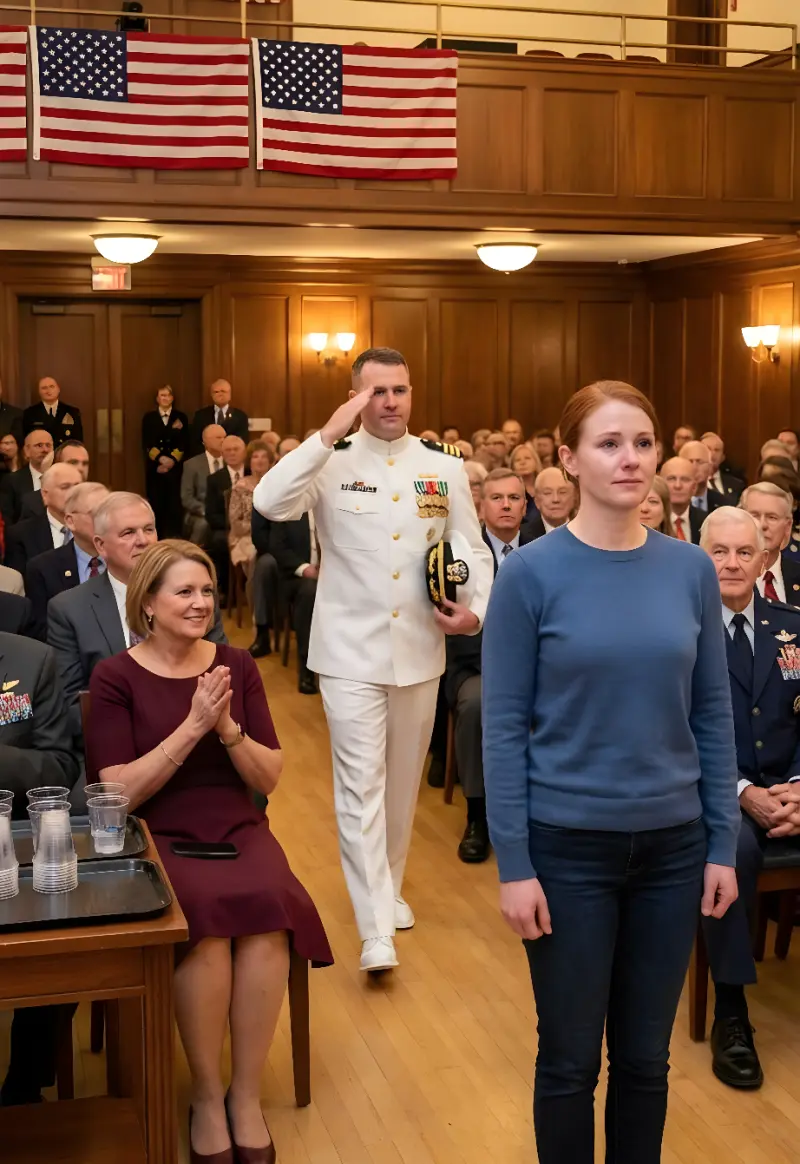
A man in full dress whites entered, his presence commanding immediate attention. Conversations stopped. Chairs shifted. Even the veterans in the front row straightened instinctively.
He began walking toward the stage, but halfway down the aisle, he stopped.
His gaze moved across the room.
And then it landed on me.
Without hesitation, he turned away from the stage and walked directly toward the back of the hall, straight toward where I stood with the drink tray in my hands.
When he stopped in front of me, the room seemed to hold its breath. He stood tall, raised his hand, and gave me a formal salute.
Sometimes the quietest return is the one that changes everything.