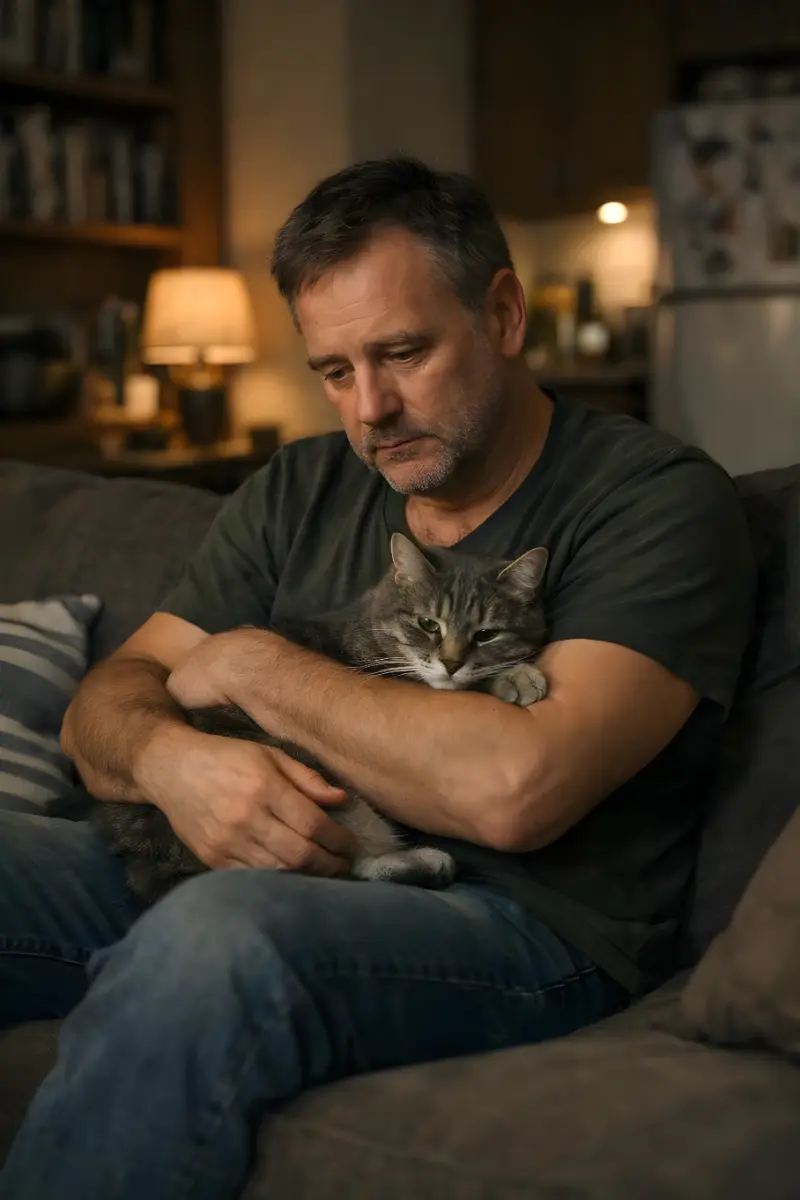
On Thursday afternoon, I brought him home, and for the first hour I was certain I had made a terrible mistake. Three hours later, he was asleep against my legs, as if he had spent years waiting for the chance to truly rest.
He looked worse in person
He looked bad in the photos, but seeing him in person was harder. Thinner, paler, more exhausted. His fur was rough and lifeless, like it had not been touched kindly in a very long time. One ear had a small notch in it, and his face carried the worn look of an old animal that has endured too much for too long.
The volunteer who handed me the carrier said they had found him among apartment blocks on the outskirts of Bologna. He had been surviving on scraps and sleeping wherever he could, just trying not to get soaked when it rained.
“No one knows how long he was there,” she said.
That sentence stayed with me all the way home. It followed me into my apartment and settled in the quiet corners of the room.
No one knows how long he had been living like that—not only hungry and cold, but existing as if no one saw him at all. Days when you can disappear and nothing changes, because no one notices.
I live alone, and maybe that is why the thought struck me so deeply.
A small home, but a warm one
My apartment is nothing special: a tiny living room, an old sofa, and a floor lamp that flickers for no reason. The kitchen always looks tired no matter how much I clean it, as if it has already lived through too many similar evenings. But it is warm, it is quiet, and it is safe. That night, all I wanted was for him to feel that too.
I opened the carrier and stepped back, giving him space and time.
He did not come out.
He did not even poke his head out. He stayed still inside, as if waiting for the worst to begin. As if this were not the start of a new life, but only a brief pause before something harder.
I sat on the floor a few feet away and spoke softly, trying to keep my voice calm.
“You don’t have to hurry, Rufus.”
My voice sounded strange in that room. I’m not used to speaking out loud when the television is off and the apartment is silent.
After a while, he finally came out—slowly, almost pressed to the floor, as if every step took effort. He stopped every few paces, looking around, sniffing the table leg, the edge of the rug, the underside of the sofa, checking whether this place was safe.
When I set a bowl of food in front of him, he looked at me first, then at the bowl, then back at me. There was something in that look that went beyond caution.
It was as if he needed permission to eat.
He didn’t throw himself at the food the way movies often show. There was no panic—just small bites, pauses, another bite. As if he still expected someone to take it away.
Then came the moment I did not expect
I thought he would crawl under the sofa and stay there for the night. That seemed the most likely outcome. I was ready for days filled with hiding places, sudden movements, and trust built slowly over time.
But he surprised me.
When he finished eating, he licked his mouth once and remained in the center of the room with that tired, confused expression, as if he still could not understand what was happening. Then he turned toward me, and by then I was sitting on the sofa, awkwardly trying not to stare.
He moved toward me slowly, as though each step were a question even he could not answer. Then he climbed up beside me, awkwardly and with effort, as if his body no longer moved the way it once had.
He paused, pressed his paws into the cushion, turned in a small circle, then another, as if trying to remember how this worked.
And finally, he lay down against my leg—not just near me, but close, as if that were the only place that made sense.
For a moment, I could not explain why it affected me so much. Something inside me simply cracked open.
He did not choose the far corner of the sofa. He did not hide. He chose closeness, warmth, and the presence of another living being.
At first his eyes stayed half-open, alert to every sound outside the apartment door. But then, little by little, something changed.
- His shoulders relaxed.
- His breathing became slower and deeper.
- His paw stretched out and rested on my leg.
Then, at last, he truly fell asleep.
I sat there in the dim yellow light, careful not to move. My leg went numb, but I barely noticed. I kept thinking about him outside, in the rain, behind dumpsters, under cars—curling up anywhere he could, always sleeping with one eye open.
And I thought about how easily a person can grow used to loneliness without noticing it. You go to work, pay the bills, come home tired, and one day the silence no longer feels unusual.
But that night, with an old cat asleep against me, my apartment felt like more than a place to live.
It felt like home.
Summary: In just a few hours, a frightened stray began to trust, and in doing so, reminded me that safety, warmth, and quiet companionship can change everything.