Living on Someone Else’s Patience
“Don’t start,” her sister had said at the exact moment the number lit up on the screen — the number after which Lena no longer owed anything to anyone.
“How much longer are we supposed to tiptoe around her? She’s a grown woman, and she’s been sitting here like a stray. And don’t tell me stories about her clever work and investments. I’ve heard enough of that nonsense.”
Olga answered her husband in a barely audible voice, the kind people use in old apartment blocks where even a whisper slips through the walls.
“Sergey, quiet. Lena is in the next room.”
“Let her hear. Maybe then she’ll understand this isn’t a holiday home.”
Lena sat on the narrow sofa, feet tucked up under her, staring at the faded wallpaper. She knew every pale branch in that pattern by heart. In eight months, you can memorize not only the wallpaper, but also other people’s pauses, irritation, and exhaustion at your presence.
The most humiliating thing was not being asked to leave.
The most humiliating thing was when you began to live as if you were already in the way. You closed doors more softly. You visited the kitchen less often. You boiled the kettle during the day so it would not disturb anyone at night. And all the while, you felt you were taking up not space, but someone else’s patience.
Lena worked from home, creating botanical tables and descriptions of rare plants for a publishing house in Prague. It was real work — demanding, careful, precise. It simply did not make noise. It did not smell like an office. It did not look “proper” to Sergey, who measured life by shipments, invoices, and how much money a person brought in on a certain day.
To him, Lena was just a quiet woman in a stretched sweater, sitting at a laptop, drinking tea, and taking far too long to recover from her divorce.
For Olga, it was more complicated, because Lena was not just a younger sister. She was the girl who had shared one blanket with her at their grandmother’s summer house, eaten bread with sugar on the porch, and sworn they would never leave each other.
Then adulthood arrived with its own promises, and those promises did not always keep their word.
After their parents died, Olga handled everything: documents, the funeral home, the notary, bills, neighbors, and the smell of medicine that lingered in the apartment for weeks. Lena drifted through those days as if underwater. When the inheritance came up, Olga said she would buy out Lena’s share. Lena trusted her the way children trust older sisters: if she said it was for the best, then it must be.
Years passed. Marriage, a move, a new city, hopes, a rental repair, and then one short sentence from her husband: he had been living another life for a long time, and there was no room for her in it.
When Lena came home, she was not arriving as a guest. She was arriving as someone whose world had already cracked open.
Olga opened the door, held her shoulders, and said, “Stay with us as long as you need. Get yourself together.”
But people sometimes need more time to get themselves together than is comfortable for those around them.
At first Sergey stayed quiet. Then he started sighing. Then he asked when Lena would find her own place. Then he discussed it with Olga in the kitchen. Then he stopped bothering to hide his tone. Lena heard every word.
- She packed calmly, without tears.
- She took her laptop, work drive, a wool scarf from her mother, and the old wire bracelet from childhood.
- She rented a tiny studio and moved out under a wet November snow.
What she had not spent on “a beautiful life,” as Sergey liked to sneer, had been quietly invested years ago. She had been frightened of poverty and chose the one thing she could do: put everything into shares of a small chemical company.
Five years later, the number on the screen meant freedom.
In mid-December, Olga sent a message inviting her for New Year’s Eve “like before.” Lena agreed, bought gifts, and started to soften. But three days before the holiday, Olga called to say plans had changed: Sergey had invited colleagues and their families. It would be crowded. Awkward. Better to meet after the holidays, just the two of them.
Just the two of them. When no one else was around. When her presence would be easier to explain.
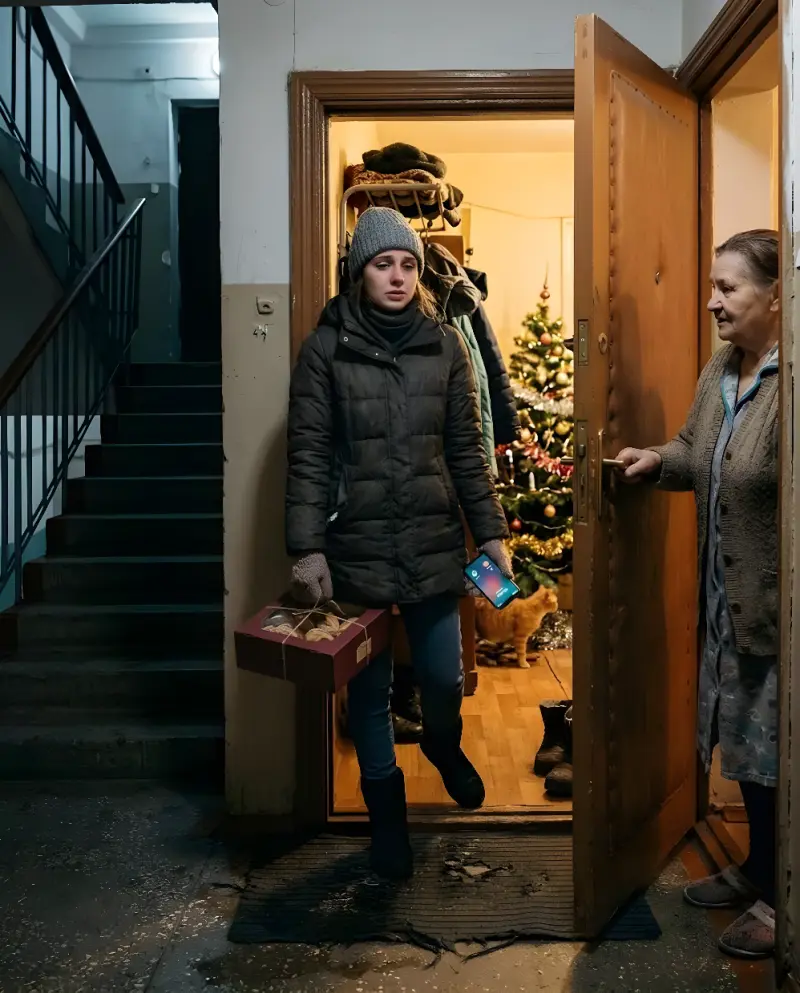
On December 31, Lena stood in her quiet studio, then went out for mandarins simply to escape her own thoughts. There she met a neighbor, Tamara Pavlovna, who took one look at her face and said, “Come with me. I’ve got salad, roast duck, and a cat who has already knocked down the tree twice.”
Lena said yes.
At ten to midnight, her phone vibrated again: first the broker’s notification, then Olga’s call. On the screen glowed the figure after which Lena would never again have to ask anyone for a corner, for patience, or for a seat at someone else’s table.
And when she answered, the first thing she heard from her sister was not a greeting.
Summary: A quiet betrayal, a long-held hurt, and one life-changing number finally give Lena the strength to step out of other people’s shadow and into her own future.