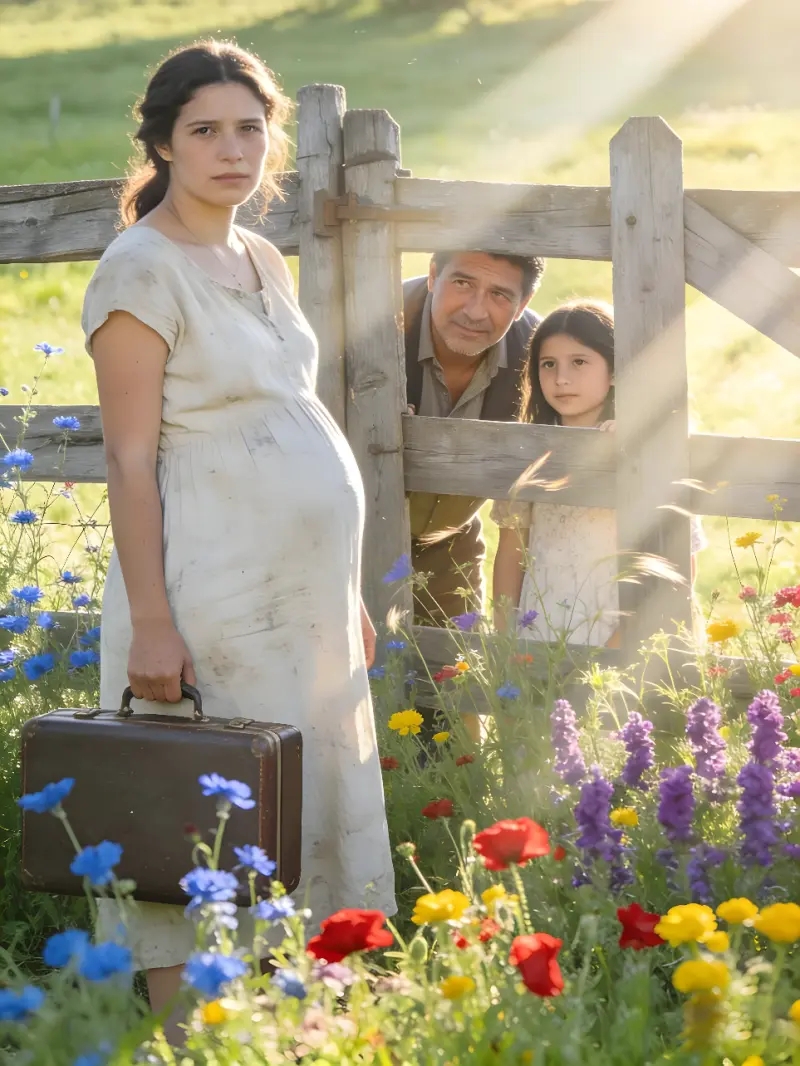
As the sun began to slip behind the hills of Jalisco, Mateo held his hoe in the air and froze. It was not because he was tired. It was because his daughter, Lucía, who had been pulling weeds along the fence with a small metal trowel, had gone completely still.
“Dad… someone is at the gate.”
Mateo looked up. In the middle of the wooden entrance stood a woman alone. She did not move forward, and she did not step back. She carried an old leather suitcase, a heavy backpack, and wore a pink floral dress that barely covered the roundness of her belly. She was many months pregnant. Dust clung to her sandals, her legs, and her hands. She looked exhausted, but not broken.
Lucía pressed close to her father’s arm.
Mateo walked slowly to the gate. When he stood before her, he saw that she was young, too young to be carrying such a burden on her own. She had dark hair, tired eyes, and a quiet dignity that the road had not taken from her.
“Good afternoon,” he said.
“Good afternoon, sir.”
She swallowed and spoke without circling around the truth.
“If you let me stay… I’ll cook.”
The wind moved between them. Somewhere in the distance, a chicken clucked. Mateo considered refusing. He thought of the child who depended on him, the small house, the ranch that barely provided enough for two. He thought this was not his problem.
But then he looked at her again. She was not asking for pity. She was offering work.
“What’s your name?” he asked.
“Ana.”
Mateo was silent for a moment. Then he opened the gate.
“Come in.”
That was all.
Ana looked at him as if she needed to be sure she had heard correctly. Then she stepped inside, holding her suitcase with both hands. Lucía moved aside to let her pass, never taking her eyes off her. And so, in silence, the three of them walked toward the house: a simple brick home with a tile roof, a front porch, and a twisted jacaranda tree Lucía had climbed since she was six, even though her father forbade it.
Inside, Mateo pointed to the back room.
“There’s a bed and a wardrobe. It’s nothing special.”
“It’s more than I need,” Ana replied.
That same night, she cooked with what little they had: tomato, onion, garlic, rice, beans, and a piece of meat Mateo had taken from the freezer without much thought. Yet from that stove came something different. The house filled with the smell of real food, of warmth, of something Mateo had not felt in years.
Lucía kept finding reasons to walk past the kitchen until she finally lingered in the doorway.
“Do you have bay leaf?” Ana asked.
“In the top cupboard, behind the salt,” Mateo called from the living room.
“I’ll get it,” Lucía said before anyone could ask.
Ana smiled a little.
“Thank you, Lucía.”
They ate together in silence, but it was no longer the silence of two people. It was the silence of three people still learning how to fit into one another’s lives.
What Changed in the Days That Followed
- Mateo rose before dawn to tend the animals, while Ana made coffee and warmed tortillas.
- Lucía, cautious at first, slowly began staying close to Ana whenever she could.
- The house grew fuller, not with things, but with routines, kindness, and small acts of care.
One morning, while they hung sheets under the shade of the mesquite tree, Lucía suddenly said, “My mother died when I was born.”
Ana stopped moving, holding a wet shirt in her hands.
“I’m sorry,” she said gently.
“I never even knew her,” Lucía continued. “My dad keeps a picture of her in a drawer. He almost never takes it out.”
“It still hurts him,” Ana said.
Lucía looked at her sideways. “Yes.”
A little later she asked, “And the father of your baby?”
Ana’s shoulder tightened slightly.
“He’s not here anymore.”
Lucía understood enough to ask no more.
Some wounds are too deep for long explanations. Sometimes the kindest answer is simply enough to be understood.
The first truly close moment came on a Tuesday afternoon, when Mateo had gone to town. Ana sat on the porch peeling yucca for dinner, and Lucía sat on the step nearby. Ana showed her how to cut it more carefully, and Lucía tried again and again until she got it right.
Then the baby moved.
It was not a tiny flutter, but a clear motion beneath Ana’s dress. Lucía’s eyes widened.
“I saw it!”
Ana laughed softly.
“He’s awake.”
Lucía hesitated, then asked, “Can I touch?”
Without a word, Ana let her place a careful hand on her belly. A moment later, Lucía felt a gentle kick beneath her palm.
She gasped. “He felt me.”
“Yes,” Ana said. “And you felt him.”
By the time Mateo came home that evening, he found Lucía drawing in the living room and Ana reading in the armchair. It was not an extraordinary scene, and yet it changed something in him. The house looked less empty.
Days later, Lucía asked Ana, very directly, “Do you like my dad?”
Ana did not laugh.
“Your father is a good man.”
“That’s not what I asked.”
Ana sighed. “I don’t know exactly what I feel yet. But I do know I feel safe here.”
Lucía lowered her eyes. “I wouldn’t mind if you stayed.”
Ana looked at her in silence, and for the first time, her eyes filled with tears.
A few days before the baby was due, Mateo heard a soft cry in the hallway before dawn. He found Ana leaning against the wall, breathing differently.
“It’s time,” she said.
Within minutes, the old truck was rolling through the dark road toward the hospital, carrying with it one thought, stronger than fear: that everything would be all right.
Summary: What began as a request for one night of shelter slowly became something larger—a home warmed by trust, quiet compassion, and the beginning of a new family.