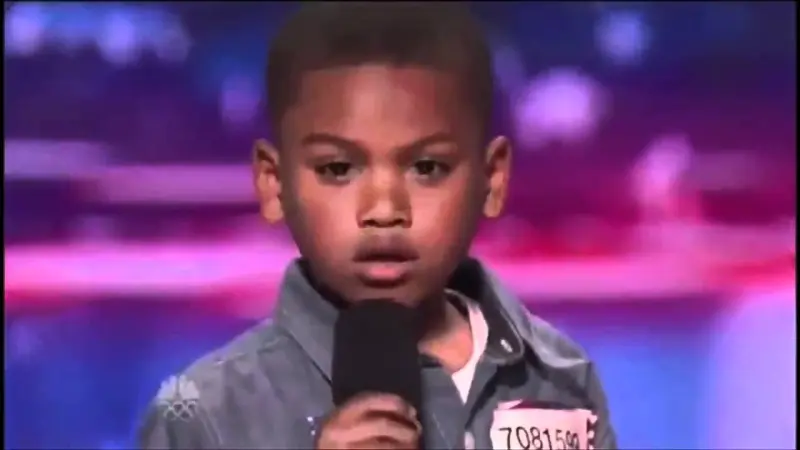
A seven-year-old stepped into the spotlight with big dreams
When Mir Money, just seven years old, walked out onto the America’s Got Talent stage, he carried himself with surprising confidence. He was tiny compared with the set around him, yet his energy made him seem larger than life. A backward baseball cap, a small gold chain, and a wide smile gave him a standout look. Before performing, he said plainly that he wanted to win so he could help support his family.
That honest remark shifted the mood immediately. The audience warmed to him before a single lyric was spoken. In moments like this, a child’s openness can be more powerful than any polished introduction.
Key Insight: His appearance was modest, but his presence made a strong first impression.
Once the music started, Mir moved without hesitation. He bounced across the stage with restless confidence, delivering his rap with sharp timing and clear focus. His words were simple, yet the way he shaped them gave the performance personality. He marked the beat with nods and hand motions, and he handled the pauses like someone far older.
The crowd responded with steady clapping. Some people smiled at the contrast between his small frame and his bold delivery. Others seemed genuinely impressed by how naturally he held the rhythm. Even though he was young, he showed a sense of control that made the performance memorable.
- Bold stage presence
- Clear rhythm and flow
- Strong emotional motivation
- Audience attention from the start
Still, not every judge was fully on board. Talent competitions often balance promise against polish, and younger performers are judged with extra caution. Partway through Mir’s set, Howard Stern pressed his red X. The reaction in the room was immediate. Surprise spread across the audience, followed soon after by another buzzer from a different judge.
People began exchanging uneasy looks. The message felt harsher because of who was on stage. It was not just another contestant being challenged. It was a child trying his best in front of a national audience.
“You could feel the room change the second the buzzers went off.”
What happened next is what made the audition unforgettable. Mir’s earlier confidence slipped away. His face changed from determined to vulnerable, and tears began to fill his eyes. The rap turned shaky, then nearly stopped. He had tried to stay strong for his family, but the disappointment hit him all at once.
The atmosphere in the theater shifted with him. Laughter disappeared. Applause faded. In its place came a heavy silence that made the moment feel even more intense. The discomfort was impossible to miss.
Key Insight: The emotional weight of the scene came not from the buzzer alone, but from watching a child absorb it in public.
Very quickly, the audience turned against the judges. Loud boos rolled through the room, sharp and sudden. The reaction was less about taste in music and more about concern for a young performer who had been visibly hurt. The crowd was reacting to the human side of the moment.
Howard Stern’s expression changed as well. The usual sharpness gave way to something more regretful. On live television, that kind of visible shift is rare, and it made the scene feel even more personal.
- The performance began with confidence.
- The judges interrupted with buzzers.
- Mir became emotional.
- The crowd reacted strongly.
- Howard stepped in to comfort him.
Rather than let the tension remain, Howard walked across the stage. That short walk carried a lot of meaning. He moved from being a judge to being a concerned adult, and the change in tone mattered. He bent down to Mir’s level, hugged him, and spoke gently.
Howard called the boy “terrific” and “so brave.” He also admitted, with unusual openness, that the job was rough and that he did not want to make children cry. The comment softened the moment and showed how quickly criticism can become something more personal when a child is involved.
Mir did not move on in the contest, and on paper that might look like a loss. Yet the story did not end there. Clips of the audition quickly spread online, and the response was overwhelmingly warm. Viewers praised the young rapper for being brave enough to stand on such a huge platform and speak about helping his family.
Many people also used the moment to talk about the responsibility talent shows have when children compete. Honesty matters, but so does care. That balance became part of the larger conversation around the audition.
There was also a gentler reaction after the broadcast. People imagined Mir returning home and replaying the experience with family members who had supported him. They pictured his cap, his chain, and the way his voice might grow stronger over time. The moment seemed to represent a mix of nerves, disappointment, and encouragement all at once.
For Howard, the exchange appeared to leave a mark too. His apology and embrace suggested that empathy sometimes matters more than judgment. In a setting built around criticism, the human response stood out most.
In the end, Mir Money’s appearance became one of the season’s most discussed moments not because he won, but because he showed courage in front of millions. He stepped forward for the people he loves, and that alone gave the performance real weight. The stage may have been a place of competition, but it also became a reminder that kindness can matter more than scores. That is what viewers were left remembering long after the music stopped.