Ricardo was not the kind of man who asked questions. He trusted numbers, schedules, and control. In business, that made him formidable. At home, it made him distant.
So when his wife casually mentioned that their housekeeper had been taking food from the kitchen every afternoon, he did not become angry. He became curious. Not because the missing food mattered to him, but because the lack of control did.
Consuelo had worked in the house long enough to become almost invisible. She arrived early, spoke little, cleaned everything, and left without drawing attention. The kind of person wealthy families often overlooked, assuming silence meant loyalty.
But every day at exactly 4:15 p.m., she repeated the same routine. She packed leftovers carefully. Bread. Fruit. Sometimes soup, placed into old containers as though she were protecting something precious.
Ricardo watched her leave, then followed her in his SUV. She took a bus out of the polished neighborhoods he knew so well, past the city, past the paved roads, until the streets gave way to dust. At first, he told himself he would turn back. Then, something inside him refused to let him stop.
When Consuelo got off the bus and continued on foot, Ricardo followed at a distance. The heat was harsh, but that was not what unsettled him. It was the feeling in his chest, a slow, tightening unease, as if some buried truth was rising to the surface.
After nearly twenty minutes, he saw a cluster of broken-down houses ahead. There were no shops, no music, no signs of life. Yet Consuelo walked forward with complete familiarity, as if she had made this journey many times before.
He hid behind a crumbling wall and watched.
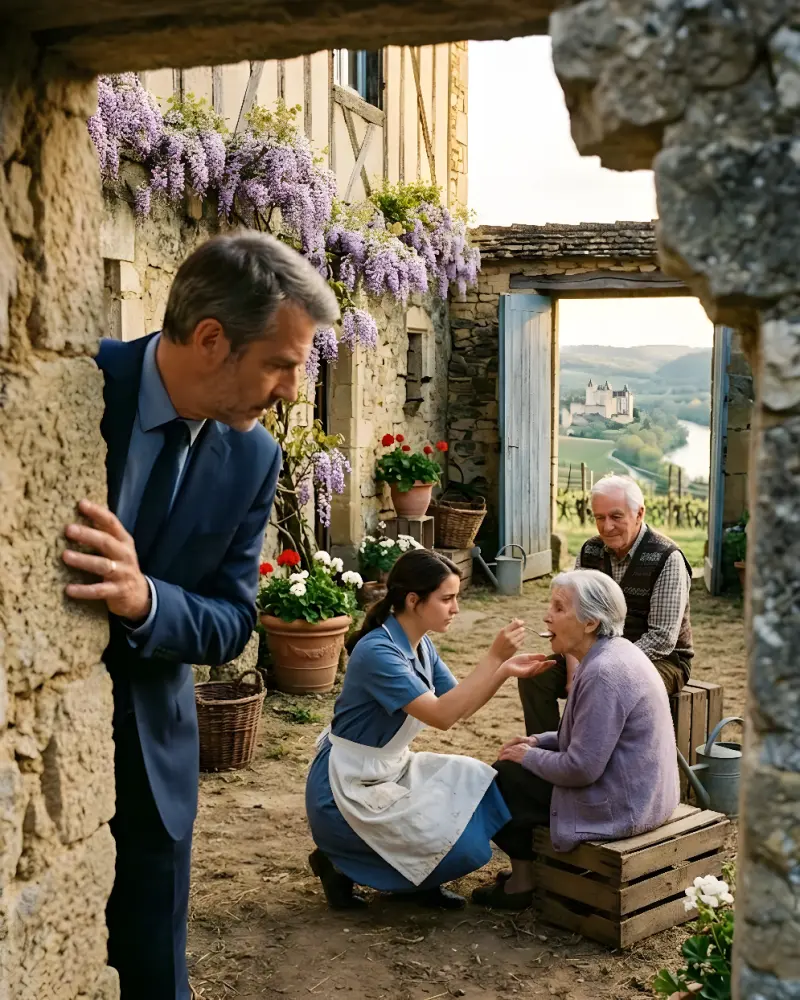
Two elderly people were sitting outside a fragile adobe home, waiting on wooden crates as if they had nowhere else to go.
Consuelo approached them, and when she spoke, her voice changed completely.
“I’m here,” she said softly.
Then she unpacked the food with tender care. She served the old man first. Then she turned to the woman, gently wiping her face before helping her eat, one small bite at a time. It was the kind of attention given by someone who had done this many times before, with love and patience.
Ricardo felt something tighten in his chest. Not guilt yet. Something stranger. Recognition.
The old man’s hands looked familiar. Too familiar. And the woman’s smile stirred something deep and long-buried, something he had not touched in years.
He left without a sound.
That night, he could not sleep. Every time he closed his eyes, he saw those hands, that smile, and the strange ache in his chest. It felt as though his past had found him and was now standing at his door.
The next morning, he returned before Consuelo arrived. He told himself he simply wanted proof, something rational and clear. But when he looked through the broken window, his heart began pounding so hard he felt dizzy.
The old man was sleeping on a narrow cot. The woman sat nearby, softly murmuring a tune with no real voice left in it. Then a framed photo slipped from a shelf and landed face down on the dirt floor.
Ricardo picked it up. And when he saw it, the world seemed to stop.
It was him at eighteen, standing in front of an adobe house with a backpack on his shoulder. The same photograph he kept framed in his own living room. The very same image.
- The old man’s scar matched a memory he had buried for decades.
- The woman’s face, though worn by time, carried the features he had once known better than his own.
- The realization struck all at once: these were his parents.
For twenty-three years, Ricardo had never returned. No calls. No visits. No apologies. And there they were, surviving on leftovers, cared for not by their son, but by the housekeeper he had almost accused of theft.
When he finally stepped inside, his father still had not seen him. But his mother looked up. She smiled gently and said, in a voice that broke something open inside him, “Rosita, you came. I’m so happy, my dear.”
Ricardo froze. His mother did not recognize him.
And what Consuelo said next made him understand that the truth was even more painful than abandonment.
Sometimes the deepest wounds are not the ones we expect. Sometimes the truth arrives quietly, carried in a paper bag of leftovers, and changes everything forever.