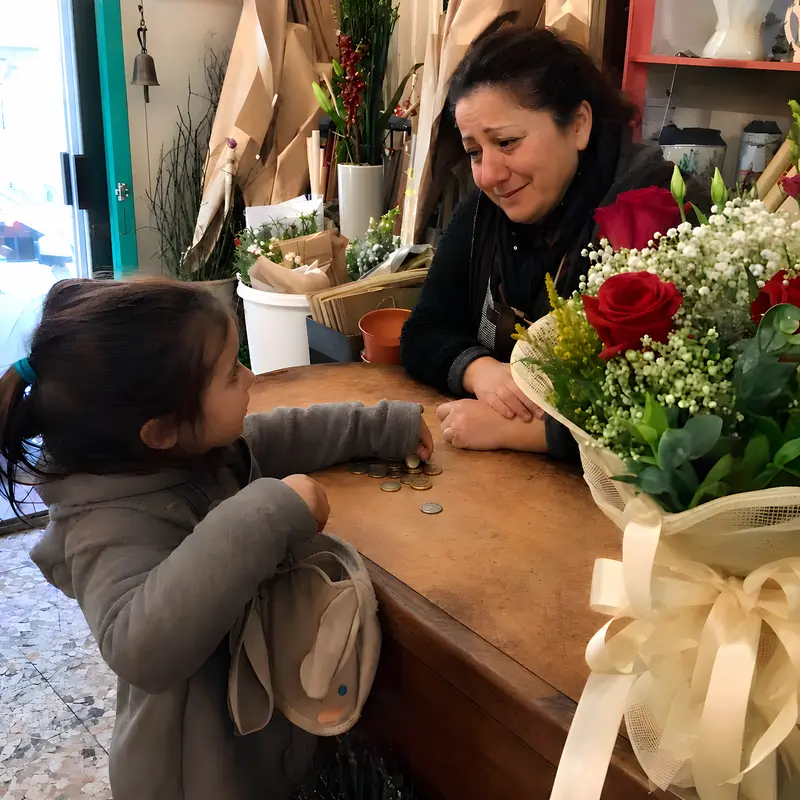
I run a small flower shop in a provincial town. Nothing fancy. A narrow window, a slightly scratched wooden counter, buckets full of roses, carnations, daisies, a few green stems, and rolls of wrapping paper behind the register.
On Saturdays, people always come through the door. Someone buys a bouquet for an anniversary, someone picks up a plant for a family visit, someone takes three roses to say sorry. And every now and then, someone comes in quietly, chooses a simple bunch, and says nothing at all. In some cases, no questions are needed.
That Saturday, I was arranging pale ribbons when the door opened slowly.
A little girl stepped inside.
She was about six, maybe seven. Small and thin, wearing a coat that was too big on her shoulders and a little frayed at the sleeves. Her brown hair was tied back carelessly with a blue elastic, and a few strands fell over her eyes. In her hands, she held a worn-out coin purse with a faded rabbit on the front.
She didn’t speak right away.
She stopped in front of the central table and looked at the largest bouquet I had prepared that morning: red roses, tiny white flowers, a touch of greenery, and a cream-colored ribbon. I had made it thinking someone would buy it for an anniversary or an important dinner. The tag said: 42 euros.
The girl looked at it as if it belonged somewhere far beyond her reach.
I smiled. “Can I help you, little one?”
She came closer to the counter with slow steps.
“Ma’am… can a big bouquet like that make a sad person smile?”
I went quiet for a moment. Children usually ask whether roses have thorns, whether they can touch the petals, whether a flower is real or artificial. Not her. She wanted to know whether flowers could ease pain.
I leaned toward her. “Who is it for?”
She held her purse even tighter.
“For my mom. It’s her birthday today. But she forgot.”
I set down the ribbon I had been holding.
“What’s your name?”
“Celeste.”
It was a gentle name, one of those you don’t hear every day.
“And why did your mom forget her own birthday, Celeste?”
She looked down.
“Because she works all the time. In the mornings she helps elderly people at a home. Then she cleans when she can. At night she says she doesn’t need anything. But that isn’t true.”
She paused.
“Sometimes she cries in the kitchen when she thinks I’m asleep.”
Something tightened in my throat.
“I have €1.87,” she said. “I know it’s not enough. But I can sweep the shop. Or straighten the paper. I just want to give her something. My mom has never had a big bouquet.”
I looked at the 42-euro bouquet. Then at the coins. And to be honest, for a moment I thought like a shopkeeper. Rent had gone up. Bills had gone up. Flowers cost money, and a small business doesn’t survive on air and goodwill. At the end of the month, the numbers have to be counted, even when the heart wants something else.
But then I looked at Celeste’s hands. Small hands, tense with hope.
She turned red. “I’m sorry,” she whispered, and started gathering the coins back quickly. “Just take one flower. My mom says you shouldn’t ask for things you can’t pay for.”
That sentence hurt.
A little girl should not have to learn so early to make her love smaller.
I told her, “Wait here for a moment.”
I went to the back and picked the best roses I had set aside. I added white blossoms, a little greenery, and a light ribbon. Not a perfect display bouquet. A warm one. One that seemed to say, someone sees you.
When I came back, Celeste hadn’t moved.
“But this costs too much,” she said quietly.
I placed the bouquet on the counter.
“Not today. Today, in my shop, there’s a special rule. Big bouquets for mothers celebrating their birthday cost exactly €1.87, if they’re bought by a daughter who brought everything she had.”
She looked at me as if she wasn’t sure she had understood.
“Really?”
“Really.”
Then she placed every coin on the counter, one by one, neatly lined up. After that, she searched her purse again and found two more cents tucked in a corner.
“I’ll give you these too,” she said. “My mom deserves the most beautiful one.”
I turned away for a second.
Celeste picked up the bouquet with both arms. It was almost bigger than she was. Before leaving, she turned back.
“Thank you, ma’am.”
She didn’t say it loudly.
But she said it in a way that stayed with me.
About an hour later, just as I was about to close, I saw Celeste standing by the door.
Beside her was a woman: plain coat, hair tied up in a hurry, tired face. She held the bouquet against her chest as if afraid the moment might disappear.
She looked at me for a long time.
Then she said, “I don’t know what my daughter told you. But today she reminded me that I’m not just a tired woman. I’m still her mother.”
Celeste pressed herself against her side.
The woman lowered her eyes to the bouquet.
“You made her believe her love was enough.”
I shook my head. “No. She paid. With everything she had.”
The mother said nothing else. Her eyes filled with tears, and she only nodded.
Since that day, I keep a two-cent coin in the register drawer. Not because it’s worth much, but because it reminds me why I still open this shop every morning.
We go through life counting: rent, groceries, hours, bills, prices. And then one day, a little girl walks in with €1.87.
And she reminds you that the things that matter most never really had a price tag.
Summary: A small act of love turned an ordinary day in a flower shop into an unforgettable reminder that the most precious gifts are often measured not in money, but in heart.