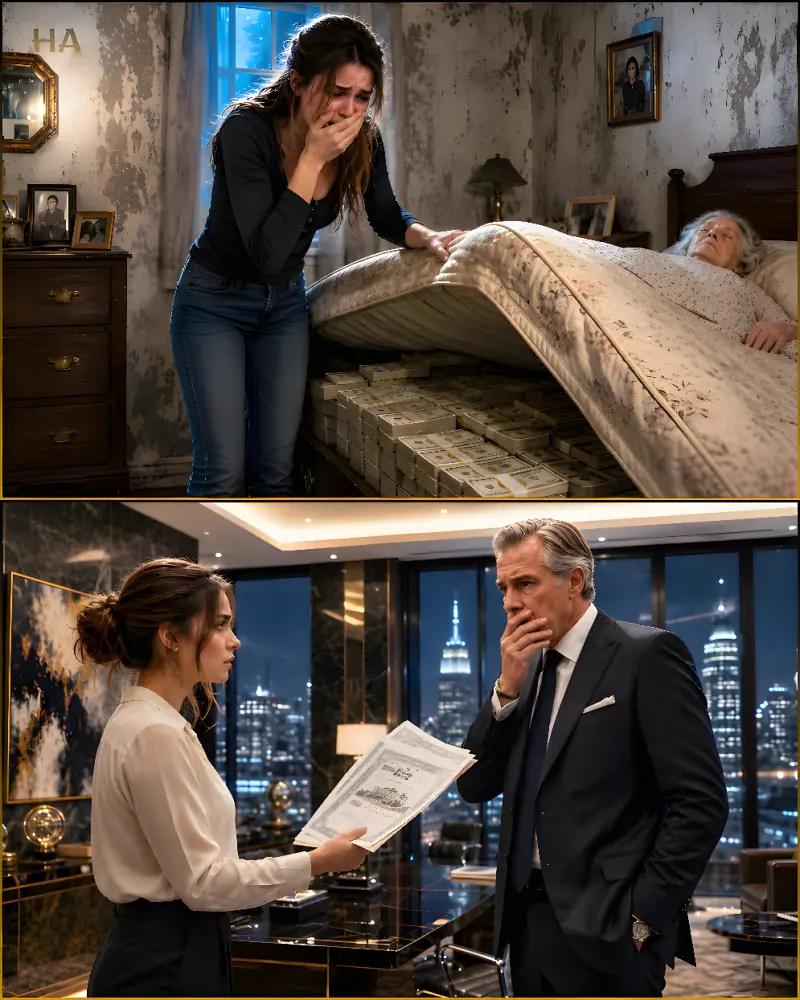
The night my mother died, I found nearly half a million dollars hidden beneath the mattress she had slept on for eighteen years.
It wasn’t in a safe. It wasn’t tucked into a bank envelope. It wasn’t locked away in some polished wooden drawer with a neat brass key. It was hidden beneath a hanging mattress in a two-room apartment above a laundromat in Cleveland, inside a faded floral fabric pouch that still carried a faint mix of menthol balm, laundry soap, and the rose-scented cream she used whenever winter made her hands rough.
My mother, Grace Brooks, owned only four coats in her life. Two had patches at the elbows. One had a zipper that worked only if you held your breath and pulled it at an angle. The last was the black wool coat they buried her in.
Her monthly pension from the old textile mill was eight hundred and twenty dollars. Our rent was seven hundred and forty. So when my fingers closed around the passbook and I opened it under the yellow kitchen light, the number at the bottom looked so impossible that for a moment I thought grief had damaged my eyesight.
Balance: $482,916.37.
I stared until the digits blurred.
Behind me, my father sat at the kitchen table with an unlit cigarette between his fingers, even though my mother had made him promise years ago that he would quit. He wasn’t smoking it. He was only holding it, letting the ash gather and crumble as if the cigarette were the only thing keeping his hand steady.
“Dad,” I said, my voice barely there. “What is this?”
Henry Brooks looked at the passbook. Then he looked at the bedroom door, as if my mother might still be inside and listening.
At last he said, “Your mother was saving it for you.”
“Saving it?” I gave a short, wrong laugh. “Dad, she bought the cheapest soup at Save-A-Lot and cut her own hair over the sink. She wore shoes until the soles split. How does someone save almost half a million dollars on an eight-hundred-dollar pension?”
He took a slow breath. His face looked older than it had that morning at the funeral.
“Some things had to wait until your mother was ready,” he said quietly.
“She’s dead.”
The word struck the kitchen wall and came back to us.
I hated myself for saying it that way, but I couldn’t take it back. The apartment was still crowded with casseroles, sympathy cards, and the small remains of ordinary life. Her slippers still sat beside the bed. Her coffee mug was still in the sink, rinsed but not put away, because some foolish part of me believed that if I left it there, she would complain in the morning that I hadn’t wiped it properly.
My father extinguished the cigarette without ever lighting it.
“Take the passbook to the bank tomorrow,” he said. “Ask for the statements. Then come home.”
“Why?”
“Because once you see them, you’ll ask a different question.”
I didn’t sleep. I sat on my mother’s bedroom floor with the passbook in my lap and listened to the laundromat dryers below thud like a second heartbeat. Everything in that room seemed to accuse me of not knowing her at all. A broken plastic comb on the dresser. A sewing box full of buttons. A Bible she never took to church but always kept beside her bed. A shoebox with my school essays, birthday cards, ticket stubs, and a dried corsage from my graduation dance.
- I had always thought my mother’s life was small because poverty made it small.
- That night, for the first time, I wondered if she had made it small on purpose.
The next morning I put on my only pair of slacks, a white shirt my mother had bought on sale, and a black cardigan with a loose thread at the sleeve. My eyes were swollen. My knees shook. Still, I walked into Lake Erie Federal Bank holding the passbook like evidence.
The clerk smiled politely until she saw the account number. Then her expression changed. She typed something into her computer, looked at the screen, then at me, and lowered her voice.
“Miss Brooks, would you like a printed history of transactions?”
“Yes,” I said. “All of it.”
It took nearly twenty minutes. When the printer finally stopped, she handed me a stack of pages thick enough to feel like a confession.
I sat near the lobby windows and began to read.
At first I saw only dates and amounts. Then the pattern rose off the page.
Every month. The same amount. The same sender.
$11,000.
For eighteen years.
The first deposit had been made on the day I was born. The sender’s name was printed in sharp black letters beside each transfer:
Marcus Whitmore.
I didn’t know the name, but my body reacted before my mind could catch up. The lobby seemed to tilt. The polished floor stretched too far. The air-conditioning touched the back of my neck, cold as hospital sheets.
I flipped faster.
Eleven thousand. Eleven thousand. Eleven thousand.
Two hundred and sixteen transfers.
Nearly 2.4 million dollars.
Yet the account held less than half a million.
My mother hadn’t simply saved money. She had hidden a river and left me a lake.
I drove home with the statements in the passenger seat. At every red light, I looked again at the name.
Marcus Whitmore.
When I reached the apartment, my hands were shaking so hard I could barely unlock the door. My father was still at the kitchen table, exactly where I had left him, except the cigarette was gone and an untouched cup of coffee sat in front of him.
I dropped the papers onto the table. They struck the wood with a flat, heavy sound.
“Who is Marcus Whitmore?”
My mother had left behind more than money. She had left behind a question, and I was beginning to understand that the answer would change everything. In that quiet apartment, surrounded by grief and paper, I realized the truth was larger than the secret itself.