“Dad, please. I don’t want to go back there today.”
Mattia was standing by the door, backpack on his shoulders, eyes lowered. He was only eight, but in that moment he seemed older than me. Or maybe it was just that I felt small.
My name is Andrea Conti. I work as a gardener in a retirement residence in a small town in Emilia. I trim hedges, tend flowerbeds, collect leaves, and fix whatever I can. I’m a single father, and that summer I hadn’t found a spot for Mattia at summer camp.
His grandparents lived too far away. My friends had their own problems. And I couldn’t afford a sports camp or a week at the seaside.
So Mattia came to work with me.
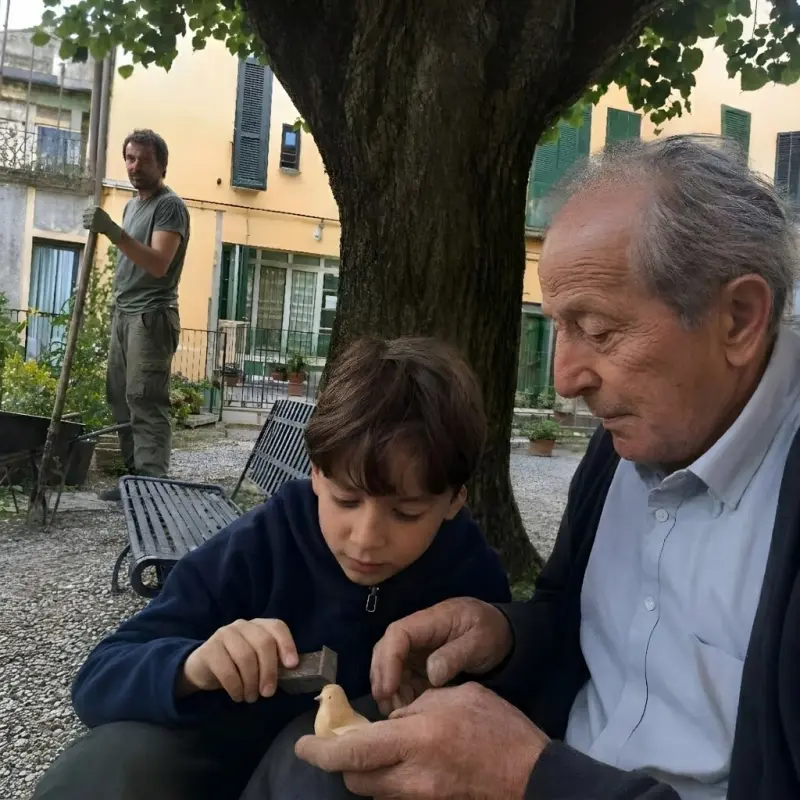
Every morning I packed him a sandwich, a water bottle, and an old notebook. He would sit on a bench in the inner courtyard of the residence, under a huge linden tree, while I worked a short distance away.
I watched him when I thought no one could see.
At first, he stayed there with his tablet in his hands until the battery died. Then he stared at his shoes, drew lines in the dirt with the tip of his sneaker, and sighed like he was carrying the weight of the whole world.
It hurt to see.
The other children talked about beaches, swimming pools, camping, and games with friends. My son, meanwhile, spent his vacation beside my rakes and bags of soil.
I kept repeating one ugly thought to myself: “I’m taking his childhood away.”
Then Mr. Rinaldi arrived.
He was eighty-four, lived on the ground floor of the residence, and had the face of someone who didn’t smile out of habit. He walked slowly, always wore a light shirt tucked into his trousers, and had large hands full of veins—hands like a man who had worked his whole life.
I often saw him looking out into the courtyard.
He hardly ever spoke to anyone.
That day I saw him walk over to Mattia. I immediately set down my shears.
I thought, Now he’ll tell him to leave.
Mr. Rinaldi stopped in front of my son and pointed at the tablet.
“Do you want to spend the whole summer staring at that thing?”
Mattia didn’t answer.
I hurried over.
“I’m sorry, Mr. Rinaldi. I couldn’t find anyone to keep him. I’ll try to keep him farther away, so he won’t bother you.”
He barely looked at me.
“He doesn’t bother me. He’s bored. That’s different.”
Then he sat down beside Mattia.
The next day he came back with a wooden box.
Inside were sandpaper, a pencil, a few pieces of linden wood, and a half-carved little bird.
“If you’re going to stay here, you might as well use your hands,” he told my son.
Mattia made a face.
“I don’t know how.”
The old man nodded.
“Exactly. You always begin there.”
He wasn’t gentle in the sentimental way. He wasn’t one of those elderly people who pat your head and call everything wonderful.
- “Slowly.”
- “Follow the grain.”
- “Don’t force it.”
- “If it comes out crooked, that doesn’t mean it’s ruined.”
As I passed by with the wheelbarrow, I saw them together under the linden tree. My son bending over a piece of wood. The old man beside him, serious, attentive, patient.
After a week, Mattia no longer complained in the morning.
In fact, he started asking, “Dad, do you think Mr. Rinaldi will be there today?”
The tablet stayed in the backpack.
At night, at home, Mattia would show me his hands dusty with wood powder as if they were medals. He told me that Mr. Rinaldi had been a carpenter when he was young. Tables, chairs, wardrobes, doors. Real things, he said. Things that last.
Sometimes the old man talked about his wife too.
Only a few words.
“She liked simple things.” Or, “She always said I made the most comfortable chairs in town.”
When he spoke about her, he would lower his eyes.
Mattia listened without interrupting.
Near the end of summer, my son began working on a small wooden robin. It wasn’t perfect. One leg was shorter than the other, the beak too round, the wings a little uneven.
But to Mattia, it was beautiful.
He wrapped it every night in a dish towel and placed it on his nightstand.
Then, one afternoon, a wing broke.
I found him sitting on the bench, the bird in his hands and tears in his eyes. My stomach tightened.
“Come on, sweetheart,” I said. “We’ll make another one.”
Mr. Rinaldi lifted a hand.
“No. Don’t throw it away.”
Mattia sniffled.
“But it’s broken.”
The old man held the little bird for a long time and said, “Broken doesn’t mean finished. It means you need more patience now.”
He took a thin piece of wood and showed Mattia how to repair the wing.
The repair showed.
But that scar made the bird different from all the others.
When school reopened, the teacher asked the children to talk about their vacations. Parents were invited to listen.
I sat in the back of the classroom.
One child talked about the sea in Puglia. Another spoke about the mountains. A girl showed photos from camping with her cousins.
Then it was Mattia’s turn.
He walked to the front of the class without posters or photographs. He only had a dish towel in his hands.
He opened it carefully and placed the robin on the teacher’s desk.
“I didn’t go away this summer,” he said. “I went to work with my dad.”
I stopped breathing.
Mattia touched the repaired wing.
“At first I thought it was a bad thing. Then I met Mr. Rinaldi. He taught me that when something breaks, you don’t have to be ashamed. You can fix it. Slowly.”
Then he looked toward me.
“Dad thought he had given me a terrible summer. But he actually brought me to the right place.”
I lowered my head and cried.
A few days later, I brought Mr. Rinaldi a photo of Mattia with his robin.
He looked at it in silence.
Then he only said, “He still needs to learn how to sand properly.”
But he put the photo on his cabinet, next to the picture of his wife.
And then I understood everything.
I thought I had not given my son enough.
In truth, I had given him an encounter.
And sometimes an encounter is worth more than a vacation.
Because some gifts can’t be bought. They’re found on a bench, beside two old hands, while a child learns that even broken things can fly again.
In the end, that summer wasn’t lost at all. It became the season that taught my son, and me, how to mend what matters most.