The night my family ended
I was seventeen when my parents decided my place in the family was no longer secure. It happened in our living room, beneath the chandelier my mother loved to show off. My father placed a suitcase by the door as if he were ending an argument, not abandoning his child. My mother stood near the clock, calm in the cold way people become when they have already decided how they want the story to sound.
“You have a few minutes,” my father said. “Take what you need.”
I waited for one of them to soften, to remember that I was still standing there. No one did. My mother turned the family portrait on the mantel away from us, as if even the picture should not witness what she was doing. Then I walked out with one suitcase, a little money, and a silence behind me that felt larger than the house itself.
Three nights later, an elderly woman named Elena found me on a park bench before sunrise. She did not ask me to prove my pain. She simply offered me breakfast.
“Come home for breakfast,” she said. “No one should be alone like that.”
That was the first kindness I had received in days, and it changed the direction of my life.
The life Elena helped me build
Elena gave me a room, then a job, and then something even more valuable: confidence. She taught me how to run a restaurant, how to read a contract, and how to stand tall in rooms where people expected me to disappear.
When my son was born, she held him with a tenderness that made the world feel safe again. She looked into his face and smiled.
“Bright eyes,” she whispered. “This child is going somewhere.”
She was right. He grew up surrounded by books, sketches, and questions. While other children played with toy tools, he wanted to know how the human heart worked, why fear changed a pulse, and how courage showed itself in a person’s body. He was thoughtful, disciplined, and determined in the quiet way that becomes greatness later.
- He studied late into the night.
- He asked careful questions no one else thought to ask.
- He became the kind of young man people remembered.
Years passed. I worked, studied, and built a life in the space my parents had left behind. Then one morning, the city paper published his photo: Dr. Sigard Harrison, youngest department chief in the state, cardiac surgery, Springfield Memorial.
My parents return for what they abandoned
By evening, my mother called for the first time in twenty years. Her voice was polished and distant, as if time had not touched her at all.
“Olivia,” she said, “we need to discuss our grandson.”
Not my son. Not the child they had never held. Their grandson.
Then came the emails, the gifts, and the carefully worded messages about family, legacy, and second chances. They did not ask who he had become. They asked when they could be seen with him.
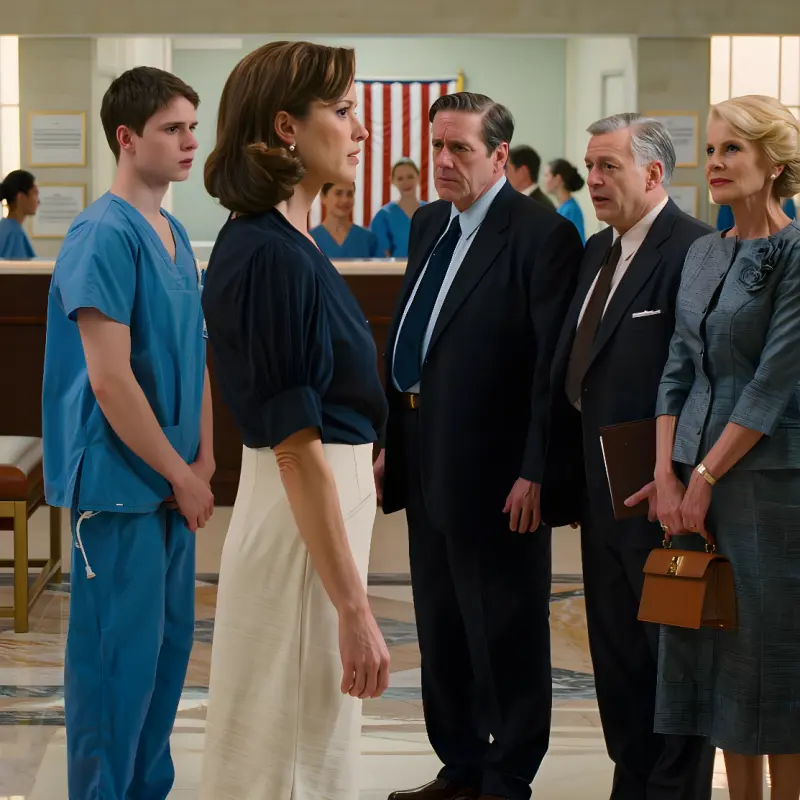
The first time they appeared in person, they chose the hospital lobby. Springfield Memorial was all marble floors, bright windows, and polished railings, the perfect place for a performance. My mother wore pearls. My father stood beside her in a dark suit, speaking loudly enough for everyone nearby to hear.
“We are here to see our grandson,” he announced. “Dr. Harrison.”
My mother touched her chest with practiced sorrow. “He deserves to know his real family.”
That was when I walked in.
For a brief moment, my mother looked pleased, as if my presence completed the scene. My father lifted his chin.
“He carries our family line,” he said. “We expect to be welcomed.”
I looked at both of them, the same people who had once told me to take what fit into a suitcase and leave the rest behind.
“You should recognize what your own choices already decided,” I said.
Before they could answer, the corridor doors opened behind me. My son stepped into the lobby in surgical scrubs, tired from a long shift, calm and composed. He looked at me first. Then at them.
Lance, who had come with me, reached into his folder. Inside was the quiet proof my parents had never expected anyone to keep.
The lobby fell silent. For the first time in twenty years, my parents were face-to-face with the truth they had tried to erase—and the family they had once chosen to lose.
In the end, time did not protect them from the consequences of their choices. It simply brought the truth into better light.