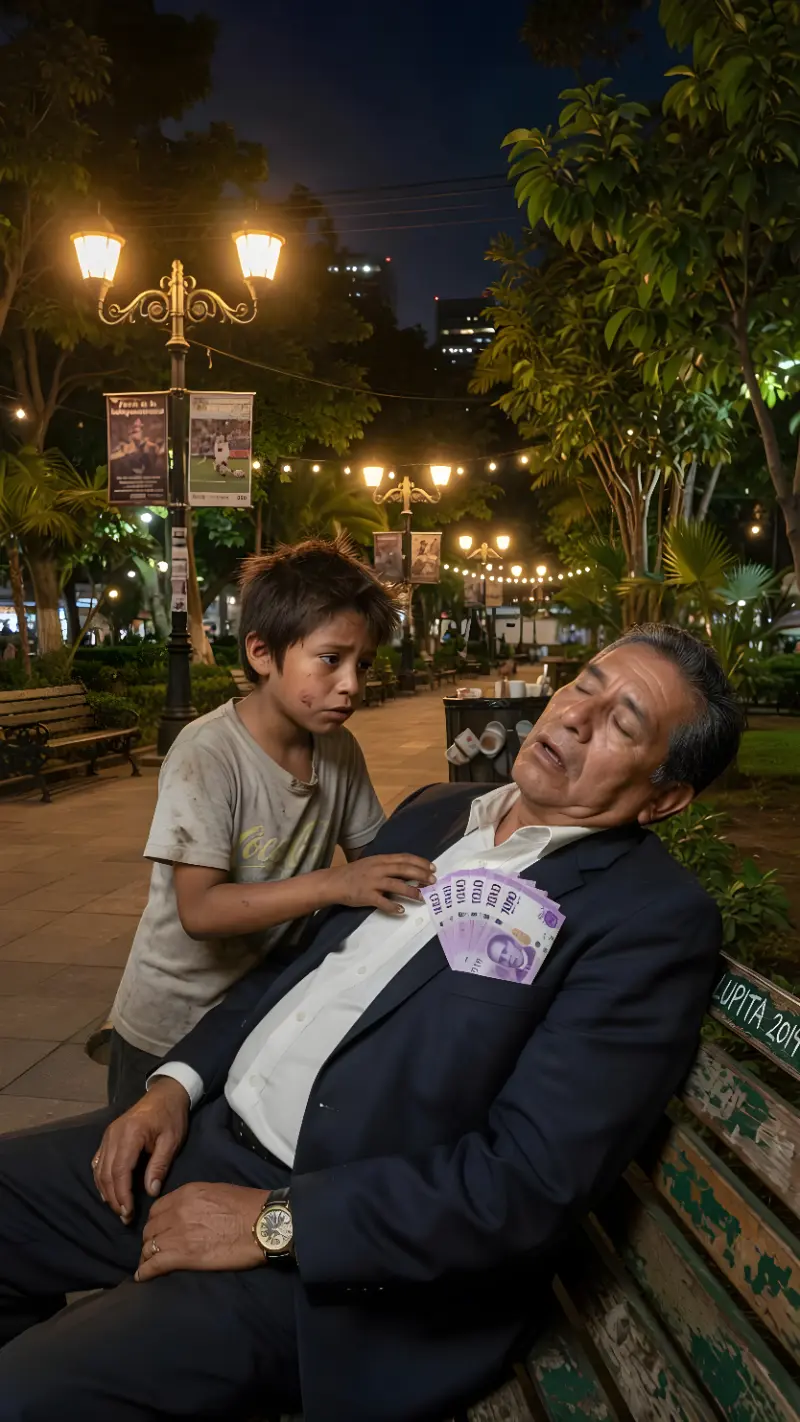
A night that exposed a hardened heart
Roberto was one of the most powerful men in Jalisco, the owner of a tequilera empire built over decades of ambition, sacrifice, and relentless control. By the age of 58, he had earned wealth, influence, and respect in the business world, but those achievements had come at a cost: his trust in others had all but disappeared, and his heart had grown colder than the night air over his own agave fields.
That evening, his anger was already boiling. He had just argued with his only son, Mauricio, a spoiled 28-year-old who seemed to contact him only when he wanted money. Worse still, Roberto had discovered that Mauricio had tried to forge his signature in an attempt to steal millions of pesos to cover a gambling debt. When confronted, the young man had lashed out cruelly, saying he wished his father would die soon so he could inherit everything and stop pretending to tolerate him.
“Everyone in this world just wants my money,” Roberto muttered bitterly, as though the entire city were filled with people waiting to take advantage of him.
He sat alone on a cold iron bench in the upscale Andares district of Zapopan, waiting for his driver and bodyguards to pick him up. The November wind cut through the night, a reminder that even a glamorous city can feel merciless to anyone without protection, shelter, or hope.
The child he refused to see
Then a small figure appeared in front of the bench. It was a boy, no older than seven, barefoot and trembling. His thin shirt looked worn out and too small for the weather, and his face carried the exhaustion of someone far too young to have seen so much hardship.
With a shaky voice, the boy asked if the man could spare a little money for food. He explained that he had not eaten in two days and only wanted enough for something simple to keep hunger away.
Roberto looked at him with open disdain. In his mind, children like this were often part of a larger scheme, trained to beg, distract, or steal. Instead of compassion, he answered with anger and suspicion, accusing the boy of being a thief and ordering him to leave.
- He spoke as if the child were a criminal.
- He assumed the worst without asking a single real question.
- He turned a plea for help into a public humiliation.
The boy stepped back in fear, his eyes filling with tears. He lowered his head and walked away slowly, dragging his tired feet across the damp pavement.
A cruel test in the dark
As Roberto watched the child sit alone under a distant streetlamp, hugging his knees for warmth, a twisted idea formed in his mind. He wanted proof that he was right. He wanted to expose the boy as a liar or thief and feel justified in his harshness.
So he took a thick stack of cash from his coat pocket and left a portion of it visible near the edge of his jacket. Then he leaned back on the bench, closed his eyes, and pretended to be asleep.
In his mind, the trap was simple: if the boy reached for the money, Roberto would catch him, shame him, record everything, and hand him over to the police. He believed he was preparing justice. What he was really preparing was a lesson he would never forget.
Sometimes the moment we set a trap for others becomes the moment our own character is revealed.
Fifteen tense minutes passed in the silence of the park. Then came the soft sound of footsteps approaching, careful and hesitant, growing closer and closer until they stopped right in front of him.
Roberto held his breath, waiting for the boy’s hand to reach for the money. But what happened next was not what he expected. In the darkness, the child was about to do something that would shake the millionaire’s confidence and leave him overwhelmed with shame.
To be continued in Part 2.
Summary: A proud millionaire tries to trap a hungry street child, but the boy’s unexpected actions in the dark begin to reveal the true meaning of dignity, mercy, and regret.