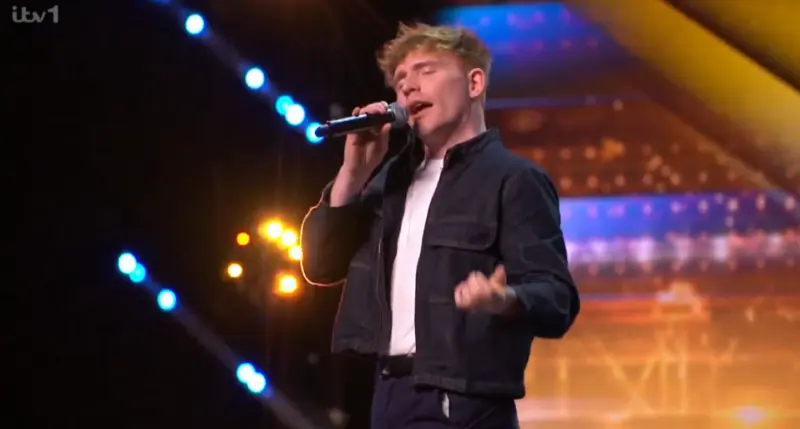
The performance that instantly lit up social media
When Mickey Callisto walked onto the Britain’s Got Talent 2025 stage, the audience had little idea what was about to unfold. He appeared in bold, eye-catching colors and carried himself like a performer who already knew the room. Then the singing began, and everything changed at once.
His vocals, stage presence, and polished delivery quickly pushed the moment into viral status. Almost immediately, viewers and judges were reminded of Freddie Mercury. That comparison felt natural, thanks to the theatrical energy, the showmanship, and the confidence he projected under the lights.
Simon Cowell responded with unusual excitement. He leaned forward and called Mickey a “really, really good Freddie Mercury tribute act.” The crowd approved loudly, but the praise came with a certain limitation. Mickey was being applauded, yet he was also being placed inside a well-known mold.
He was celebrated for capturing the feel of a legend, even while people questioned who he might be beyond that comparison.
Key Insight: The audition stood out not just because it evoked Queen’s frontman, but because it raised a larger issue about identity on a talent show.
As the competition progressed, that issue became increasingly difficult to overlook. By the semi-finals, Mickey wanted to introduce one of his own original songs. He said the track would better reveal his character and move him away from the Freddie Mercury image.
Instead, the production team took another direction. He was asked to sing Queen’s “Somebody to Love,” a choice that pleased some viewers and irritated others. Many people online argued that the show was turning him into “the Freddie guy” instead of letting Mickey Callisto define himself more freely.
- His original song was meant to highlight his individual style.
- The show steered him back toward a Queen classic.
- Online debate focused on whether he was being boxed into one identity.
Even with his strong voice and refined delivery, Mickey did not make it to the final. The result surprised many viewers, several of whom felt he had earned a place in the last stage. In the end, magician Harry Moulding won the season, while Mickey’s run finished just before the final round.
Yet the story did not end with the competition. In fact, his performances gained fresh life online. Clips spread quickly and drew millions of views, turning him into a fan favorite for people who saw more than imitation. To those supporters, he represented the daring, dramatic energy that has always made rock performance so compelling.
What stands out most is the tension in his journey. Mickey Callisto was never merely trying to duplicate a legend. He was trying to stand near that legend without vanishing into the shadow. That contrast is a major reason the audition stayed memorable.
In the end, the moment became bigger than a simple Freddie Mercury comparison. It showed how a confident artist can make a lasting impression, even when the spotlight keeps trying to cast him in someone else’s role. Mickey’s audition proved that presence, originality, and passion can still catch fire and stay with an audience long after the music stops.