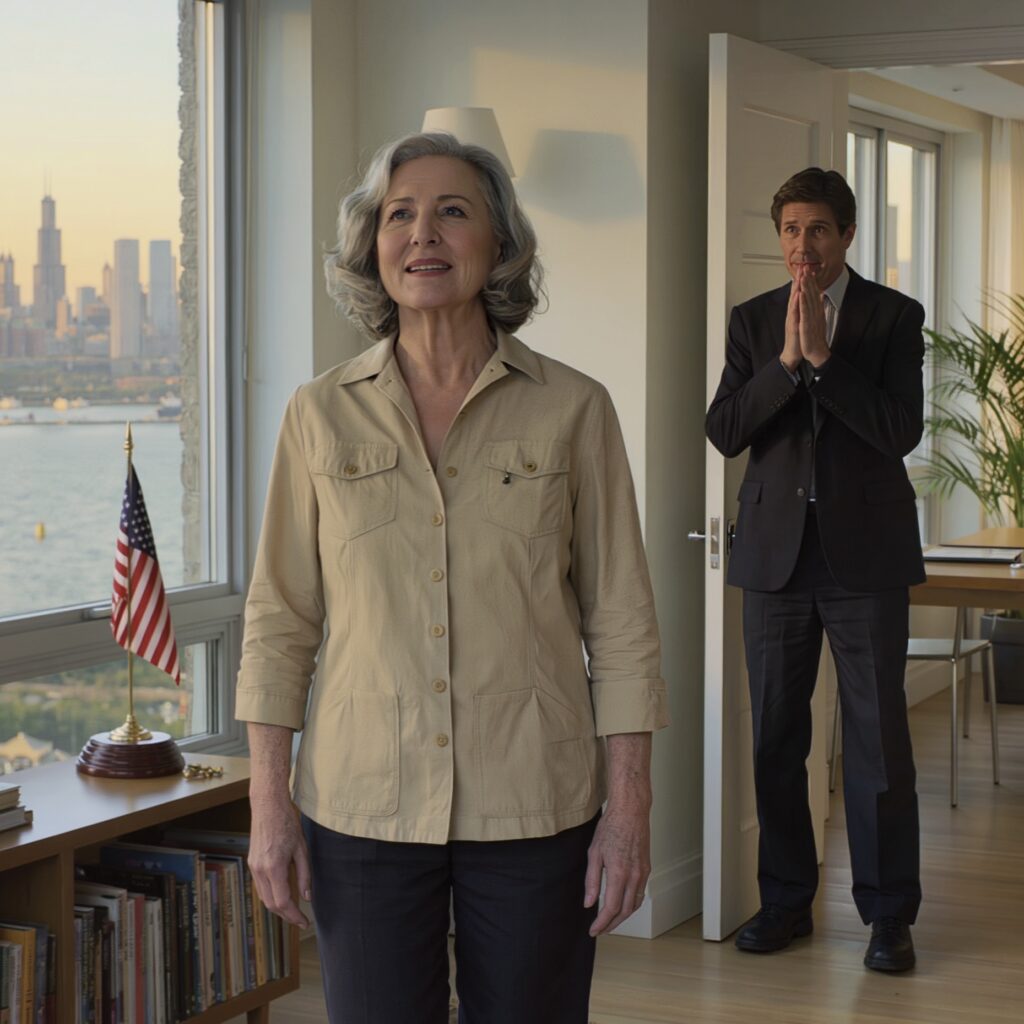
A receptionist presented me with a clipboard holding numerous forms. Her forced smile lacked warmth.
“Please fill these out thoroughly. Ensure you mark any high-risk behaviors or health issues. When finished, take a seat until your name is called.”
As I walked to a secluded area of the donation center’s waiting room, I felt a jolt of shame. The blue vinyl chair squeaked as I perched on it, staring blankly at the forms.
Harper Bennett, 53 years old.
Address: I paused before writing my sister Clare’s address. Just six months earlier, I would have proudly listed my penthouse on Lakeshore Drive. Six months, which felt like a different lifetime.
Students around me focused on their phones. An elderly gentleman napped in the corner, while a young woman in scrubs, seemingly finishing a night shift, diligently completed her paperwork. Each of us present to exchange a piece of ourselves for cash.
They appeared accustomed to this routine. I felt like a fraud in my pressed blouse—the last vestige of my previous life, saved for job interviews that never happened.
Only for the plasma, I reminded myself, repeatedly clicking my pen. Just $40 to cover Mia’s medication.
My daughter’s asthma had worsened following the loss of our health insurance. Her inhaler was $60, while I had a measly $22.47 left in my checking account. I spent the morning searching for the cheapest options at pharmacies, but there was no avoiding the fact—Mia needed her medication, and I was out of alternatives.
I filled out the medical questionnaire with unnerving honesty. No recent tattoos. No travel to malaria-afflicted regions in the past six months, a first for me in decades. I used to jet around coordinating global events.
History of drug use? No.
Had I been in prison recently?
“No,” I answered, reflecting that perhaps I should’ve claimed a “yes” just to receive more attention.
“Have you fainted during any medical procedures?”
I checked “no,” but briefly pondered having marked “yes” to receive a gentler approach. I’d only eaten a peanut butter sandwich yesterday while Clare was at work, a frighteningly low point in a string of disheartening experiences.
“Harper Bennett?”
A young woman in colorful scrubs appeared at the threshold. I grabbed my purse and followed her into a small screening room equipped with a blood pressure cuff and scale.
“First-time donor?” she inquired, inviting me to sit.
“Is it that evident?” I tried to smile.
“We remember our regulars,” she sweetly said, as she wrapped the cuff around my arm. “I’m Andrea. I’ll assist with your intake and initial screening.”
Andrea, likely in her late twenties, treated me warmly while she evaluated my vitals. When she checked my veins, a whistle escaped her lips in appreciation.
“You have fantastic veins for donation,” she commented. “This will be seamless. Some people we have to poke around for, but yours are practically waving at me.”
“At least some parts of me still function,” I murmured before catching myself.
Andrea gave me a curious glance but didn’t delve into the matter. Instead, she proceeded to take a preliminary blood sample, cleaning the crook of my arm with an alcohol swab.
“Small pinch,” she notified me before inserting the needle.
I barely noticed the prick.
“Perfect veins. You were destined for this.”
The dark red liquid swiftly filled the small vial. After labeling it, Andrea prepared a second tube.
“Just need to check a few levels before proceeding with the donation.”
As she worked, I scrutinized the donation center with more care. The walls were adorned with posters promoting life-saving, community service, and the scientific merits of plasma donations. No mention of the $40 that motivated me and likely many others to be here today.
“All set with this stage,” Andrea announced, placing a cotton ball over the tiny puncture and bending my arm. “I’ll run these quick tests; if everything checks out, we’ll get you prepared for the full donation. It should only take a few minutes.”
I nodded, patiently waiting as she left with my blood samples. I could hear the soft hum of machines and occasional beeps from the donation room next door.
This reality—selling my plasma for my daughter’s medication—struck me again.
How had Elegance by Harper, my premier event planning firm in Chicago for twenty years, crumbled so entirely?
How had Gavin, my husband for twenty-five years, abandoned me so readily?
“You’ve ruined our lives,” he’d yelled while gathering his belongings, leaving me numb on our bed, as if the spoiled seafood that had sickened half the attendees at the Lakeside Bank anniversary gala had somehow been my doing, rather than a catastrophic equipment malfunction.
My bitter thoughts were interrupted when the door swung open again.
Andrea returned, her demeanor dramatically shifted. She looked pale, her eyes wide, gripping my blood sample tube as though it were a ticking bomb.
“Mrs. Bennett,” she began, her tone noticeably altered. “I need to… There’s a—”
She hesitated, collected herself.
“Would you be able to wait just a few more minutes? Dr. Stewart needs to confirm something regarding your sample.”
“Is something wrong?” My heart raced. “Am I ill?”
“No, it’s not that.”
Her reassurance felt authentic.
“It’s just… Please wait. Dr. Stewart will clarify everything.”
Before I could inquire further, she hurried out again, clutching my blood sample.
Five minutes rolled into ten, then fifteen. I considered whether I should gather my things and leave. Clearly, something unusual was occurring.
When the door opened again, a man in his late forties clad in a white coat entered, followed closely by Andrea. His face reflected excitement barely contained.
“Mrs. Bennett, I’m Dr. James Stewart, medical director here.”
He extended his hand, which I shook automatically.
“I apologize for the wait, but we needed to affirm something quite remarkable about your blood.”
“Remarkable?” I echoed.
“Yes.”
He took a seat on the rolling stool across from me, leaning in with intent.
“Mrs. Bennett, you possess what is known as Rh-null blood. This blood type is often dubbed ‘golden blood’ as it is the rarest on Earth. Only about forty-two known individuals globally have this blood type.”
I stared at him, convinced I must have misheard.
“Excuse me. What?”
“Your blood lacks all Rhesus antigens. It’s universally compatible with any rare blood type.” His tone reverberated with awe. “Finding a new Rh-null donor is akin to discovering a unicorn.”
As I struggled to fathom this news, my phone beeped. Dr. Stewart checked his pager, eyes replicating the surprise on his face.
“Mrs. Bennett, please excuse me for just a moment. This is quite urgent. I’ll return shortly to explain everything in greater detail.”
He dashed out, leaving me alone with Andrea, who still viewed me as if I had sprouted wings.
“What does this imply?” I asked. “I just needed $40.”
Andrea’s smile conveyed a potent mix of awe and pity.
“I believe, Mrs. Bennett, your day is about to change in unimaginable ways.”
Twenty minutes later, Dr. Stewart came back with a tall man in a flawlessly tailored charcoal suit, his presence authoritative, stark against the clinic’s plain furnishings.
“Mrs. Bennett, this is Tim Blackwood,” Dr. Stewart introduced, his voice pitched slightly higher than before. “He’s representing the Richter family and wishes to confer with you.”
The impeccably dressed man approached and extended a manicured hand.
“Mrs. Bennett, it’s an honor. I apologize for this unconventional introduction, but time is critical.”
I shook his hand mechanically, feeling increasingly disoriented.
“I don’t comprehend what’s unfolding.”
Dr. Stewart gestured for us to sit together.
<p“Our system automatically logs rare blood types into an international database. Once we verified your Rh-null status, an alert was triggered. Mr. Blackwood had already been in Chicago on additional business.”
<p“Fortuitous timing,” Tim Blackwood commented smoothly. “Mrs. Bennett, are you familiar with Alexander Richter?”
The name sparked a distant memory.
<p“The Swiss banker. I recall he sponsored the International Finance Summit in Geneva a few years back. My company bid for the event but lost to a local agency.”
<p“Exactly.” Blackwood nodded, seemingly impressed. “Mr. Richter is currently facing a critical medical issue. He requires heart surgery that can only be performed with transfusions from an Rh-null donor. His medical team has been searching for a compatible donor for weeks.”
Dr. Stewart added, “Your blood type is the only match they’ve found in the Western Hemisphere.”
I looked between them, reeling from their implication.
You want my blood for this billionaire’s surgery?”
“We’re prepared to offer you substantial compensation for your assistance,” Blackwood stated, opening a sleek leather portfolio. “The Richter family is providing three million dollars for your immediate cooperation. A private jet is prepared at the executive airport to fly you to Switzerland today.”
The room seemed to shift around me. Three million.
“The procedure will involve multiple donations over approximately two weeks,” Dr. Stewart clarified. “It’s intensive, but not dangerous with proper medical oversight, which you would receive at Switzerland’s premier private clinic.”
Three million.
The figure hung in the air, almost ludicrous in its enormity. Just hours earlier, I had been desperate for $40 to buy my daughter medication. My business debts alone had surpassed two million. Everything I’d created over two decades was wiped out in a single disastrous event. And now this stranger was ready to wipe it all away because of a characteristic in my veins I hadn’t known existed until just that moment.
“This is a prank, right?” I whispered.
“I assure you, Mrs. Bennett, this is entirely serious,” Blackwood stated. “Perhaps this will convince you.”
He proffered his phone, tapping a few times before handing it to me. The display showed a bank transfer authorization for $250,000.
A deposit,” he explained.
My hands shook as I returned the phone.
“I need to call my daughter.”
Andrea immediately led me to a private office where I dialed Mia. She answered on the second ring.
“Mom, is everything alright? Did you obtain the funds for—”
“Mia.” I interrupted, my voice trembling. “Incredible news just unfolded.”
I relayed the situation as best I could. A long silence ensued after my explanation.
“Mom, this sounds insane,” she finally replied. “Like organ trafficking or something.”
“I verified Dr. Stewart’s credentials,” I insisted, having made sure to see his medical license prior to calling. “And the RTOR Banking Group is legitimate. I catered an event for one of their partner firms years ago.”
“So, you’re heading to Switzerland today?”
“If I commit to this, we can settle all the debts. You can return to school. We can start fresh.”
Another pause.
“What’s the alternative?”
“Not going through with it.”
I considered the outcome carefully. If I backed out, I’d still be homeless, jobless, and frantic for $40. Mia would remain working retail instead of completing her architecture degree.
“I’m not sure there is another option, sweetheart.”
“Then go,” Mia urged adamantly. “But promise to keep in touch constantly and ensure everything is documented before you agree.”
After the call, I took time to scrutinize the contract Blackwood had drafted. Years of negotiating catering agreements had taught me to examine fine print meticulously. The agreement was exhaustive: the payment amount, medical protocols, accommodation arrangements at a private clinic, transportation.
I demanded several alterations—a precise donation schedule, limits on volume per session, and a clear right to halt the entire procedure if my health faltered. Blackwood appeared taken aback by my thoroughness but conceded to my requests.
“You’re more astute than I expected, Mrs. Bennett.”
“Until recently, I operated a multi-million-dollar corporation,” I affirmed evenly. “This might be atypical business, but it remains business.”
Three hours later, I found myself boarding a private Gulfstream jet, carrying only my purse and a small overnight bag hastily packed from Clare’s guest room. Andrea embraced me farewell, slipping me her personal number and extracting a promise of safety.
As the plane taxied for liftoff, I gazed out the window at Chicago’s skyline diminishing. Somewhere in that arrangement of buildings lay the luxurious apartment I’d lost, the office where I’d constructed my business, and the life I’d once thought defined me.
“Mrs. Bennett, would you like something to drink?”
A flight attendant appeared alongside me. “We’ve organized a full meal service for the flight to Zurich.”
“Just water for now, thanks.”
My stomach twisted too tightly to even contemplate food. Tim Blackwood, seated across the aisle, immersed himself in work on his laptop, occasionally making calls in fluent German and French. From what I could glean, Alexander Richter’s condition had stabilized enough for surgery, but time remained a critical factor.
As the plane achieved cruising altitude, I retrieved my compact mirror and scrutinized my reflection. I appeared as the same Harper Bennett—the silver strands in my dark hair that I’d finally stopped dyeing the previous year, the fine lines framing my eyes that Gavin had suggested I should “tweak,” and the stubborn set of my jaw inherited from my father.
Nothing about me signaled that I carried something so unique and precious within.
“Mrs. Bennett,” Blackwood interrupted my reverie. “Dr. Klaus Weber, Mr. Richter’s personal physician, wishes to speak with you via video conference to outline the medical procedure in detail.”
As I joined him, a peculiar calm washed over me. Just twenty-four hours earlier, I was deemed worthless, abandoned by my husband, a failed entrepreneur, a burden on my sister. Now I was speeding across the Atlantic because my blood might save one of the wealthiest men in Europe.
“Mr. Richter’s surgery will occur at Clinique Desalp,” Dr. Weber explained, displaying remarkable precision. “There will be multiple transfusions required, and your blood type is essential for ensuring his successful recovery.”
That clinic overlooked Lake Geneva, resembling a resort more than a medical facility. Its large windows offered breathtaking views of mountain scenery reflected in placid waters. My suite—and it was genuinely a suite, not a hospital space—boasted a lounge, a marble restroom larger than Clare’s entire guest room, and a private terrace, priced at thousands per night in my previous life.
I was scarcely settled when a gentle knock announced my medical team.
Dr. Klaus Weber was a dignified man in his sixties, silver-haired and bespectacled, exuding an academic aura. He introduced two nurses displaying the quiet efficacy characteristic of Swiss medicine.
“Mrs. Bennett, welcome to Clinique Desalp,” Dr. Weber said, his English clear with only the faintest hint of a German accent. “I trust your journey has been comfortable.”
“Very much so,” I replied, still adjusting to this outrageous shift from being a desperate plasma donor to a VIP guest. “Though I’m eager to comprehend what precisely I’ve signed up for.”
Dr. Weber nodded affirmatively.
“Of course. Transparency is paramount.”
He motioned toward the sitting area where the nurses prepared equipment for a preliminary assessment. Over the following hour, he meticulously outlined the surgery’s particulars.
Alexander Richter faced a rare congenital heart defect that had recently worsened, necessitating urgent surgery. The complexity of the operation required numerous blood transfusions. However, the genuine obstacle lay in the hypersensitivity of his immune system.
“Any blood besides Rh-null would incite a catastrophic reaction.”
“Your blood literally holds the key to Mr. Richter’s survival,” Dr. Weber concluded. “We will need several donations before surgery and potentially more during his recovery phase.”
As he spoke, the nurses monitored my vitals and drew blood samples, executing comprehensive health evaluations. I yielded to their tests, observing with detached curiosity as they managed my samples with remarkable care, labeling them according to unfamiliar color-coding systems.
“When will the first donation occur?” I queried.
“Tomorrow morning, conditional upon your tests confirming suitability,” Dr. Weber replied. “We’ve devised a nutrition and hydration protocol to optimize your recovery between donations.”
He handed me a leather folder.
The extensive timetable, dietary regulations, and supplementation regimen are thoroughly explained here.
After they exited, I stood on the terrace, watching dusk settle over Lake Geneva. The air was crisp and invigorating, imbued with a delicate scent of pine from adjacent woods. I attempted to call Mia, but the line went straight to voicemail as she would be at work. Instead, I sent her photos of the clinic and an exhaustive medical update.
My phone buzzed as I was wrapping up.
To my surprise, it was Gavin, my first communication from him in months that didn’t involve lawyers.
_Harper. I heard whispers you’re in Switzerland for some medical procedure. Are you unwell? Should I be worried?_
The text emitted the acuteness of Gavin’s projected concern, veiled in self-interest. I wondered whether news about my rare blood condition had found its way to the press, or if he had somehow tracked my unexpected international travel.
I typed and erased multiple responses before finally landing on:
_Not ill. Handling business. No cause for concern._
His next reply arrived almost instantaneously.
_We should discuss this when you return. I’ve been reflecting on our situation._
I laughed, the sound reverberating throughout the vacant suite.
“I bet you have,” I muttered, leaving his text unread.
The man who accused me of ruining our lives. Who drained our joint accounts before I even realized what had occurred. The man who moved in with his thirty-two-year-old marketing coordinator while I was still reeling from the demise of my business. That same man suddenly wanted to confer now that I might be on the verge of acquiring millions.
A knock at the door interrupted my bitter musings.
When I opened it, Tim Blackwood held a garment bag.
“Mrs. Bennett, I hope I’m not interrupting,” he said. “Mr. Richter has requested your presence for dinner, should you be willing.”
“Mr. Richter is here?” I inquired, taken aback. I had assumed he would be in intensive care.
“He’s in the private wing,” Blackwood explained. “Defying medical advice, he insists on meeting the woman whose blood will save his life. Dinner will be brief and carefully monitored by Dr. Weber.”
He handed me the garment bag.
“We thought it wise to provide suitable attire, as we recognized your travel arrangements were made on short notice.”
Inside was a stunning black dress that had a suspicious resemblance to my size, accompanied by shoes and a minimalistic pearl necklace. Previously, I might have found the assumption offensive; now, practicality outweighed pride. I hadn’t prepared anything for an elegant dinner with a billionaire.
After ninety minutes, I found myself ushered into a private dining room where Alexander Richter awaited.
My first impression was of a man whose frail physique sharply contrasted with an air of authority. Tall and thin, with deeply set eyes assessing me with something akin to fascination, he rose slowly as I entered, leaning slightly against an ornate walking stick.
“Mrs. Bennett,” he greeted me, his voice surprisingly robust. “Please, take a seat.”
Gesturing to the chair across from him at a table set for two, I responded, “Mr. Richter, I must say my day has unfolded quite differently from my expectations this morning.”
A hint of a smile graced his lips.
“Nor did I foresee meeting the woman whose veins harbor the key to my survival.”
He poured water from a crystal carafe.
“What circumstances brought you to that donation center in Chicago?”
The direct nature of his inquiry startled me.
<p“My daughter needed $40 for her asthma medication.”
He arched an eyebrow.
“Forty dollars? Doesn’t seem an adequate amount to drive someone of your evident caliber to sell their plasma.”
The remark stirred me, albeit accurately encapsulated.
“Six months ago, I operated a thriving event planning firm, lived in a high-rise on Lakeshore Drive, and believed I had a solid marriage,” I recounted. “Life’s twists can be swift, Mr. Richter.”
“Indeed,” he concurred, studying me with growing curiosity as the staff quietly placed our first course on the table. “What led to your misfortune?”
Fueled by a mix of exhaustion and surreality, I divulged the entire truth: the catastrophic equipment failure that poisoned half the guests at the Lakeside Bank gala, the resulting lawsuits, the supplier’s bankruptcy that left me culpable, and finally Gavin’s abandonment when our resources dwindled.
“So, this morning I was in desperate need of $40 that I didn’t possess,” I summed up, emerging from my recounting to discover I had scarcely touched my meal. “Now I dine with a man poised to pay millions for my blood. Life is positively unpredictable.”
Richter listened without interruption, his expression inscrutable. Once I finished, he paused before responding.
“What intrigues me most about your narrative, Mrs. Bennett, is that while you’ve lost everything external—business, home, spouse—you preserve something of incredible worth that no one can extract.”
He gestured toward my arm, where my mark from the morning’s blood test remained faintly visible.
“A profound metaphor exists there, wouldn’t you agree?”
Our eyes locked, and in that moment, I felt understood in a manner I hadn’t experienced in years, perhaps not even throughout my marriage. This stranger, this billionaire battling for his life, had stripped my situation down to its essence in a way that both disarmed and disturbed me.
“I suppose there is,” I replied softly, though I would trade metaphorical significance for my daughter’s tuition at a moment’s notice.
His laughter warmed the room, genuine and yet surprising to him, a pained expression quickly following it. The nurse promptly stepped forward, but he gestured her away.
“I sense we will get along well, Mrs. Bennett,” he remarked, re-establishing himself. “I suspect our relationship may benefit us in ways neither of us yet acknowledges.”
The first donation occurred the following day in a beautifully appointed room resembling a spa rather than a medical setting. I reclined in a heated leather chair while Dr. Weber’s team prepared equipment with choreographed precision.
“We will collect one unit today,” Dr. Weber clarified, ensuring the catheter in my arm was properly inserted. “Your comfort and safety are our priority, Mrs. Bennett. If any discomfort arises, please inform us immediately.”
I nodded, watching as my dark blood coursed through the tubing into a specialized collection bag. The liquid crimson flowing into a bag that had previously held no significance was now treated like liquid gold.
“What makes my blood so exceptional?” I inquired, genuinely curious. “I grasp that it’s rare, but how is it distinct?”
Dr. Weber adjusted his glasses, evidently pleased by my inquiry.
“Most individuals possess Rhesus antigens—protein markers—on their red blood cells. Yours have none. No Rhesus antigens—sixty-one possible types—ensuring compatibility in emergencies. This omission is particularly crucial in Mr. Richter’s case, as your blood will not elicit an immune response typically triggered by standard transfusions.”
“And there’s no match in his family?”
“Blood types aren’t merely inherited like eye color,” he explained. “Rh-null arises from a specific genetic mutation. The likelihood of locating it within his family is practically nonexistent.”
The donation process took less than fifteen minutes, but Dr. Weber insisted I remain for two hours afterward for observation. A chef delivered a gourmet meal rich in iron and protein, accompanied by fresh-pressed juice and mineral supplements. The level of care astonished me, starkly contrasting my expectations from the donation center in Chicago.
Returning to my suite, I discovered a gift box resting on the coffee table, containing a handwritten note from Alexander Richter.
_A token of appreciation for today’s donation. The first of many, I hope. —A.R._
Inside lay a delicate platinum bracelet adorned with a single ruby charm—simple yet elegant, undoubtedly affluent. Uncertain about the propriety of accepting such a gift, I set it aside and contacted Mia.
“Mom.” She answered promptly. “I was about to call you. Are you alright? Did they draw your blood yet?”
“Just completed,” I reassured her. “The process was straightforward—far more comfortable than I imagined the donation center would be.”
I detailed the clinic and the meticulous care I received.
“That’s good,” she acknowledged, yet I sensed hesitation in her tone.
“What troubles you, sweetheart?”
“Dad showed up at Aunt Clare’s, looking for you.” Her tone shifted to one of steel. “When Clare told him you’re in Switzerland, he bombarded her with questions about why and who you’re with. He seemed… I don’t know… calculating.”
Feeling unsurprised, I sighed.
“He texted me yesterday. Did he mention wanting to talk when I return?”
“Yes. He informed Clare he’d been reflecting and realized he acted hastily. Can you believe it?”
“Unfortunately, I can.”
Moving to the balcony, I gazed out at the lake.
“Has my blood condition made the news?”
“Nothing specific, but there was a small article discussing the Richter Banking Group preparing for a major medical procedure involving their CEO. It noted flying in a critical medical resource from America. Perhaps he connected the dots.”
Gavin had always been astute regarding financial matters. If he sensed even a whiff of my potential windfall, I feared he would resurface eagerly.
“Mom,” Mia continued solemnly, “you wouldn’t contemplate reconciling with him, would you?”
“Absolutely not,” I affirmed decisively. “Twenty-five years of marriage concluded the moment he departed. No amount of cash alters that.”
Following our conversation, I spent the afternoon resting as dictated, aimlessly flipping through Swiss magazines that blurred before my eyes. My mind repeatedly returned to Alexander Richter’s observation—how I’d lost everything external yet still carried something of extraordinary value within me.
Though I recognized the metaphor, I couldn’t help but wonder: Had my value become synonymous solely with this biological quirk? Had I reverted to being a resource again, this time for my rare blood instead of my event-planning acumen?
A knock interrupted my ruminations.
Andrea Rodriguez, the nurse from Chicago, appeared at my door, her presence unexpectedly comforting amid this foreign environment.
<p“Andrea, what brings you here?” I exclaimed.
“Dr. Stewart arranged for me to join the medical team. Since I was the first to identify your Rh-null status, they believed I could be of assistance during the donation process.”
Her appraisal of the suite was unmistakable.
<p“Quite a step up from our clinic, isn’t it?”
We settled in, and Andrea’s familiarity quelled some of the isolation I felt. She shared her experience specializing in rare blood disorders during her training, before financial necessity redirected her toward the more secure income of the donation center.
<p“How are you managing?” she asked, genuinely concerned. “It’s quite a lot to process in just twenty-four hours.”
<p“It feels surreal,” I admitted. “Yesterday, I sought $40, and today a billionaire has gifted me a ruby bracelet for a unit of blood.”
<pAndrea’s eyes widened.
“He gifted you jewelry?”
I revealed the bracelet, still nestled in its box.
“Is that inappropriate? I haven’t decided whether to accept it.”
“It’s unusual,” she noted thoughtfully. “In standard medical practices, strict ethical guidelines govern gifts between patients and donors, but absolutely nothing about this situation is standard.”
A sudden arrival of Tim Blackwood brought an update to the discussion. My blood work showed excellent recovery, and they desired to continue with another donation the following morning. The surgery was tentatively scheduled within three days.
“Mr. Richter has also requested to meet with you tomorrow evening,” Blackwood added. “He found your conversation engaging and feels reducing his stress will improve his pre-surgical condition.”
“Is that medical advice, or is he manipulating his condition?” I asked bluntly.
Blackwood maintained a professional demeanor, but a hint of amusement flickered in his eyes.
“In my experience, Mrs. Bennett, with Mr. Richter, those concepts rarely exist independently.”
After he left, Andrea regarded me with concern.
<p“Just be cautious about boundaries, Harper. The power dynamics have become uniquely complex.”
She was correct, of course. Simultaneously invaluable and vulnerable, I provided the literal lifeblood for a man accustomed to wielding enormous power—yet now entirely dependent on me for financial salvation. I had to maneuver this bizarre relationship with care.
That evening, another text flickered across my phone from Gavin.
_I called Clare looking for you. Why didn’t you mention Switzerland? What medical procedure necessitates international travel? We ought to discuss this as a family._
I stared at the message, anger bubbling up from a well I had thought previously dry.
“As a family,” I scoffed, finding the audacity astounding. Here stood the man who depleted our accounts and took up residence with another woman while I was still reeling from losing my business, now invoking family ties.
Again, I typed and erased several responses, finally typing out:
_We aren’t family anymore, Gavin. You made that abundantly clear when you left. My medical decisions are no longer your concern._
His reply came swiftly.
_Let’s not be hasty, Harper. Individuals can make mistakes. I’ve been reconsidering our situation lately._
“Really?” I murmured, placing my phone aside without engaging further.
The man who berated me for ruining our lives. The man who siphoned our funds before I was aware of the chaos. The man who shunted away from our life while moving in with another woman was now showing up at my door, hoping the possibility of my newfound wealth would charm me back into his world.
A knock interrupted my reflections.
When I opened the door, Tim Blackwood was back, holding another garment bag.
“Mrs. Bennett, hopefully this won’t interrupt you,” he said. “Mr. Richter has asked if you’d join him for dinner, should you feel up for it.”
“Mr. Richter is here?” I questioned, surprised. I had assumed he would be secured in intensive care.
“He’s in the private wing,” Blackwood explained. “Ignoring medical advice, he insists on meeting you.”
He handed me the garment bag.
“We assumed it best to provide suitable clothing since we understood your arrangements were hurried.”
Inside was an exquisite black dress that appeared remarkably tailored to my size, alongside shoes and a simple pearl necklace. Once, I might have found this presumption offensive; however, practicality outmatched pride. I had neglected to pack anything appropriate for dining with a billionaire.
After ninety minutes, I was led into a select dining area where Alexander Richter awaited.
My initial impression was of a man whose physical weakness contrasted shockingly with his authoritative presence. Tall and frail, with deep-set eyes assessing me with disturbing precision, he rose slowly as I entered, leaning against an ornate walking stick.
“Mrs. Bennett,” he said, his voice surprisingly firm. “Please, join me.”
He gestured toward the chair opposite him, set for two. I acknowledged, “Mr. Richter, I must confess I scarcely anticipated my day unfolding like this.”
A slight smile graced his lips.
“Nor did I expect to meet the woman whose blood might save my life.”
He poured me water from a glass carafe.
“What circumstances compelled you to that donation center in Chicago today?”
The direct approach of his question caught me unprepared.
<p“I was attempting to secure $40 to cover my daughter’s asthma medication.”
He raised an eyebrow.
“$40? That seems like a surprisingly small amount to drive one of your apparent caliber to sell plasma.”
I bristled slightly at his insinuation, albeit substantially accurate.
“Six months ago, I owned a successful event planning business, resided in a penthouse on Lakeshore Drive, and believed I had a solid marriage,” I stated. “Life can shift rapidly, Mr. Richter.”
“Indeed, it can,” he agreed, his attention now focused on me as servers began to present our first course. “What transpired?”
Somehow emboldened by the surreal state of affairs, I shared my unfiltered truth: the equipment failure that tainted half the guests at the Lakeside Bank gala, the ensuing lawsuits, the supplier declaring bankruptcy that left me sued, and Gavin’s abandonment following the evaporations of our assets.
“As such, I required $40 I didn’t possess this morning,” I concluded, observing I had scarcely touched my meal throughout the narrative. “Yet now I’m dinnering in Switzerland with a man prepared to pay millions for my blood. Life is unfathomably unpredictable.”
Richter listened in complete silence, his expression unreadable. When I finished, he took a moment before speaking.
“What intrigues me about your journey, Mrs. Bennett, is that you have shed everything external—your business, your residence, your husband. Yet you harbor within you something of immeasurable worth that no one can confiscate.”
He gestured toward my arm, where the minuscule mark from my morning blood test was just noticeable.
“There’s a deep metaphor there, wouldn’t you say?”
Our eyes met across the table, and in that instant, I felt seen in a way I hadn’t since long before—perhaps not even throughout my marriage. This man, fighting for his life, had crystallized my situation to its essence, both disarming and unsettling.
“I suppose there is,” I acknowledged quietly, though I would have happily traded metaphorical depth for my daughter’s college tuition in an instant.
He laughed, genuine mirth surprising even him, but a twinge of pain followed his amusement. The nurse stepped forward, and he waved her away.
“I suspect we’ll get along well, Mrs. Bennett,” he said, reinstituting control. “I believe our relationship may provide benefits to both of us in ways neither have yet grasped.”
The initial donation transpired the next morning in a state-of-the-art room that mimicked a spa more than a medical establishment. I reclined in a heated leather chair while Dr. Weber’s team executed their preparations with synchronized precision.
“We’ll be taking one unit today,” Dr. Weber explained, ensuring the catheter in my arm was correctly positioned. “Your comfort and safety are our top priorities, Mrs. Bennett. If you feel any discomfort, please inform us immediately.”
I nodded, observing my deep shades of red fluid flow through the tubing into a specialized collection bag. What had been worthless to me yesterday was now treated like liquid gold.
“What makes my blood so special?” I probed, genuinely curious. “I understand it’s rare, but what exactly distinguishes it?”
Dr. Weber adjusted his glasses, appearing pleased by my inquiry.
“Most individuals harbor Rhesus antigens—proteins on their red blood cells. You have none. Your blood lacks all possible Rhesus antigens, making it universally compatible with emergency situations. More importantly, for Mr. Richter’s situation, your blood won’t precipitate the severe immune response that arises with typical transfusions.”
“Is there truly no match in his family?”
“Blood types aren’t merely inherited like your eye color,” he clarified. “Rh-null stemmed from a precise genetic mutation. Discovery among relatives would be incredibly unlikely.”
The donation process took less than fifteen minutes, but Dr. Weber insisted I stay two hours for observation afterward. A gourmet meal full of iron and protein arrived, along with fresh-pressed juice and mineral supplements. The unparalleled level of care was impressive, strikingly different from what I expected at the donation center in Chicago.
Returning to my suite, I found a small gift box awaiting me on the coffee table, featuring a handwritten note from Alexander Richter.
_A token of appreciation for today’s contribution. The first of many, I hope. —A.R._
A delicate platinum bracelet adorned with a ruby charm lay within—simple yet elegant, evidently expensive. Uncertain about the propriety of accepting such a gift, I set it aside and called Mia.
“Mom.” She picked up immediately. “I meant to call you. Are you alright? Did they take your blood yet?”
“I just finished,” I assured her. “The procedure was easy—far more pleasant than I anticipated from the donation center.”
I described the clinic and the meticulous attention I received.
“That’s marvelous,” she noted, yet I captured a hint of hesitation in her voice.
“What’s wrong, dear?”
“Dad turned up at Aunt Clare’s trying to locate you.” Her tone hardened. “When Clare informed him you were in Switzerland, he began probing for reasons and who you were with. He seemed… I don’t know… calculating.”
Feeling unsurprised, I sighed. “He texted me yesterday. Did he mention wanting to talk when I return?”
“Yes. He divulged to Clare that he’s rethinking his actions and realized he made a hasty choice. Can you believe that?”
“Unfortunately, I can.”
Moving to the balcony, I stared out at the lake.
“Has my blood situation made the headlines?”
“Nothing very specific, but a minor article discussed the Richter Banking Group gearing up for a significant medical procedure involving their CEO. It mentioned flying a critical medical resource from America. Perhaps he connected the dots.”
Gavin had always been sharp about financial matters. If even the whisper of my newfound fortune reached him, I anticipated his eager reappearance.
“Mom,” Mia pressed, her voice dropping. “You don’t… you wouldn’t consider reconciling with him, would you?”
“Absolutely not,” I declared firmly. “Twenty-five years of marriage concluded the moment he walked away. No wealth can shift that.”
After we concluded our conversation, I found myself sifting through the documents around my dining table, examining the various drafts that detailed my evolving relationship with the RTOR Banking Group. The prospect of joining our worlds was daunting, but the potential for forging something entirely unique beckoned enticingly.
The next morning, I received a text from Andrea.
_Emergency with AR overnight. Stable now, but it was a rough few hours. Thought you should be aware._
My heart skipped a beat as I dialed her immediately.
“What occurred?”
“Post-surgical complications,” she detailed. “Fluid accumulation around the heart. They performed an emergency procedure to drain it. He’s okay now, but it was touch-and-go for a bit.”
“Why didn’t anyone notify me?” I protested, already slipping into clothing.
After a moment, she replied, “He specifically requested they not disturb you.”
This obstinate, infuriating man.
I dressed swiftly and headed to the medical wing, where I found David pacing outside his father’s room, displaying signs of exhaustion in yesterday’s clothes.
“Mrs. Bennett,” he acknowledged stiffly. “I’m surprised they notified you.”
“They didn’t,” I clarified, refraining from disclosing my source. “How is he?”
“Stabilized.” David’s jaw clenched. “Dr. Weber states the immediate threat has receded.”
“Your father has been requesting you,” he added after a pause. “In fact, he seems to have wanted to speak with you since regaining consciousness—despite me staying at his bedside throughout the night.”
His tone harbored thinly veiled resentment, which might have bothered me previously. Now, I merely felt tenderness towards David, who was grappling with the possibility of losing his formidable father while simultaneously feeling overridden by a stranger.
“He holds you in high regard,” I reassured him. “He mentioned only yesterday your exceptional management of our Asian operations.”
A brief flicker of surprise crossed David’s face before professionalism returned.
“Did he?”
“Yes,” I affirmed. “Yet he also mentioned your shared trait of viewing life primarily through risk assessment and asset protection.”
David’s smile tightened slightly.
“That sounds precisely like Father.”
“Perhaps we should both see him,” I proposed—an olive branch of sorts. “He would likely appreciate our cooperation instead of rivalry for his attention.”
David studied me, intrigue shimmering beneath the surface as he mirrored his father’s piercing gaze.
“You’re not what I estimated, Mrs. Bennett.”
“Harper, please. And what were your assumptions?”
“Someone potentially opportunistic.”
The inference stung, yet it was a reflexive reaction.
“A middle-aged woman facing financial crisis, suddenly valuable to a wealthy man.” He shrugged awkwardly. “You must acknowledge, from an external viewpoint…”
“That I appeared to be exploiting your father during his vulnerability,” I completed, irritation sharpening my response.
David bore the grace to appear contrite.
“When framed in that sense…”
“Let’s proceed to your father,” I stated, punctuating the uncomfortable dialogue. “I have a few pressing matters to articulate regarding notification protocols during medical emergencies.”
Alexander appeared conspicuously frail, his complexion waxy amidst the white linens, tubes, and monitors adorning him. Nevertheless, his gaze sparkled with what might have been delight upon spotting me enter alongside his son.
“A united front,” he remarked, his voice weaker than yesterday but carrying the familiar sardonic tone. “Should I feel concerned?”
“Absolutely,” I asserted, taking the seat next to him while David remained on his feet. “We’ve formed an alliance to enforce proper rest and recovery measures, something you seem to have been disregarding.”
“Physician, heal thyself,” David interjected humorously, shifting closer. “Or at the very least, heed the actual medical professionals.”
Alexander’s sight flicked between us, gauging our positions.
“Interesting development.”
“What’s captivating,” I countered, “is that you decided not to alert me regarding your medical emergency. Care to provide an explanation?”
A trace of his characteristic grin returned.
“You required your rest, and there was nothing you could effectuate.”
“That’s not your prerogative to determine,” I retorted. “Not after everything we have experienced.”
David cleared his throat.
“I should grant you two some privacy.”
“No, remain,” Alexander commanded, surprising us both. “What I require to discuss is relevant for both of you.”
He shifted uncomfortably, wincing softly.
<p“Last night’s ordeal served as a poignant reminder of my mortality—more acute than I would prefer. I must address certain matters, and establish contingencies.”
“Father, you’ll fully recover,” David urged, moving closer.
“Eventually, perhaps, but recovery is clearly more intricate than we had anticipated.”
Alexander turned his gaze toward me.
“Harper, in light of the business plan I presented to you yesterday, I wish to accelerate its implementation.”
“Accelerate it?” I queried, perplexed.
“RTOR Banking Group represents multiple clients facing extreme setbacks—financially, reputationally, and operationally. Your insights would hold immense value for them.”
He scanned the room momentarily.
<p“I’ve allocated a preliminary investment fund for Eventuality Consulting as a subsidiary venture, with David overseeing its financial structure while you shape the methodology and client relations.”
David appeared disconcerted.
This is the first I’m hearing of this, Father.”
“Because I’ve just resolved this decision.” His tone allowed no contradiction, despite his weakened state. “Harper’s perspective on collapse and recovery offers a unique angle. Coupled with our financial resources and client connections, it signifies a considerable opportunity.”
I took a seat back, absorbing the implications.
“You intend for me to work for RTOR Banking Group?”
“With,” he rectified. “As a partner in the new endeavor—benefiting from our infrastructure, while maintaining an independent approach and expertise.”
He glanced at David.
“The proposal documents are in my safe. Blackwood requires the combination.”
David hesitated momentarily, torn between professional curiosity towards this new industry trajectory and anxiety about his father’s health.
“We should deliberate this upon your regaining strength.”
“We’re shaping this conversation now,” Alexander stated, firmly reclaiming control. “I may not possess the luxury of perfect timing.”
The blunt acknowledgment of his mortality silenced us momentarily.
“Why are you pursuing this, Alexander? I require the truth.”
His eyes, slightly sunken yet still penetrating, locked directly on mine.
<p“Because some debts cannot merely be settled with funds. Because talent mustn’t be squandered over circumstance. Because your blood may have saved me, yet I wish to offer the same opportunity for rebirth in return.”
The transformative honesty in his voice resonated throughout the space. This was no mere business proposal or act of charity. It was something far more intimate—a recognition of a shared experience despite our contrasting circumstances.
David, observing this exchange with interest, cleared his throat once again.
“I shall retrieve those documents and offer appropriate due diligence. If you’re serious about this venture, it merits careful investigation.”
When he departed, silence enveloped Alexander and me. Eventually, he spoke again, his voice still faint.
“You haven’t replied yet, Harper. Would you be willing to undertake this venture?”
I scrutinized him—this complex figure who had overturned my existence as completely as my blood had altered his.
“I have reservations