Pavel requested my card on Wednesday morning during breakfast. His voice sounded appropriately concerned, yet devoid of panic.
— Katia, I have an urgent company payment; my card has been blocked for just two days. Can you help me out?
I wiped my hands on my apron and retrieved the card from my wallet. Pavel snatched it quickly, as if afraid I might reconsider, and planted a kiss on the top of my head.
— Thank you, my dear. You always save me.
After twenty years of marriage, I learned not to ask questions. I had trust. Or perhaps I only pretended to.
On Friday evening, while ironing his shirt, I overheard Pavel speaking on the phone in the next room. The door was slightly ajar. His tone was lively, completely different from how he spoke to me.
— Mom, don’t worry; everything is taken care of. The restaurant is booked, a table for six, and the menu is amazing—cognac and sparkling wine, just how you like it. No, she doesn’t know about it. Why would she? I told her we’d celebrate at home, just a small gathering.
Frozen in place, the iron stilled in my hand.
— My little gray mouse won’t suspect a thing. A clueless provincial girl, mom, you remember, she hails from a village near Krasnodar. She’s lived in Rostov for twenty years and still remains a peasant. Yes, I’m paying with her card. Mine is blocked. But you should see the level of the celebration at Tikhiy Don! She’ll never come near it, don’t worry. Let her stay home and watch TV.
I switched off the iron and stepped into the kitchen, poured myself a glass of water, and drank it in one go. My hands didn’t tremble. Inside, I felt hollow and cold, as if someone had scraped away everything alive.
Little gray mouse. Clueless provincial girl. With her card.
I set the glass down in the sink and looked out the window. Outside, night was falling. Maybe he’s right. Perhaps I really am a little gray mouse. Except mice bite when cornered.
On Saturday morning, I had the card blocked. I told the bank I had lost it and feared it might be misused. After dealing with the bank, I traveled across the city to the private neighborhood where I used to live.
Vassili Kisseliov opened the door in slippers, eyebrows raised in surprise.
— Katia? What a surprise! Come in, what brings you here?
We sat in his kitchen, sipping tea. I told him everything. Simply, without embellishments. He listened attentively, not interrupting.
— I see, he said. — Listen, Katia, you saved my family once, remember? When my father lost his job, you showed up with a sack of potatoes, saying it was too much. We knew you had given your last stock. Now it’s my turn. The celebration, it’s Monday night, right? The banquet starts at nine. I’ll call you when they place the order and go to pay. That’s when you come in. I’ll sort it out with the waiter.
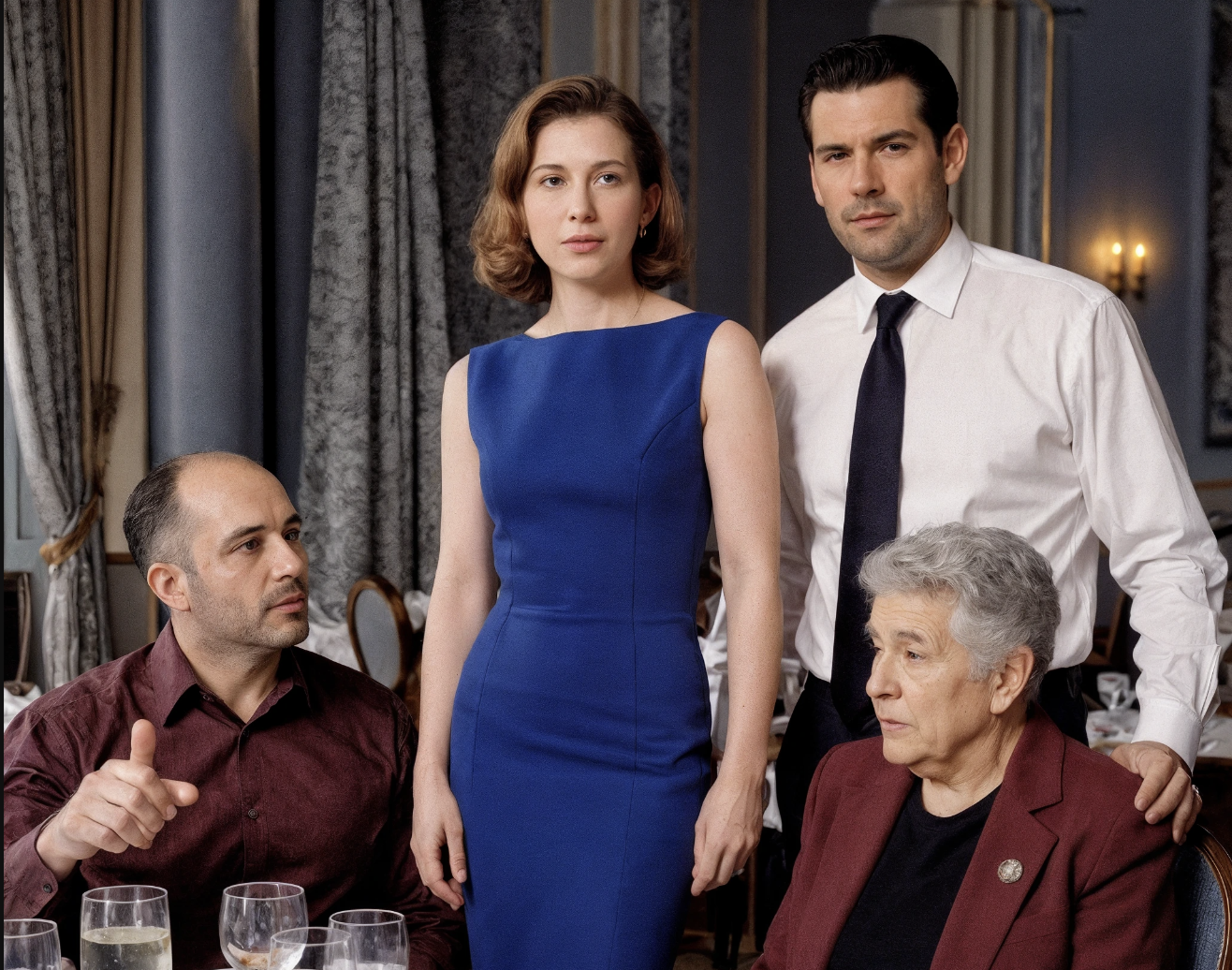
On Monday evening, I wore a dress. The blue one I had sewn three years ago but never wore—there had never been an occasion. I styled my hair and applied makeup. Looking in the mirror, I didn’t see a mouse.
The phone rang at ten-thirty. Vassili.
— Come. The bill has arrived. Your husband is going to show off with your card.
The taxi dropped me off in twenty minutes. The restaurant “Tikhiy Don” sparkled with stained glass and gold. Vassili greeted me in the lobby and pointed to the room with a nod.
— Third table from the window.
I stepped inside. The room was filled with laughter, the clinking of glasses. Slowly, I wove my way between tables and suddenly caught sight of them. Pavel sat regally at the table’s end, next to Tamara Petrovna in a burgundy suit and her sister Marina with her husband. Empty plates, glasses, and dessert scraps littered the table.
The waiter brought the bill on a tray. Pavel didn’t even glance at the amount; he pulled my card from his pocket and placed it on the tray as if it were his personal fortune.
— The service is excellent, he announced loudly, addressing the table. — You see, mom, I told you I’d throw a real party. Not some shabby affair, but a true royal banquet.
Tamara Petrovna nodded proudly, adjusting her hairstyle.
— My son, you’re marvelous. That’s generosity; I recognize my boy. Unlike some who can only sew and sit in a corner.
Marina chuckled softly. Pavel beamed, evidently pleased with himself.
— Oh, mom, you know me. Only the best for you. Luckily, I can afford it.
The waiter took the card and went toward the terminal. He swiped it once. Twice. He glanced at the screen, furrowed his brow, and returned to the table.
— Excuse me, the card isn’t going through. It’s blocked.
Pavel paled.
— What do you mean, blocked? That’s impossible. Try again.
— I’ve tried three times, sir. The card is invalid.
I approached the table. Tamara Petrovna saw me first. Her expression morphed into shock.
— Ekaterina? — Pavel stammered, springing to his feet. — But… what are you doing here?
I looked at him with unwavering calm.
— I came to the party. The one you organized with my money. With my card. Without me. Your little gray mouse.
The silence at the table was so profound one could hear glasses clinking at the neighboring table.
— Katia, listen, this is a misunderstanding, — Pavel started, reaching out toward me, but I stepped away.
— This isn’t a misunderstanding, Pavel. It’s a lie. I heard your entire conversation with your mother on Friday. Every word. The “clueless provincial girl.” The “peasant.” The assumption that I wouldn’t suspect a thing and would stay home watching TV while you feasted here.
Marina stared at her plate. Tamara Petrovna clutched her napkin tightly.
— You were spying? — Pavel exclaimed indignantly. — Are you monitoring me now?
— I was ironing your shirt, and you were loudly declaring to the whole house how you had successfully deceived me. You boasted to your mother about leading your wife around by the nose. That isn’t spying, Pavel. It’s simply that you didn’t even bother to hide. You thought a mouse wouldn’t bite.
Pavel attempted to regain his composure.
— Fine, I admit I was wrong. But let’s not create a scene here, alright? Let’s go home and discuss this calmly.
— No, we will talk about it here. I had the card blocked on Saturday. I reported to the bank that it was stolen because you deceitfully took it and used it for something I was unaware of. So now, my dear husband, you will pay yourself. In cash.
Vassili approached the table, arms crossed over his chest.
— If there’s an issue with payment, I will have to call the police. The bill must be settled. And there’s also the incident of the card reported stolen.
At first pale, Pavel’s face turned red, then purplish.
— Katia, do you realize what you’re doing? You’re embarrassing me!
— Me? — I smiled ironically. — You’re the one who has brought shame upon yourself. Alone. When you decided that the little country mouse didn’t even deserve the truth.
Tamara Petrovna abruptly rose, pointing her finger at me.
— How dare you speak to him like that? You are nothing! Without him, you are nobody!
I looked at her intently, then replied softly:
— Perhaps. But now, I am nobody and don’t need to pretend. And that’s far better than being someone’s little gray mouse.
For the next twenty minutes, they gathered money. Pavel emptied his wallet, Tamara Petrovna rummaged through her purse, Marina and her husband searched their pockets. They counted at the table, whispered, and searched for small change. The waiter remained beside them, unfazed. Other patrons cast curious glances.
I stood there, watching the facade of opulence collapse, all the bluff, all the deceit.
When they finally assembled the total, I pulled an envelope from my bag and placed it in front of Pavel.
— Divorce petition. You’ll read it at home.
I turned and headed for the exit. Back straight, steps firm. Vassili held the door open and whispered:
— You’re holding strong, Ekaterina.
The night in Rostov greeted me with a cold wind, and in my chest, something warm and light spread. Freedom.
The divorce was finalized three months later. Pavel called and asked for forgiveness, but I did not respond. I took half from the sale of the apartment. I rented a small space downtown and hung a sign: “Ekaterina’s Atelier.”
The first order came from Vassili—uniforms for the waitstaff. Afterwards, orders poured in. I sewed, worked, and welcomed clients. I hired an assistant, a young girl named Sveta.
Pavel called me once more, a year later. His voice was drunken and pitiful.
— Katia, I was wrong. Mom lives with me, she eats away at me every day, I lost my job. Let’s start again, alright?
— No, Pavel.
I hung up and didn’t think of him again.
The atelier thrived; there were queues of clients. Recently, I met Konstantin Mikhailovich, the director of a factory who ordered work clothes. We see each other casually, with no promises. He calls me by my first name. Not “mouse.”
Sometimes, I recall that evening at “Tikhiy Don.” The way I crossed the room, the way I looked at Pavel, the way I placed the envelope on the table. I understand it was not an ending. It was a beginning.
Recently, I saw Marina at the supermarket. She turned her head away. I did not call out to her. Why should I? We live in two different worlds.
Yesterday, Vassili visited the atelier, sat down, and we had tea together.
— So, Ekaterina, do you regret anything?
I gazed out the window. Outside, it was springtime, the sun was shining, life was thriving.
— Not for a single second, Vassia.
He nodded.
— You’re right.
— We should only regret what we haven’t done. Not what we have.
When he left, I returned to my work. I was sewing a wedding dress for a young girl radiating happiness during her fitting. Watching her, I thought: I hope she never has to block a card in twenty years or demand respect in a restaurant.
But that’s her life. Her choice.
And I have mine. And I love it.
The little gray mouse died that night at “Tikhiy Don.” And I was born. The true version of myself. One who is unafraid to bite when cornered. One who knows her worth. One who will never again just hand over her card on trust.
Tomorrow morning, Konstantin Mikhailovich will stop by to collect his order. We’ll drink tea and discuss fabrics and patterns. Maybe he’ll invite me to dinner at his place again. Maybe I’ll accept. Or maybe I’ll say I’m busy— that I have an urgent order.
And that will be my decision. Mine.
I am no longer the one silently slicing bread while staring at the ground. I am the one who walks into a room with head held high. And that is the best version of myself.