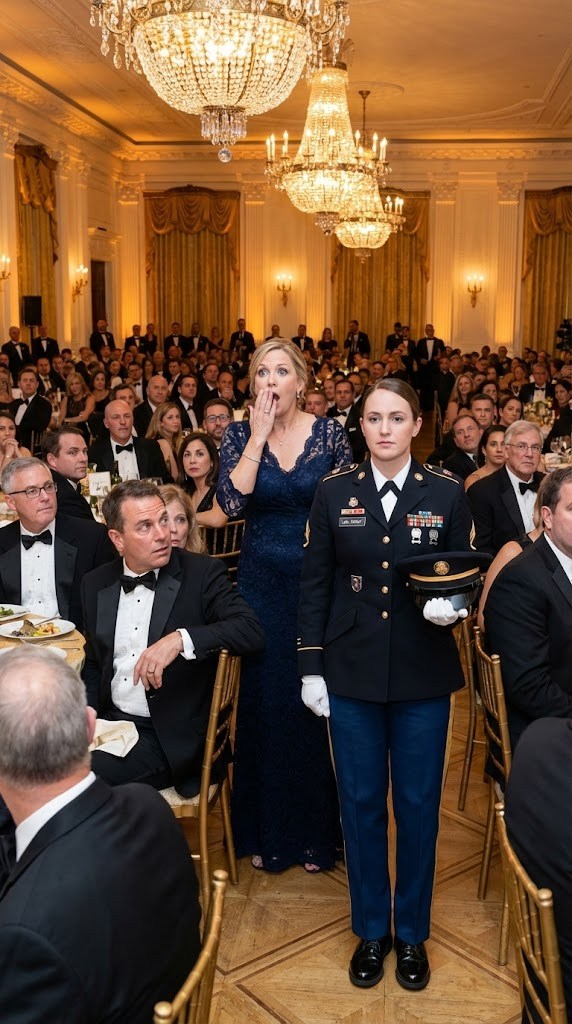
The laugh wasn’t sharp or openly mean. It was the sort of polite chuckle people use when they’re sure they’ve already placed you in a smaller box. Linda Parker pressed a linen napkin to her mouth, then looked around the dining table as if she’d just offered a harmless little comment.
“Rachel has always been more of an office person,” she said, voice light and confident. “Basically a secretary. Someone has to handle the paperwork, right?”
Across from her sat her son, Alex, in crisp Navy dress blues. The SEAL trident on his uniform caught the chandelier’s glow. He didn’t grin along with the room. His jaw flexed—just enough to signal restraint.
I noticed because noticing is part of how I’ve survived.
My name is Lieutenant Colonel Rachel Miller. I’m forty years old. I’ve served eighteen years in the United States Air Force. And I’ve learned something that surprises people: the tensest moments aren’t always far away in loud places. Sometimes they happen at a perfectly set table, in a home that smells like lemon polish and certainty.
- Setting: A carefully planned family dinner in suburban Virginia
- Occasion: Celebrating Alex’s return from deployment
- Atmosphere: Beautiful on the surface, tight underneath
The roast was cooked to perfection. The silverware sat aligned like it had been measured. This wasn’t a casual meal—it was an event, rehearsed in someone’s mind long before anyone arrived.
Everyone understood the purpose of the night.
Everyone, it seemed, except me.
Linda turned toward me with a smile that could pass for friendly if you didn’t listen too closely. “So,” she asked, “are you still doing administrative work on base? Filing reports? Setting up meetings?”
I lifted my glass and kept my tone even. “I run operations.”
She gave a small wave of her hand, dismissing the words as if they were a technicality. “Of course. Operations paperwork.”
Alex shifted in his seat. It was subtle, but I caught it—an unspoken caution, like a quiet alarm going off.
My mother tried to smooth things over by praising the food and nudging the conversation elsewhere. But Linda didn’t let go. She leaned into comparisons—talking about “real risk,” “real service,” and the difference between those who “support” missions and those who “do” them.
Each sentence tightened the room a little more, like an invisible cord being pulled one inch at a time.
Some people don’t raise their voices when they try to diminish you. They just keep smiling while they do it.
Finally, Alex spoke. His voice was controlled, but firm. “Mom, you should stop.”
Linda laughed again, as if he’d misunderstood her intentions. “What? I’m proud of both of you. Just in different ways.”
I could have let it pass. For years, I’d used quiet as armor. In uniform, in meetings, at gatherings—silence often kept things from turning into something worse.
But there was something about the certainty in her tone—about who mattered, who counted, and who deserved respect—that sat wrong in my chest.
Linda leaned forward, elbows near the edge of the table. “So what do you actually do all day?” she asked. “Really?”
I set my glass down with care, making sure my hands didn’t show what I felt.
“I can’t discuss operational details,” I said calmly.
Linda’s smile widened, satisfied. “See? That’s what secretaries always say.”
- I wasn’t angry at the joke itself.
- I was tired of what it implied.
- And I could feel Alex watching, as if he already knew where this was heading.
Alex looked at me then—truly looked. Not like a guest across the table, but like someone reading a situation with professional focus. His eyes asked a question he couldn’t say out loud, especially not in a room full of family and fragile pride.
I drew a quiet breath and chose my words with the same discipline I’d learned over years of service. “There are parts of my job I can’t explain at dinner,” I said, my voice steady. “But it isn’t because I don’t do anything. It’s because what I do involves people’s safety.”
Linda’s expression flickered, but she recovered quickly, the way practiced hosts do. “Well,” she said, still pleasant, “I’m just trying to understand.”
I nodded once, politely—then added a single name. Not loudly. Not dramatically. Just clearly enough that it landed.
Alex went still.
Not offended-still. Not confused-still.
Recognition-still.
The kind of silence that happens when a room bumps into something real.
Respect doesn’t come from the title someone assumes you have. It comes from the truth they didn’t bother to ask for.
Linda blinked, sensing the change without knowing why. My mother’s hands paused mid-motion. The careful warmth of the dinner—the polished, controlled comfort—suddenly felt less certain.
I didn’t offer details. I didn’t need to. The point wasn’t to “win” the conversation or embarrass anyone.
It was simpler than that: in any family, in any workplace, in any room where people feel safe to judge others, it helps to remember you don’t always know who you’re talking to—or what they carry quietly behind their calm smile.
And sometimes, all it takes is one name to remind everyone that assumptions are easy… and respect is earned the moment we choose to give it.
Conclusion: That night wasn’t about proving I was more than a label. It was about refusing to let someone else decide my worth based on their narrow definition of service. Titles can be misunderstood, but character—and the work done in silence—speaks for itself.