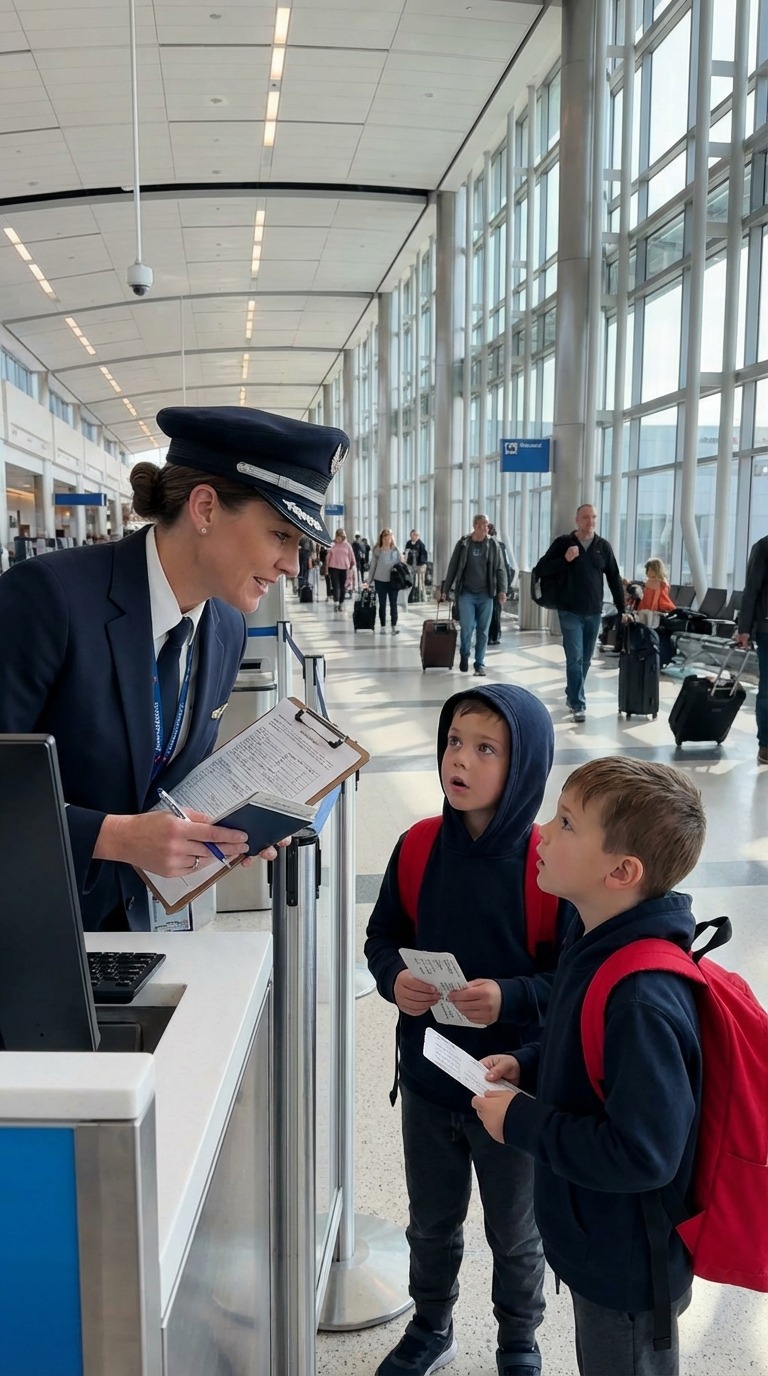
Newark Airport felt like a rushing river that Friday afternoon—rolling suitcases, overlapping announcements, and passengers moving in quick, determined lines. At the center of the commotion, Flight 482 to Los Angeles was calling its final group to board.
Among the crowd stood two 17-year-old identical twins, Ava and Lily Thompson. They wore the same cozy sweatshirts and well-worn jeans, and they carried themselves with the bright, contained excitement of people about to start a long-awaited break. Spring vacation meant California, sunshine, and time with their aunt—something they’d been counting down to for weeks.
Each girl held a boarding pass like it was a promise. Backpacks rested on their shoulders. Everything seemed ordinary—until they stepped up to the gate.
A sudden stop at the gate
A flight attendant glanced at the girls and didn’t return their cheerful energy. Her expression tightened as she looked them over.
“Excuse me,” she said, clipped and skeptical. “Are you sure you’re on the right flight?”
Ava kept her voice polite and steady. “Yes, ma’am. We checked in online. Seats 14A and 14B.”
The attendant studied the tickets, then looked from their faces down to their shoes, as if searching for a reason to doubt what the boarding passes clearly said.
“Are you traveling alone?” she asked.
Lily nodded. “Yes. We’re going to visit our aunt.”
The attendant exhaled with visible impatience. “Wait here.”
In a busy airport, a small pause can feel enormous—especially when everyone else keeps moving.
She set their boarding passes on the counter and walked away. Ava and Lily exchanged a look that said the same thing: Did we do something wrong? They hadn’t argued. They hadn’t broken any rule. They had simply shown up like every other passenger.
A supervisor steps in
After several long minutes, a supervisor approached. He wore an airline vest and an expression that suggested he wanted the conversation over before it began. He didn’t quite meet their eyes.
“There’s an issue with your tickets,” he said flatly. “You’ll need to leave the boarding area.”
Ava blinked, caught off guard. “But we haven’t even boarded. The tickets are paid for. We already went through security.”
The supervisor’s tone sharpened. “Don’t make this difficult. It’s not personal. It’s procedure. You need to step away.”
Nearby, quiet murmurs rose. Someone whispered to a companion. Another traveler leaned closer, curiosity pulling attention toward the twins like a magnet.
- Passengers began staring openly.
- A few phones lifted, as if the moment were entertainment.
- The twins felt their faces heat with embarrassment.
The girls were guided out of the line and directed to stand near a window, away from the gate door. From there, they could see the plane they had imagined all week—now sitting just out of reach, as if the trip had been erased with a single decision.
The question they didn’t want to ask
Ava wrapped her arms around herself, trying to feel smaller in a space that suddenly felt too public.
“Lily…” she whispered. “Do you think… it’s because of us?”
Lily’s mouth tightened. Her eyes stayed forward, fixed on the aircraft outside, but her voice came out strained. “Because we’re Black?”
The words landed heavy between them. They didn’t want to believe it. They didn’t want to say it. Yet the feeling—unfair, confusing, and painful—pressed in all the same.
Lily pulled out her phone. Her hands shook slightly, but her decision didn’t. “We’re calling Dad.”
She tapped the contact and lifted the phone to her ear. The line rang once, twice—then a familiar voice answered.
“Ava? Lily? Are you okay? You sound really upset,” he said, instantly alert. “What happened?”
Conclusion
In a place built around schedules and rules, Ava and Lily found themselves abruptly treated like they didn’t belong—without a clear explanation and under the gaze of strangers. But instead of shrinking into silence, they reached for the person who would listen first and act fast. Whatever came next, that call marked a turning point: the moment the twins stopped being passive passengers in someone else’s decision and started reclaiming their voice.