The invitation arrived on an ordinary Tuesday in March, heavier than a normal card and far fancier than anything that ever came to my mailbox. Thick cream paper. Gold lettering. The kind of envelope you expect to open with a smile—except mine faded the moment I realized what it was.
My son was getting married.
And I was finding out the way you’d inform someone about a rescheduled appointment: no call, no excited voice, no “Mom, we picked a date.” Just a formal card addressed to me like I was someone they had to include, not someone they wanted beside them.
I’m Catherine Morris, 58 years old, living in a small apartment where the hallway lights buzz at night and the community mailboxes sit out front like a row of locked little stories. That invitation looked almost out of place on my kitchen counter—right next to overdue notices and a grocery flyer with coupons tucked inside.
Some pieces of paper don’t just deliver news—they deliver distance.
Ryan is 28 now. He’s doing well. He stays busy. When I call, he’s usually “in a meeting,” even when it’s clearly after work hours. He lives downtown in a building with a front desk, elevator chimes that sound expensive, and a sign-in sheet that makes visitors feel like temporary help.
The last time I saw him there, I had to show my ID to get upstairs. He greeted me wearing his work badge on a lanyard, like he couldn’t fully step out of his professional life—even for a weekend.
His fiancée, Barbara, had been in his life for three years. I’d met her twice. Both times felt brief and carefully arranged, like a polite performance. She was lovely in an effortless, magazine-cover way: perfect hair, neutral lipstick, neat nails. When she smiled, it was the kind of smile you offer when you’re determined to be civil.
Her eyes also took inventory—my discount-store coat, my old purse—quick glances that landed like quiet judgments.
A date set in a world that wasn’t mine
The wedding was scheduled for Saturday, June 15th, at a country club her family belonged to. I could already imagine the scene: manicured lawns, white tents, sparkling glasses, and photos that would end up framed in matching silver on pristine mantels.
I could also picture myself there—standing in the middle of all that perfection, feeling like the one detail nobody ordered.
That night, I called Ryan. He picked up on the third ring, distracted. I could almost hear him multitasking.
“Oh. Hey, Mom. You got the invitation.”
“I did,” I said, keeping my voice light. “Congratulations, sweetheart.”
There was a pause—just long enough to feel empty.
“Yeah. Thanks.”
I waited for warmth. For anything that sounded like a son sharing joy with his mother. When it didn’t come, I tried to create it myself.
“When can I help? Planning can get expensive, and I’ve been saving—”
“Mom, stop,” he said, suddenly sharper. “We don’t need help. Barbara’s parents are taking care of everything.”
- No discussion about the ceremony.
- No mention of a mother-son dance.
- No curiosity about whether I wanted to be included.
“I wasn’t only talking about money,” I said carefully. “I meant… being part of it. The little things. I just thought—”
He cut me off again. “We already did all that. Just show up that day, okay? And wear something nice, but not too… you know. Conservative. Her family’s traditional.”
Something nice, but not too me.
“I understand,” I told him, because that’s what I’ve always done. “I wouldn’t want to embarrass anyone.”
“It’s not—never mind. I have to go. Barbara’s making dinner.”
The call ended, and I sat staring at the invitation as if it had teeth. In the corner, in small print, it said “Black tie optional.” I didn’t own anything remotely close to that. My “nice” dress was navy, several years old, and paired with the sensible shoes I kept for graduations and sad occasions.
Making it work the only way I knew how
So I did what I’ve done all my life: I adapted.
I cut back in quiet ways no one applauds. I skipped lunches and called it “not hungry.” I walked to work instead of paying for the bus. I canceled cable, used up the last of my good shampoo, and stopped buying little comforts that made my days easier.
I kept a jar on the counter and dropped in every spare bill as if it were a private promise.
By May, I had enough to buy a dress that wouldn’t make my son flinch. Emerald green. Simple. Elegant. Not loud, not desperate—just dignified. I even bought a pair of new shoes with a modest heel.
Then I went to a salon for the first time in years. They washed my hair, pinned it up neatly, and handed me a mirror like I’d been reintroduced to a version of myself I’d misplaced somewhere along the way.
I didn’t want to steal attention. I only wanted to look like I belonged in my son’s life.
The wedding day and the moment his face changed
On the morning of the wedding, I stood in my bathroom and barely recognized myself. I looked composed. Put-together. Almost… worthy.
For a brief moment, I let myself imagine Ryan seeing me and feeling proud. I imagined him smiling without that subtle tension I’d grown used to.
The country club looked like a picture in a brochure—green lawns rolling toward a small lake, a circular drive lined with luxury cars. My fifteen-year-old Honda, freshly washed, sat among them like it had taken a wrong turn.
Inside, the lobby gleamed with marble and crystal. Guests moved in easy circles, laughing as if they’d never had to check their balance before agreeing to anything.
I spotted Ryan near the main staircase in a tuxedo, hair perfectly styled. Barbara stood beside him, radiant in a gown that looked impossibly expensive and effortless.
When Ryan saw me, his smile didn’t brighten. It adjusted—tightened—like my presence created a task he needed to manage.
“Mom,” he said, neutral. “You made it.”
“You look so handsome,” I told him, reaching up by instinct to straighten his bow tie—an old habit from when he was small.
He stepped back just enough to break the moment. “Thanks. You look… nice.”
That pause before “nice” was quick, but it landed anyway.
Table seven and the message I couldn’t ignore
After the ceremony, I hoped the reception would feel easier. Eating gives people something to do besides make small talk and pretend.
But the reception hall had its own quiet hierarchy: white linens, crystal glasses, centerpieces arranged with the kind of care that costs more per hour than I earned in a day.
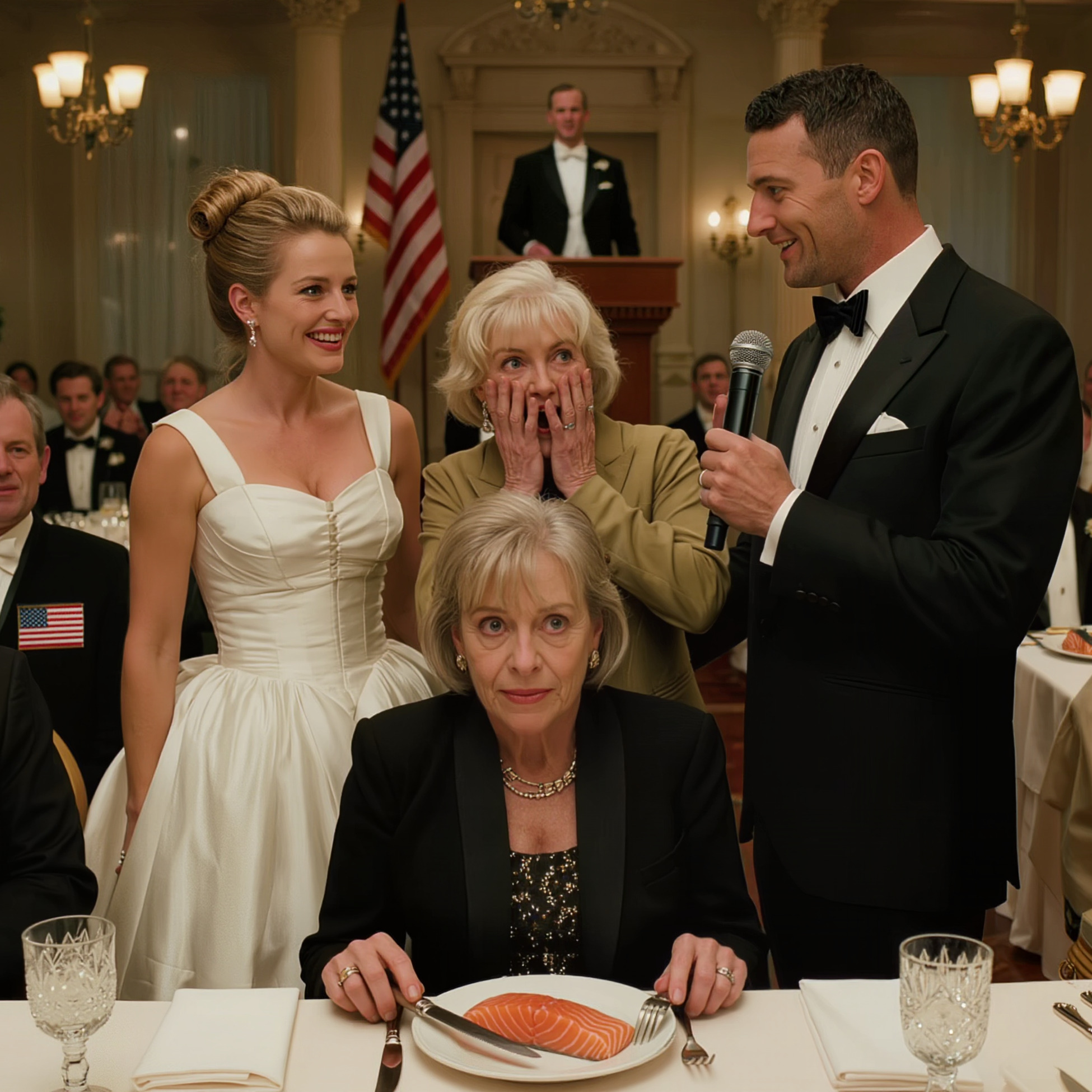
I found my place card at table seven, near the kitchen doors—back corner placement. Not close enough to matter, but not absent enough to raise questions.
An older woman—Barbara’s great-aunt Margaret—sat beside me. She was kind, and she murmured that she felt a little out of place too. I was grateful for her softness in a room that felt sharp around the edges.
Across the room, Ryan moved like a local celebrity, greeting guests, collecting compliments. He stopped at table after table.
He didn’t stop at mine.
- I told myself he’d come later.
- I told myself he was busy.
- I told myself anything that kept the ache from spreading.
Dinner service began, and the plates flowed to the front tables first—warm entrées, bright vegetables, food that still steamed when it arrived.
By the time the servers reached table seven, the kitchen was “behind.” Margaret received her plate. Another elderly guest did too. Then the server looked at my setting like it wasn’t even on the map.
“I’m so sorry,” she whispered. “There was a mix-up. Yours will be out in a few minutes.”
A few minutes became twenty. Then thirty. Around me, glasses clinked during speeches and people dabbed their eyes at sweet stories. Under the music, my stomach made a small, honest protest.
Finally, a plate appeared.
The food was cold and tired-looking, the kind of meal that had clearly waited longer than it should have.
Margaret leaned in, her expression full of quiet disapproval, and murmured something under her breath that made my throat tighten. Still, I lifted my fork. I’ve spent a lifetime swallowing embarrassment while keeping my posture straight.
The joke, the laughter, and the choice to leave
Then I heard Ryan’s voice carry across the room—light, amused, just loud enough for nearby tables to catch it. He gestured toward my corner as if I were part of the evening’s entertainment.
The room answered with polite laughter. Not harsh, not booming—just the smooth kind of group laughter that allows everyone to feel innocent because it’s shared.
I set my fork down carefully, refusing to let my hands shake.
I didn’t cry. I didn’t argue. I didn’t call attention to myself.
I stood, smoothed the emerald fabric once, and walked out with the calm of someone reclaiming her own name.
Sometimes dignity isn’t loud. Sometimes it’s simply leaving when you’re treated like you don’t matter.
No one followed me. No one called out. The party continued behind me, full of music and speeches, as if my chair had always been empty.
The email written at sunrise
Back home, I didn’t collapse into drama. I didn’t write a messy message or beg for an explanation.
I made tea. I sat at my small kitchen table. I opened my laptop and stared at the blinking cursor until the words arrived—steady, precise, and clear.
Not to punish.
Not to attack.
But to finally name what I had been living with for years: being included only in the most technical sense, while being treated as optional in every way that mattered.
By the time the sun rose, the email was sitting in Ryan’s inbox—quiet, honest, and impossible to laugh off. And when he read it the next morning, it changed something in him, not because it was cruel, but because it was true.
Conclusion: Weddings are meant to celebrate family, but sometimes they reveal the distance that’s been growing for a long time. That night, I didn’t demand attention or revenge—I chose self-respect. And in the calm space after I left, I finally said what needed to be said, in the clearest way I knew how.