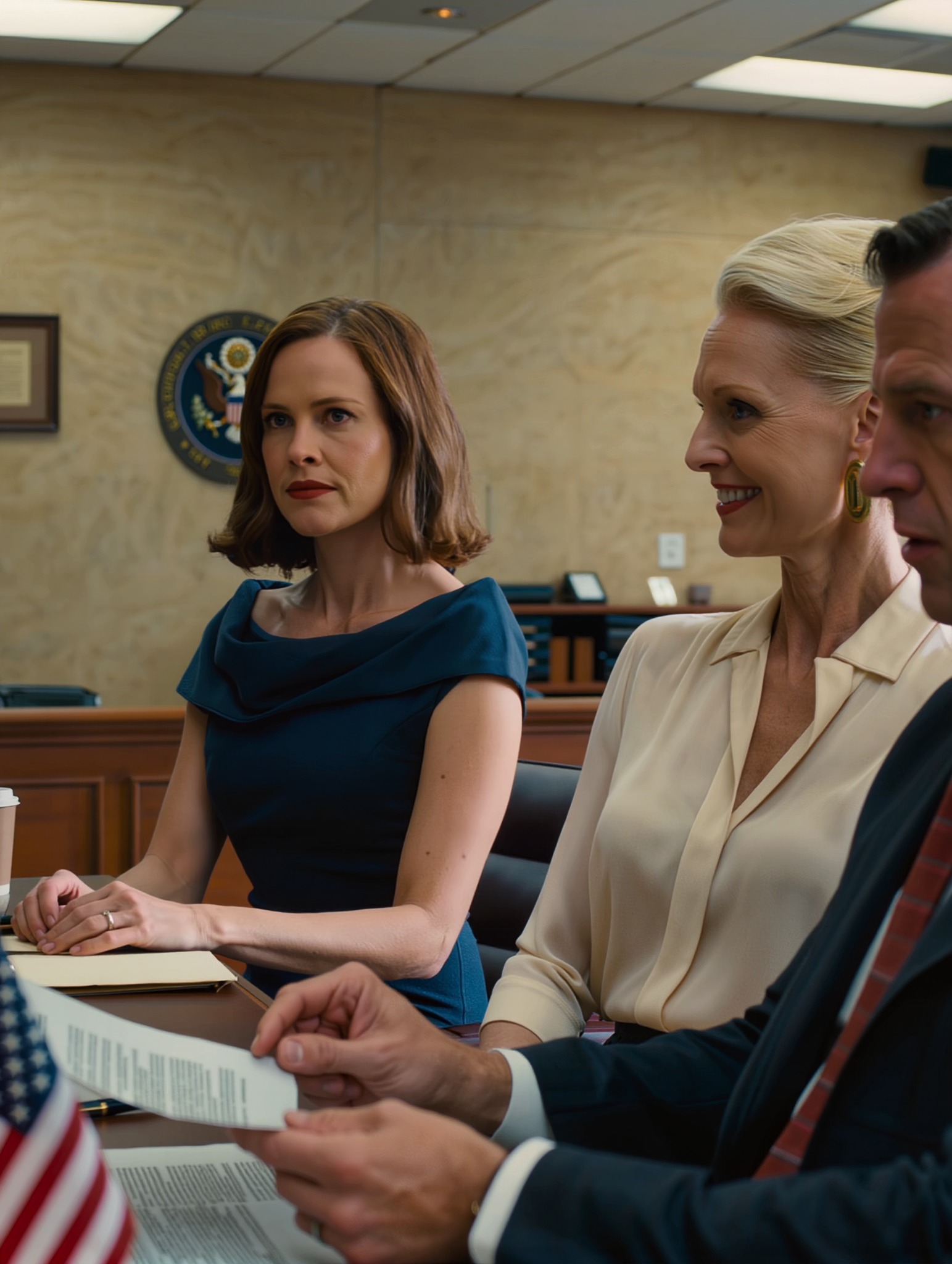
The downtown conference room looked like every other legal space you’ve ever seen: beige walls, a fluorescent light that wouldn’t stop buzzing, and a lingering scent of burnt coffee mixed with warm copier paper. Beyond the window, traffic crawled toward the bridge while the river air pressed against the glass with heavy summer humidity.
My name is Miriam Fredel. I’m 31, and until recently, my life was rooted in Covington, Kentucky—close enough to the Cincinnati skyline that it feels like the city is always watching, but small enough that people remember exactly when you moved in and whether your “I’m fine” sounded convincing.
My husband, Joel, built his law firm the old-fashioned way: long hours, a tiny rented office, and a stubborn belief that if he worked hard enough, it would all amount to something lasting. At first, his “office” was a cramped room above a retail shop where you could hear footsteps overhead like the building itself was restless. Later, it became a real suite—his name on the door in clean letters, a staff that knew his routine, and clients who shook his hand like he’d just guided them back to shore.
- A modest beginning that demanded late nights
- Growth fueled by grit, patience, and pride
- A reputation built one client at a time
Then, on an ordinary Thursday, everything stopped. Joel was gone so suddenly that my mind kept trying to rewind the day, searching for a moment when I could have seen it coming. Grief didn’t arrive politely. It moved in fast, rearranged everything, and left me functioning on autopilot—especially for my little girl, who still needed breakfast, bedtime stories, and reassurance I didn’t feel strong enough to give.
Before I’d even learned how to breathe inside the new reality, my mother-in-law, Carla, appeared at my door like she had a calendar reminder. She was neatly dressed, perfectly composed, and speaking in a tone that never had to get loud to be heard. She didn’t ask how her granddaughter was handling the loss. She didn’t ask if I’d slept, or eaten, or managed to make it through a day without breaking down.
She stood at my kitchen island and talked about my life the way someone talks about property boundaries.
Investments. Contributions. “What she put in.”
“Not the child,” she said, as calmly as declining a side dish. “Just the assets.”
Most people expect a dramatic scene at a moment like that. A slammed door. A raised voice. A furious phone call to a lawyer known for sharp elbows and sharper words. And honestly, I had plenty of support for exactly that kind of response.
My mom showed up with casseroles and righteous anger. My best friend texted me names of aggressive attorneys like she was handing me life preservers. Even my own lawyer told me, plainly, that we had a strong case if I wanted to fight.
- Family urging me to stand my ground
- Friends ready to help me “go to war”
- Legal counsel confident we could win
But I didn’t tell any of them what happened a few nights after Carla’s visit.
I went back to Joel’s office when the building was quiet and the halls felt too wide without his footsteps. The city outside hummed like nothing had changed, but inside that dark suite, everything belonged to memory. I sat at his desk and opened drawers I’d never touched before, half-expecting nothing but pens and old case files.
In the bottom drawer, I found an envelope with my name written in Joel’s handwriting—careful, unmistakable, and personal, like he was reaching across the distance to start one last conversation.
I read it there, alone, listening to the soft whir of the building’s ventilation. My hands shook at first. Then they didn’t. For the first time in weeks, my grief didn’t feel like a storm. It felt like something I could stand upright inside.
By morning, I wasn’t “better.” But I was steadier. And I knew exactly what I was going to do.
Sometimes strength doesn’t look like a fight. Sometimes it looks like letting someone walk straight into the outcome they didn’t bother to read.
When Carla pressed forward—pushing for court, pushing for paperwork, pushing to claim what she believed was hers—I didn’t argue the way everyone expected. I didn’t throw myself into a loud battle. Instead, I stepped aside.
I offered her what she was so eager to collect: the house, the firm, the entire “empire” she kept describing with a strange sense of entitlement, as if Joel’s work had always been meant to circle back into her hands.
In return, I asked for one thing. Not money. Not a compromise. Not a promise made over a tense dinner table that could be twisted later.
I asked for one thing in a way that left no openings—no loopholes, no vague phrasing, no room for future arguments.
- No verbal assurances
- No handshake agreements
- No “we’ll work it out later” language
The day of the final hearing, Carla arrived dressed like she was there to accept an award. Her son sat beside her, wearing a grin that looked too big for the moment—as if signing his name could instantly turn him into someone important.
My attorney watched me with worry, like he expected me to collapse or change my mind. The clerk slid the documents across the table, paper whispering against polished wood.
I signed.
Carla signed even faster, her satisfaction practically glowing in the set of her shoulders.
Her smile stayed perfectly intact—until her lawyer stopped cold.
It wasn’t a dramatic outburst. It was smaller than that, and somehow louder. He went still, eyes locked on a particular line as if it had rearranged itself while he wasn’t looking. The color drained from his face so quickly it made Carla’s expression falter.
In that brief silence, I understood something I wish I’d learned sooner: the most powerful turn in a story often arrives quietly—right when everyone else is sure they’ve already won.
Conclusion: People thought I was giving up when I let them take the house and the firm. But what looked like surrender from the outside was actually a decision made with clarity, protection, and purpose. Sometimes peace isn’t found by fighting the loudest—it’s found by choosing the one detail that truly matters, and making sure it’s secured in ink.