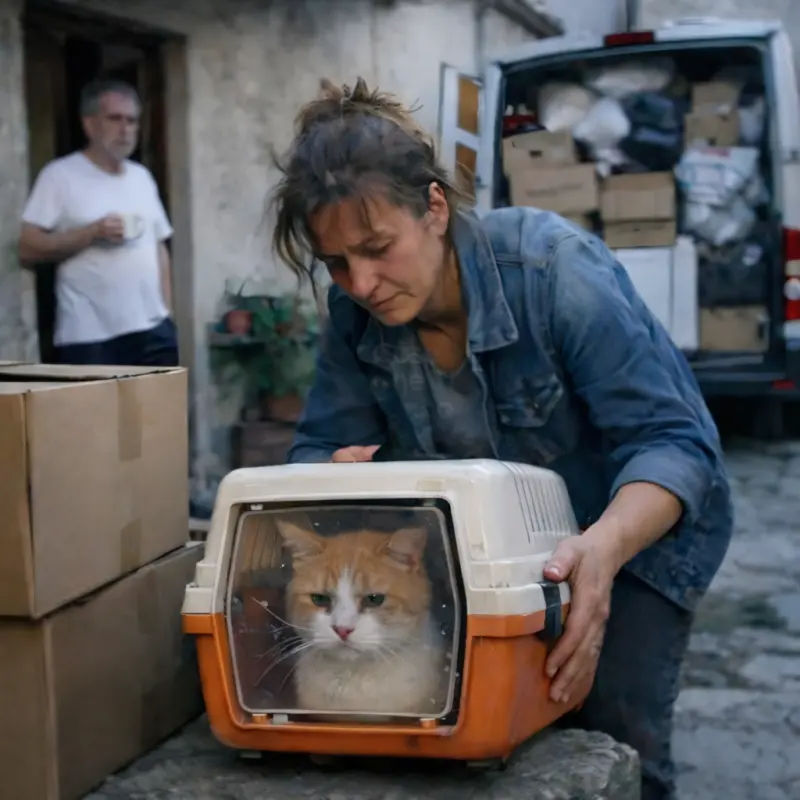
That morning, I was standing in my driveway with a cup of coffee when I saw Elisa come down the steps carrying a pet carrier.
She didn’t hold it like something precious. She held it like a burden she could no longer protect.
What struck me first was not anger or cruelty. It was the look of someone who had reached the end of a very long road, with the last thing she could bear still in her hands.
In the yard, her life was already packed into pieces: black trash bags full of clothes, two lamps without shades, a folding chair tied with rope, and a rental van loaded so tightly it looked ready to spill its contents at the first bump.
It was barely eight in the morning, and Elisa already wore the face of someone who had stopped expecting kindness from the day.
She set the carrier beside a stack of boxes and rubbed the back of her hand across her face. Inside, Mimmo was still. An old white-and-orange cat with a torn ear and the slow, tired gaze of an animal that had long ago learned not to expect too much.
“Where are you taking him?” I asked.
She didn’t answer right away.
“To the shelter,” she said at last.
Those words landed harder than I expected.
I looked at the carrier, then at the van, then back at her.
“You’re giving him away?”
She gave a short, flat smile.
“The new place doesn’t allow pets.”
When I asked if that was really how it would end, she finally looked at me. Her eyes were red, not from one quick cry, but from too many hard nights one after another.
“You think I’m doing this because I want to?” she asked.
I had no answer. And my silence said enough.
“A person doesn’t always let go because they care less. Sometimes they let go because life has cornered them so tightly they can barely hold themselves together.”
Elisa had lived next door for three years. We weren’t close, just the kind of neighbors who exchange greetings, accept packages, and complain about the trash collection as if it were a serious civic matter.
I knew she worked hard. I knew money had been tight for a while. And still, somewhere inside me, I had judged her too quickly: a pet was family, and family should never be left behind just because a new apartment was smaller.
Then she went back inside for another box, and I crouched near the carrier. Mimmo watched me through the scratched plastic. I knew that face well from the window of her living room, where he used to sit in the same quiet spot every evening, calm as an old man watching the street.
Lately, I hadn’t been sleeping well either. More than once, I had sat in my dark living room and stared outside for no particular reason. And sometimes I would see Mimmo there in Elisa’s window. It may sound silly, but it comforted me. That cat, steady and silent, made the street feel less empty.
Elisa came back carrying a box marked KITCHEN. She set it down too hard.
“I called first,” she said. “They said they’d take him.”
She sounded as if she were defending herself.
“The new place is smaller. The rent is higher than it should be. The landlord said no. I pushed, but he still said no.”
- Her hair was tied back in a rush.
- Dust clung to her jeans.
- A bruise showed on her leg.
- And worst of all, there was shame on her face.
“I can’t leave him in the car if something goes wrong,” she said quietly. “I can’t do that to him.”
That was when I understood: this was no longer about a woman giving up her cat. It was about a woman losing almost everything, while still trying to arrange her losses in a way that would hurt no one too much.
Mimmo let out a low, rough sound and pressed against the carrier door. I had never seen him do that before. Elisa slid her fingers through the bars, and her expression changed instantly.
“My sweet boy,” she whispered.
Then she broke.
She sat down among the boxes and dust, crying into one hand while Mimmo kept pushing toward her.
“He hates almost everyone,” she said through tears, trying to laugh. “My sister can’t stand him. He once threw up in her shoe.”
Then she added, “He waits for me at the window every evening. If I’m late, he’s always there.”
And then I saw it clearly.
That cat was not a burden. He was the last familiar presence in her life. The last living creature that knew what her days had been like in that house.
So I made a decision.
“How long do you have?” I asked.
“Twenty minutes.”
I looked toward my own quiet house, where no one was waiting for me, and said, “Leave him with me.”
Elisa stared. Then I added, “I’m here. Once you’re settled, you can come see him anytime. He doesn’t have to go to a shelter.”
Ten minutes later, she brought me his bowl, a worn blanket, and a stuffed mouse missing its tail. The change in her face was immediate. Relief, thin but real, replaced some of the weight she had been carrying.
When the van finally pulled away, I brought Mimmo inside. He stepped out slowly, looked around as if judging my whole life in one glance, and then jumped onto the windowsill.
By evening, when the light began to fade, I saw his silhouette in the glass: still, quiet, home.
People think saving an animal only means giving it shelter. Sometimes it does. But that day, Elisa didn’t just leave me her cat. She left me something alive to return to.
Summary: What began as a painful goodbye became an unexpected act of kindness. In the end, Mimmo found a new home, Elisa found a little peace, and I found that sometimes the smallest living presence can fill the deepest emptiness.