At ten past ten, a woman called me and asked what she could bring home with six euros and a little shame. My hand stopped over the dough.
A call that changed the evening
I spend most evenings behind the counter of my small pizzeria. Dough on the table, the oven burning hot, phones ringing, scooters coming and going. At that hour people usually ask for extra olives, a cold drink, or whether we still deliver when it rains.
Her voice was different. Low. Tired. The voice of someone who had already asked too much from the day.
“Good evening, ma’am, tell me,” I said, as I always do.
There was silence on the line. Then she spoke softly.
“With six euros… can you send me something? It’s just me and my son.”
Not enough for dinner, but enough to matter
I looked at the menu. Six euros would not buy a proper dinner for two. Maybe a small pizza. No more than that.
But that was not the point.
You could hear it in the way she breathed. In the way she waited for my answer without asking for anything more.
I asked for the address.
A run-down boarding house near the station. One of those places nobody dreams of staying in. People end up there, and that is all.
I told her, “All right. I’ll make you something.”
She did not say another word. Just a “thank you,” so quiet it almost disappeared.
- I still had dough.
- I still had tomato sauce and mozzarella.
- There was some focaccia left, two small fruit juices in the fridge, and a slice of tart I had brought from home that morning.
I made a large pizza. Not perfect. A little uneven. But warm. I added the focaccia, the juices, and the tart too.
When food is more than food
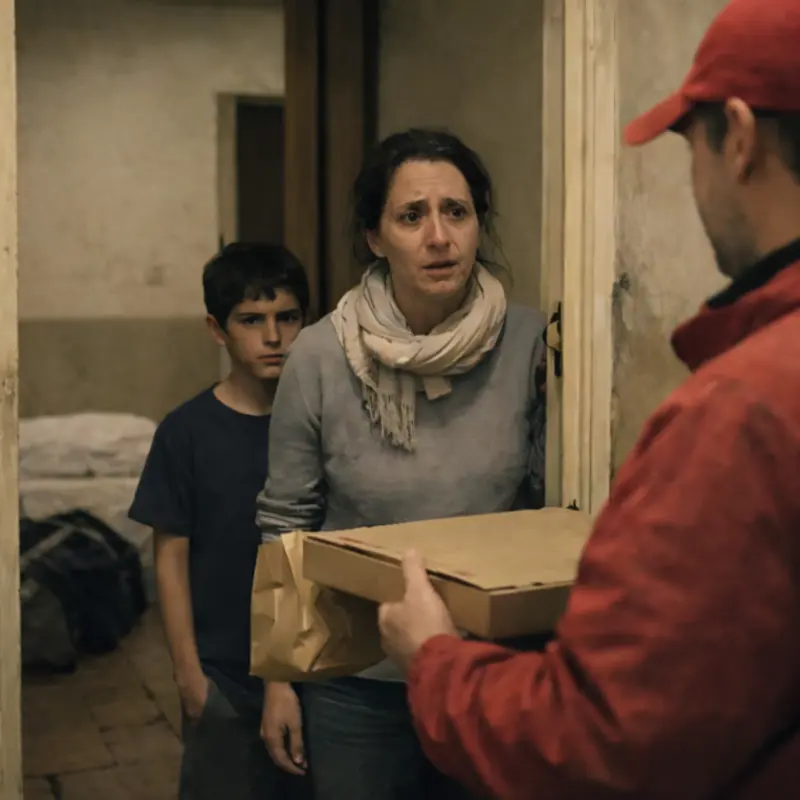
When I arrived at the boarding house, the hallway smelled of dampness and old detergent. I rang the bell. I waited. The door opened just a little.
First I saw the eyes. Then the face.
A young woman, but with a kind of exhaustion that made her seem older. She wore a light scarf around her neck, even though it was not cold.
Behind her stood a boy. Ten, maybe eleven. Thin. Completely quiet. He looked at the pizza box as if he feared I might take it back any second.
I lifted the bag and said only, “I brought a few things.”
She looked down. “I can’t pay more than six euros.”
“That’s fine,” I said. “For tonight, that’s fine.”
The boy took the pizza with both hands. Carefully. The way you take something hot, yes, but mostly something that matters.
“Thank you,” he said.
It was the first word I heard from him.
“I needed food,” she told me later. “But I needed even more for someone not to make me feel like a burden.”
Her name was Sandria. The boy’s name was Fabio. I never asked too many questions. When someone is struggling just to stand upright, they do not need another person digging inside their life.
Every now and then, I would add something extra: a yogurt, a piece of fruit, a slice of savory pie. Never too much. I did not want it to feel like charity. Just dinner from someone who understood.
Years later, the circle came back
Then, suddenly, the calls stopped. One week. Two. Three. I told myself that maybe it was a good sign. Still, every Friday, without thinking, I put aside a little extra dough. Just in case.
Two months later, in the late afternoon, Sandria walked into the pizzeria. I recognized her immediately. But she was different. No scarf. Straight shoulders. Her eyes no longer kept darting toward the door. She did not look like a woman from a fairy tale. She looked like a woman who had managed to breathe again. And sometimes that means more.
Fabio was with her. He had changed, not so much in his face as in the way he stood. He no longer looked like a boy ready to run away.
Sandria placed an envelope on the counter. I pushed it back.
“No.”
She pushed it toward me again.
“Please.”
Then she looked at me and said something I have never forgotten:
“Back then I needed to eat. But I needed even more for someone not to make me feel like I was too much.”
I opened the envelope. Three hundred euros. Too much for pizzas. Just right for something else.
I kept it aside, without signs, without names, without making a show of being kind. Just a box under the register for other people’s hard evenings. When someone called with that same voice, the one you recognize right away, I understood. And something was always found.
Years have passed. Fabio is in high school now, and on Saturdays he helps me in the pizzeria. He folds boxes worse than I do, but faster.
Last week he made a delivery to that same boarding house near the station. When he came back, his eyes were wet. He set the thermal bag beside the counter and stayed quiet for a moment.
Then he said, “The room was almost the same.”
I nodded.
He looked at his hands and added, “Before, someone brought food to us. This time, I rang the bell.”
Sometimes life changes with one hot pizza, one broken voice on the phone, and six euros that never would have been enough on their own. But they were enough to begin again.