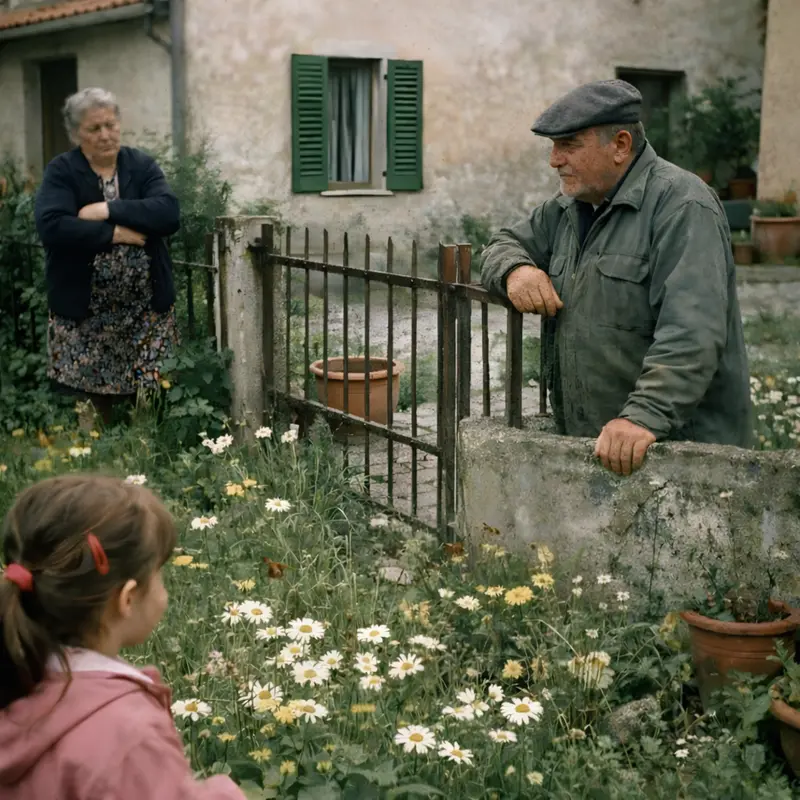
In our street, people used to talk about my garden all the time.
But in a different way.
They would say, “Mr. Bianchi’s place is always perfect.”
“Not a blade of grass out of place.”
I won’t pretend I didn’t enjoy hearing it. I did. I spent my whole life as a gardener. Never important, never loud, never the sort of man people remembered for long. Just someone who understood soil, seasons, and patience. Someone who knew when to cut back, when to wait, and when to leave things alone.
And truthfully, I have always liked order.
- Neat flowerbeds
- A clean hedge
- A path without a leaf on it
- A lawn kept low and even
That was how people knew me.
So this year, when Easter was only a few days away, they started talking.
In our small northern town, everyone was preparing something. Some were washing balconies, some were changing flowers in their pots, some were sweeping in front of their gates, and some were hanging decorated branches by their doors.
And then there was me.
My garden was full of daisies. Wild flowers. Taller grass than usual. Patches of color where there had once only been carefully cut green.
It was not dirty. It was not neglected. But it was no longer “tidy” in the way people expected from me.
I heard them talking outside my gate. In a small town, you hear everything, even what people pretend to say quietly.
“Mr. Bianchi isn’t what he used to be.”
“What a shame. He was always so precise.”
“I think he’s letting himself go.”
I would stand behind the kitchen window with my cup in my hand and pretend not to hear.
Teresa, my neighbor, was the most direct of all. She isn’t a bad woman. She is simply the kind of person who thinks a well-kept house tells you everything you need to know about someone’s life.
Two days later, she stopped me by the path and spoke softly, almost kindly.
“Mr. Bianchi… are you all right? Because your garden… well… it doesn’t really look like you anymore.”
I understood exactly what she meant. And I understood that she expected an explanation.
I only told her, “I’m watching something.”
She looked at me as though I had spoken another language.
“Oh?”
I nodded.
That was enough, because it was not something I could explain quickly.
For years, I had noticed that the garden had become quiet.
Not the street. Not the town. The garden.
Once, when spring arrived, there used to be a steady hum: bees, bumblebees, butterflies, and all that small life you hardly notice until it begins to disappear.
Little by little, there was less of it. Each year, less still.
At the same time, gardens everywhere became neater, cleaner, more controlled.
And somehow, quieter.
Years ago, my wife Anna was the first to say it, standing by the kitchen window.
“Giovanni, it’s all beautiful. But you can barely hear anything anymore.”
Back then, I only smiled. Now I think of those words often. Since she is gone, even more so.
Last autumn I began looking at things differently. I read a little, yes, but mostly I became patient. This spring, I decided not to cut everything back right away.
I left a few corners alone. I let what wanted to grow, grow. I did not remove every flower that appeared in the “wrong” place.
Not because I was tired. Not because I had stopped caring.
But because I wanted to see if life could come back.
And it did.
- First, a bumblebee
- Then two wild bees
- Then a yellow butterfly on a warm morning
I stood there as if greeting a visitor I had stopped expecting.
Still, the comments continued. One evening, I even brought out the lawn mower. I was tired of the looks, tired of the remarks, tired of people judging quickly instead of trying to understand.
I pulled the cord to start it.
Just then, I heard a small voice.
“No, please!”
I turned around.
It was Sofia, the little girl from the yellow house down the street. She was about eight, with muddy boots, red cheeks, and her hair tied back badly.
She pointed toward the flowerbed near the old pear tree.
“There’s a big bumblebee in there,” she said.
I switched the mower off.
“A big bumblebee?”
She nodded seriously.
“Yes. And two white butterflies. I watch them every day.”
I smiled. It had been a while since I had done that.
“You watch them every day?”
“Yes,” she said. “It’s alive here.”
That sentence reached me deeply because it was simple, and because it was true.
The next morning, there was a drawing hanging on my gate: flowers, bees, butterflies, and a crooked handwritten message.
Do not clean everything away. Spring lives here.
Teresa stood looking at it for a long time. This time, she noticed the garden properly—not just the tall grass, not just what seemed out of place.
Then a butterfly crossed the path, and the soft hum that had been missing for years could be heard again.
She lowered her eyes and said quietly, “Maybe we wanted everything too perfect.”
I answered, “Maybe we confused order with life.”
She nodded.
The week after that, she let a strip of flowers grow along her fence. Then the neighbor across from her did the same. Not the whole town. Not all at once. But enough for something to change.
This year, my garden is not the neatest on the street. But it breathes. And in some way, I breathe better too.
Perhaps we forget a simple truth: not everything beautiful must be controlled. Sometimes, it is enough to leave a little space—for bees, for butterflies, for spring, and for the part of ourselves that still wants the world to feel alive.
Summary: A once-perfect garden becomes a place of quiet renewal, proving that a little wildness can bring back not only nature, but hope too.