The argument didn’t begin that Sunday
The truth is, it had been building for a long time. No one had quite found the courage to say it out loud. A year ago, on a spring afternoon, when David asked me to marry him, I knew I wasn’t only saying yes to him. I was also stepping into the life he already had. David has two children: his older son, Luca, who is now a teenager, and his little daughter, Sofia, who is six.
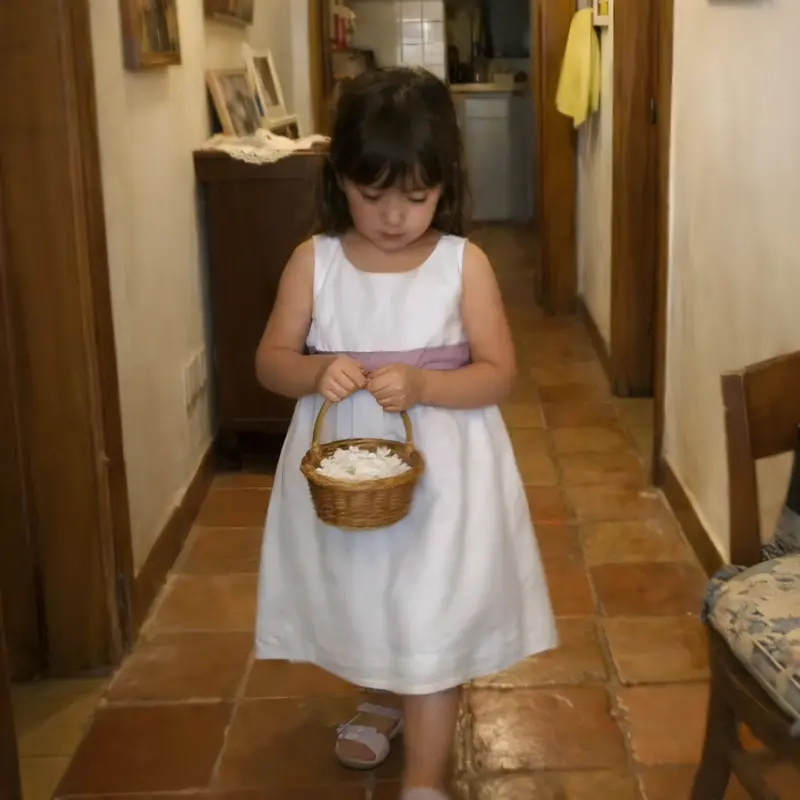
Of everyone in the family, Sofia was the most excited about the wedding. The moment she saw my ring, she looked up at me with those serious, wide eyes and asked, “Can I carry the petals?” David and I smiled and said yes.
For an adult, that may sound small. For Sofia, it was everything.
For months, she practiced walking down the hallway at home with a little wicker basket in her hands. She would take tiny, careful steps, then turn to me and ask, “Like this?” We chose her dress together: white, simple, with a soft pink sash tied at the waist. In her bedroom, she hung a calendar and crossed off each day with a purple marker.
She does not talk about it constantly. But I can see how much it means to her.
It is in the way she opens the closet just to look at the dress again. In the way she says “your wedding,” then corrects herself and says, “our wedding.” In that quiet, careful hope children carry when they have already seen a home break once before.
For Sofia, this was not just a party. It was the day something inside her would finally stop trembling.
What happened at Sunday coffee
My brother Andrea and his wife, Giorgia, had their daughter Beatrice two years ago after years of heartbreak, waiting, appointments, and disappointment. When Beatrice was born, we were all genuinely overjoyed. No one ever questioned how meaningful that moment was for them.
But over time, something unresolved remained in Giorgia. At family lunches, birthdays, holidays, and ordinary Sundays, the conversation often returned to the same place: her struggle, her pain, how deeply that child had been wanted.
We stayed quiet at first, out of care and respect. We told ourselves she needed time. We hoped she would settle. She never really did.
Last Sunday, Andrea and Giorgia came over for coffee. Sofia was in the living room drawing, humming softly while we sat in the kitchen. Then, without warning, Giorgia said, “I think Beatrice should be the one to carry the petals at the wedding.”
I told her, calmly, that Sofia had been promised that role a year earlier. That she was old enough to remember it, to understand it, to treasure it. Giorgia brushed that aside and suggested Sofia could carry Beatrice instead. When I pointed out that a six-year-old and a toddler were not a safe combination, she tried another idea: she could simply walk in carrying Beatrice herself.
That was the moment I understood this was no longer about two little girls. It was about an adult trying, once again, to make the day revolve around her needs.
- We had promised Sofia a role she had dreamed about for months.
- She had practiced, prepared, and counted down the days.
- Taking that away would have taught her that her feelings came second.
Standing firm
I said no. Just no. I told her we would keep the promise we made to Sofia. Giorgia’s face changed instantly. First came anger, then tears. She raised her voice and accused me of being cold, cruel, and ungrateful. She said that after everything she had gone through to have Beatrice, the least I could do was give her this moment. She asked whether I even loved my niece.
I let her finish, then answered as calmly as I could. I told her I do love Beatrice very much. That was never the issue. But for two years, nearly every family occasion had slowly become about her being comforted, validated, and centered. And that could not keep happening forever.
I also told her that Beatrice is two years old. She would not remember a few steps in a dress. Sofia is six. Sofia would remember very clearly if, at the last minute, she was pushed aside to make an adult happy.
Especially on the day that was meant to tell her she had a place, that she was not an afterthought, that she would not be moved aside whenever it was convenient for someone else.
Giorgia left crying. Andrea followed her without really looking at me.
That night, the phone kept ringing. My mother told me I could have been more understanding. That for the sake of the family, I should have made an effort. That Sofia could have been gently explained everything.
That hurt more than I expected.
When I hung up, I cried too. David held me and simply said, “Thank you for defending my daughter.”
Later, I went into Sofia’s room and looked at the calendar, the purple marks, the crooked sun she had drawn on the wedding day. And finally, I felt at peace.
A wedding is not only the union of two adults. Sometimes it is also the moment a child learns her place is safe. That a promise means something. That someone will stand still, even when giving in would be easier.
When I see Sofia walk ahead of us with her little basket in her hands, I will know I did more than make the right choice for myself. I kept faith with a little girl who trusted me enough to believe I would.
In the end, this was not just about petals or a ceremony. It was about protecting a child’s sense of safety, honoring a promise, and choosing what was right even when it was painful.