My husband filed for divorce as if he were delivering a final business memo: no discussion, no apology, no warning. One day our home was still standing, and the next a stack of papers appeared on my office reception desk with a sticky note that read, “Please don’t complicate things.” That was Caleb’s style—calm, polished, and quietly ruthless.
He wanted full custody of our ten-year-old daughter, Harper. In court, he described me as unstable, irresponsible, and emotionally unpredictable. He painted himself as the reliable parent: organized, composed, and steady enough to shape a child’s future. And because he wore a clean suit and spoke in a measured voice, people listened.
I sat beside my lawyer, trying to keep my hands still. Caleb barely looked at me. When he did, it felt less like seeing a person and more like looking at something he had already decided to throw away.
A Child Caught in the Middle
Harper was required to be there from the beginning. She sat beside us with her feet dangling above the courtroom floor, her small hands folded so carefully it broke my heart. I had wanted to protect her from all of it, but Caleb insisted the judge needed to understand “the real situation.”
His version of reality was our daughter watching her parents being pulled apart in a room full of strangers.
Caleb’s attorney spoke first, presenting him as the primary caregiver and the parent who offered structure and stability. Then came the quieter accusations about me—too emotional, too inconsistent, too much conflict.
“Caleb had done everything possible to keep things stable,” his lawyer said. “Meanwhile, Ms. Dawson has created an environment of uncertainty.”
I wanted to speak up immediately. I had messages, bank records, and proof that Caleb had hidden money and disappeared on nights he claimed to be working. But my lawyer had told me to stay calm and let the evidence unfold in the proper order.
Still, the judge’s face remained unreadable. Not hostile, not sympathetic—just distant enough to make me feel invisible.
Then Harper Raised Her Hand
Just as Caleb’s lawyer finished speaking, Harper shifted in her seat. At first I thought she was simply uncomfortable, but then she slowly raised her hand. Small. Steady. Determined.
Every head in the courtroom turned toward her.
My breath caught. “Harper…” I whispered, hoping she would sit back down.
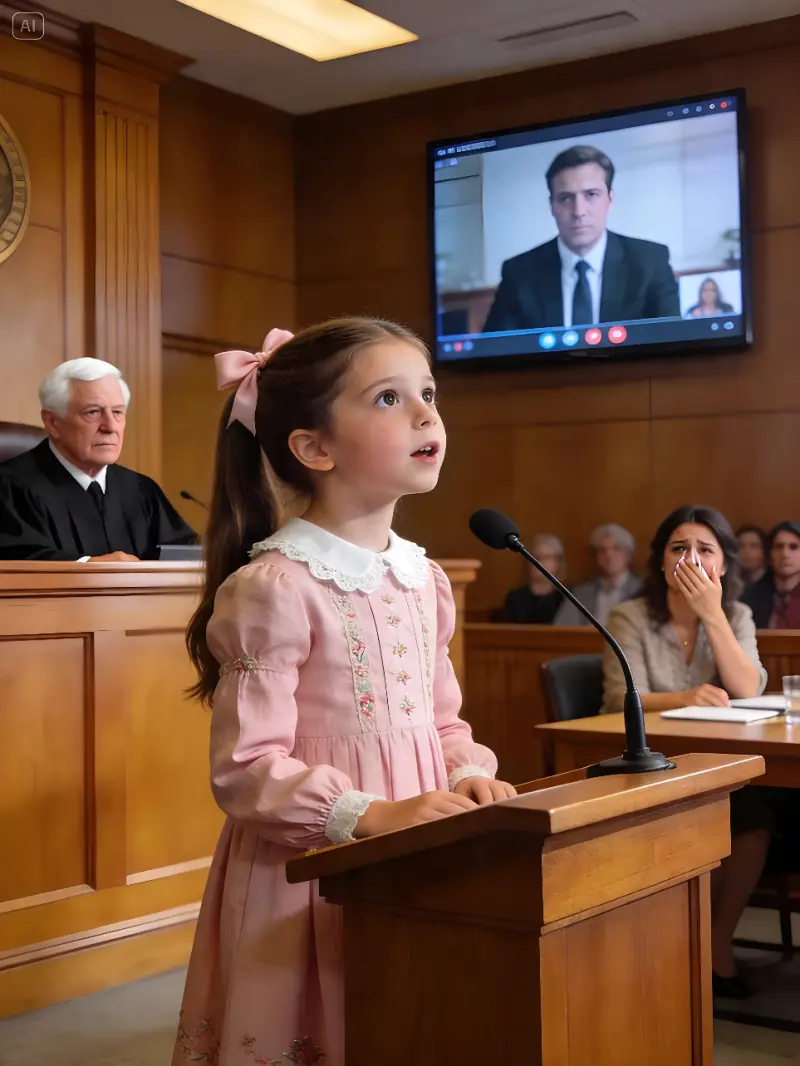
She stood anyway and looked straight at the judge with a seriousness no ten-year-old should have to carry.
“Your Honor,” she said, her voice trembling but clear, “can I show you something Mommy doesn’t know about?”
The courtroom went so quiet it felt like even the air had stopped moving.
Caleb turned toward her with sudden sharpness. For the first time that day, his composure slipped. “Harper, sit down,” he said.
But the judge leaned forward instead. “What would you like to show me?”
Harper swallowed hard. “A video,” she said. “It’s on my tablet. I hid it because I didn’t know who to tell.”
- The judge asked for the device to be reviewed briefly in chambers.
- Caleb’s expression changed instantly, as if he had been caught off guard.
- My daughter kept her eyes on the bench, brave even while her hands shook.
When the judge asked why I did not know about the video, Harper’s answer was barely above a whisper.
“Because Dad told me not to,” she said.
Caleb went pale.
In that single moment, the polished mask he had worn so confidently began to crack. The truth had not yet been fully revealed, but the room had already changed. My daughter, with all the courage in her small body, had just shifted the direction of the case.
Sometimes the quietest voice in the room is the one that changes everything. In our courtroom, it belonged to a child who knew more than anyone expected.