I grew up in Annapolis in a house filled with the smell of coffee, salt air, and engine grease. My father was Navy, and he was the quiet kind of steady—the kind of man who could spread a chart across the kitchen table and make the world feel understandable if you only paid attention long enough.
When I was twelve, a chaplain came to our front door. After that, the sea was no longer just scenery. It became a calling. I did not choose the Navy because it looked noble in pictures. I chose it because it felt like the closest way to stay connected to my father. The Academy. Commissioning. Steel decks. Long watches. Work that strips away anything false.
My mother said she wanted a normal life for me. Then she married Dale Wharton, a retired Marine colonel with a Bronze Star in a shadow box and a voice made for command. Dale had opinions about everything, especially about what counted as real service. In his version of the world, Marines fought wars and the Navy kept records.
From the moment he joined our family, I became his favorite joke.
- If I came home from deployment, he called it a cruise.
- If I mentioned a qualification, he said the Navy was just computers and paperwork now.
- When I brought home my Surface Warfare Officer pin, he held it up, smiled, and called it “water wings.”
Everyone laughed just enough to make sure I felt it. My mother never truly joined in, but she never stopped it either. She softened his words as if gentleness could remove their edge.
The only person in that house who ever seemed to really see me was Tyler, Dale’s son. He was younger, awkward at first, then thoughtful and quietly decent. He was the only one who ever asked what my qualifications meant. The only one who looked at my insignia with respect instead of amusement.
By twenty-eight, I was serving as a tactical action officer in the South China Sea. I cannot share every detail of what happened there, but I can say this: there were twelve Americans on a disabled vessel, conditions were worsening quickly, and I kept my ship in place longer than anyone expected.
All twelve got home.
What followed moved through the fleet quietly, the way important things sometimes do. No headlines. No speeches. Just a call sign that spread from one wardroom to another until people I had never met knew it anyway.
Iron Ten.
I never brought that story home. After enough years of being reduced at the dinner table, you stop offering your best truths to the people most likely to shrink them.
Then Tyler earned his Marine commission. I went to Quantico for him, not for Dale, but for Tyler.
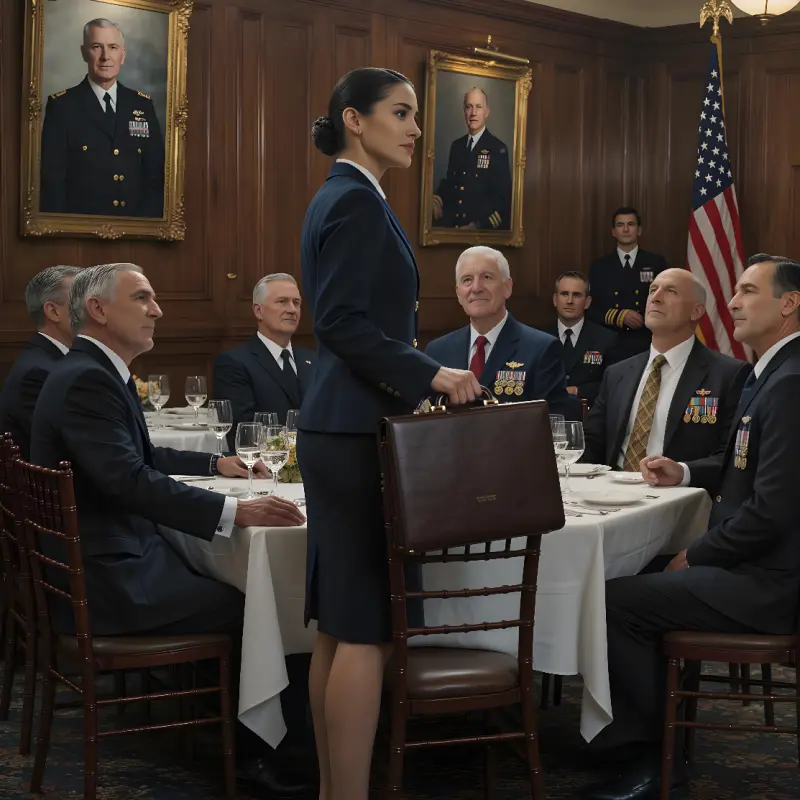
That night, the family dinner was held at the Officers’ Club. Wood-paneled walls. White tablecloths. Too much bourbon. The table was crowded with colonels, majors, and a few Navy officers Dale had invited because he liked having an audience. Tyler sat at the end, glowing with pride, his brand-new gold bar shining on his uniform.
I stayed quiet. I smiled when I should. I raised my glass for Tyler because I meant it.
Then Dale stood after his third drink and did what he always did.
“Every man here has bled for this country,” he announced, and the room laughed before he even finished.
He leaned back, grinning. “Ladies don’t get call signs.”
More laughter followed. Then he lifted his glass a little higher and added, “What would hers even be? Cupcake?”
For one long second, the only sounds were ice against crystal and a fork settling onto a plate.
Eight years of holidays. Eight years of swallowing it. Eight years of letting him decide what mattered.
I reached down, picked up my leather briefcase, and set it on the table slowly enough that the sound cut through the room.
Then I looked him in the eye and said, “Iron Ten.”
The laughter died so fast it almost sounded like relief. At the far end of the table, one Navy officer went still. Then another chair scraped back. Tyler’s expression changed first—not with confusion, but with recognition. Dale turned, still half-smiling, expecting the room to follow him the way it always had.
It didn’t.
And when the first officer rose to his feet, Dale finally looked around and realized he was the only one in the room who did not understand what those two words meant.
In the end, respect did not come from the loudest voice at the table, but from the truth that could no longer be ignored.