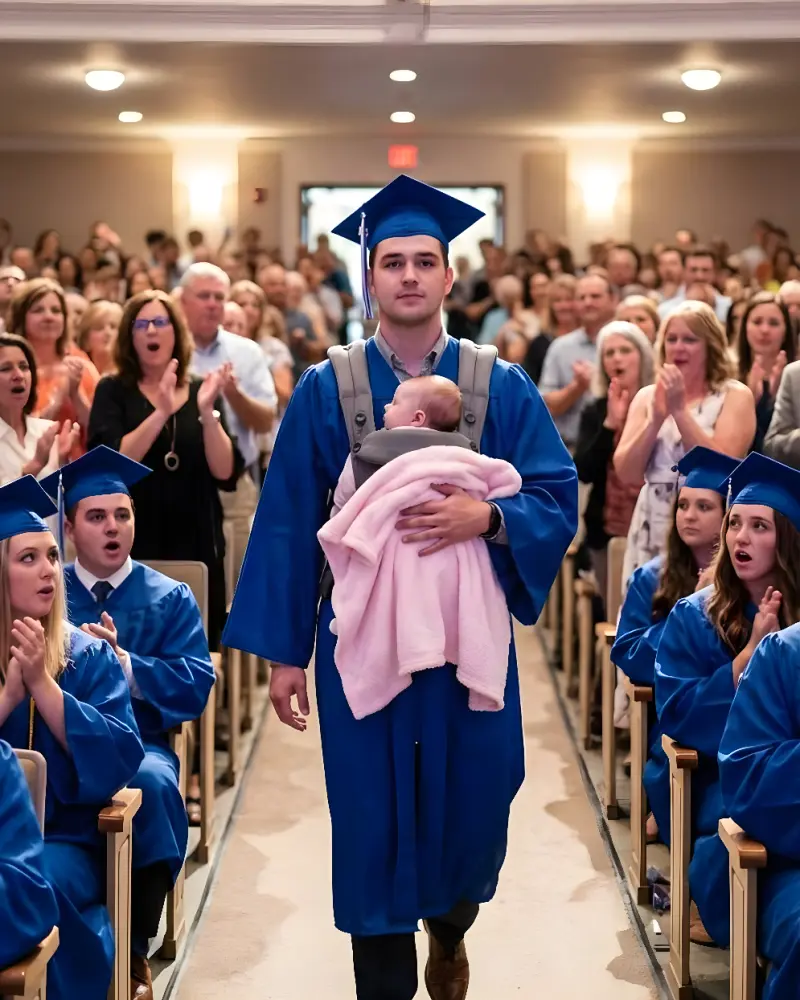
A night I thought would be about achievement
I was thirty-five the night my son graduated, sitting in the third row of a packed auditorium with a sore pair of shoes, a simple dress, and a diaper bag tucked beside my purse. Around me, families laughed, cried, and lifted cameras high, convinced they were watching the end of the hardest part of parenting.
For me, it had never been that simple. I had raised Adrian on my own since I was seventeen, after his father vanished without warning and never came back. There were no grand speeches in those years, only long shifts, unpaid bills, tired mornings, and the quiet determination to keep going for one more day.
Adrian grew up watching all of it. He noticed everything: skipped meals, hidden tears, the way I always found a way to smile even when life felt impossible. He was a quiet boy, but his silence held a deep kind of care. By senior year, he seemed ready for a future that finally looked steady.
The secret he carried
Then he began to change. He came home late. He worked extra hours. His phone stayed face down on the table. Some nights he looked worried in a way I couldn’t name, and other nights he looked strangely calm, as though he was carrying a burden too heavy to explain.
Three nights before graduation, he stood in the kitchen doorway and said, “Mom, I need you to hear everything before you decide how disappointed you are.”
My stomach tightened. Then he told me about Hannah. About the baby girl born less than two weeks earlier. About the hospital visits he had kept hidden because he didn’t want to add more pain to my life. And then he said something that stayed with me forever:
“No matter how scared I am, I will never disappear the way my father did.”
He asked me one more question, and it nearly broke me.
“If I have to bring her to graduation… will you still stay?”
I didn’t sleep that night. By morning, I knew the answer was yes.
Whispers in the auditorium
The ceremony began with all the usual joy: names called, applause rising, cameras flashing, proud faces glowing in the lights. Then Adrian stepped out of line and walked toward me with his arms open. “Mom,” he whispered, “give her to me.”
My hands trembled as I placed the tiny baby girl into his arms. He held her close, tucked beneath his gown, only her small face visible above a soft pink blanket. Then he turned and walked toward the stage.
The room reacted at once. The whispers came first. Then the laughter. A woman behind me leaned forward and said, just loud enough to sting, “Just like his mother.”
For one awful moment, I felt every old fear rise at once. But Adrian kept walking. He did not rush. He did not hide. He climbed those steps with steady care, carrying his daughter as if she belonged exactly where she was.
- He accepted his diploma.
- He adjusted his grip on the baby with calm hands.
- He stepped to the microphone and faced the entire room.
What he said next changed everything
The auditorium fell quiet. Adrian looked out at the crowd, then down at the newborn in his arms, and then at me. His voice was steady, but full of feeling.
“Before anyone decides what this moment means, I want to say something. My mother raised me alone. She worked, sacrificed, and stayed when staying was hard. If I am standing here today, it is because of her. And if I am holding my daughter today, it is because I refuse to repeat the past.”
He paused, and the silence deepened.
“I may be young. I may have made mistakes. But I am here. I am present. And this little girl will always know her father never walked away.”
By then, the laughter was gone. So was the judgment. In its place was a room full of tears, stunned faces, and a kind of respect no one had expected to feel.
That night, my son didn’t just graduate. He answered every cruel assumption with dignity, and he proved that love is not measured by perfection, but by who stays when it matters most.
In the end, what people remembered was not the whisper in the crowd, but the young man who stood on that stage and chose to break the cycle.