I was forty-five when I left the municipal animal shelter where I had worked for nearly eighteen years.
People often imagine a place like that is sad because of the animals.
It isn’t quite that simple.
The hardest part was not the barking. It was not the cages. It was not even the way certain eyes seem to follow you long after you pass the kennels.
The hardest part was the stories that arrived with them.
Every morning, I opened the gate at seven.
In winter, the yard smelled of wet concrete, cold metal, and disinfectant. The moment the dogs heard my steps, everything began: tails striking the bars, nails tapping the floor, noise rising in waves.
But beneath all that sound was always the same thing: hope.
I saw many abandonments over the years.
- People who rushed through the process.
- People who looked ashamed.
- People who talked too much because they could not bear to look the dog in the eye.
The words changed, but the meaning was always the same: I can’t do this anymore. I don’t have time. It’s become too hard.
Then one morning came along that I have never been able to forget.
It was January. Daylight had barely broken through. The sky was low and gray, and the cars outside were coated in a thin layer of frost that seemed to seep into your fingers at the slightest touch.
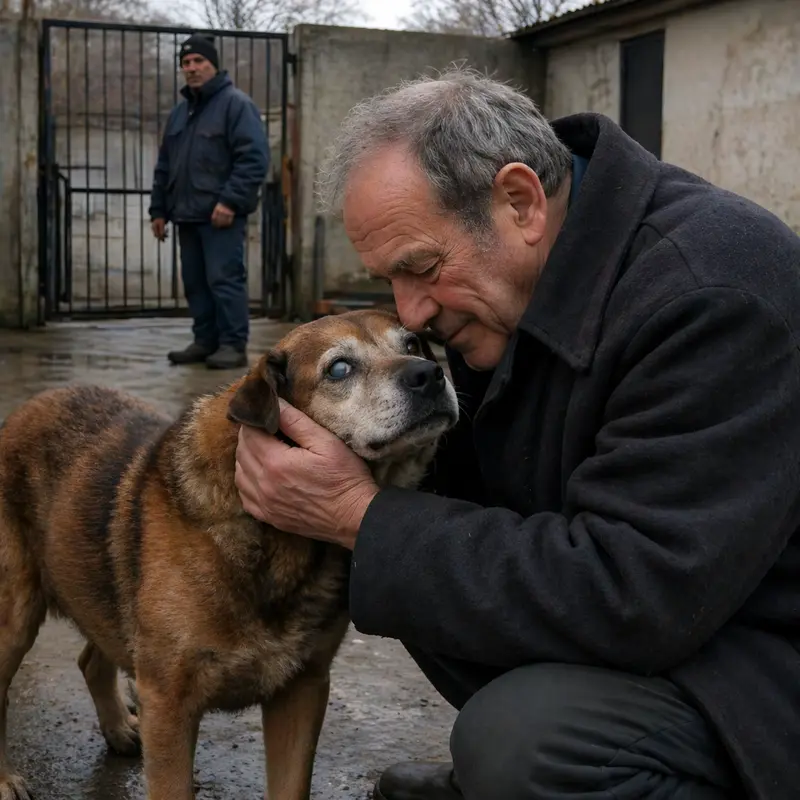
An elderly man walked in slowly, trying to keep himself upright. At the end of a leash was a large mixed-breed dog, brown and old, moving carefully beside him.
The dog’s eyes were clouded white. He was blind.
The man held the harness with a tenderness that is easy to recognize when you have spent half your life watching animals come through that gate.
This was not the hand of someone trying to get rid of a burden. It was the hand of someone still trying to protect what he loved.
He stopped in front of me, placed a hand on the dog’s head, and said in a calm voice, perhaps too calm:
“Next week I’m going into a nursing home. I have no one to leave him with. And I don’t want him to be treated like a burden after I’m gone.”
I did not answer right away.
I led them inside. The dog stayed close to his leg, not because he feared me, but because he feared the space opening between them.
The man set a bag on the table. Inside was a worn blanket, a dented metal bowl, and a page folded in four. Meal times. Favorite habits. The way he got restless at night when it rained. The fact that he calmed only when a voice was nearby.
As I read, my throat tightened. He had remembered everything, down to the smallest detail.
He knew that dog better than some people know their own relatives.
“His name is Hector,” he told me.
Then, with effort, he crouched down and held the dog’s face in both hands.
Hector lifted his muzzle toward the sound of his voice.
“I’ll be back soon, old friend,” he whispered. “Wait for me.”
That sentence has stayed with me ever since.
Not because it was cruel, but because it was the kind of promise made only when tenderness is the last thing standing against reality.
When I placed Hector in his kennel, he did not bark or struggle. He sat by the door, head turned toward the entrance, and waited.
He ate very little on the first day, and almost nothing on the second. Every time he heard footsteps, he raised his head, not anxiously, but with complete confidence that the promise would be kept.
Some days later, I called the nursing home. A short visit was allowed. The following week, Hector sat beside me in the car. He was silent the whole ride. But when we arrived, something changed. He could not see it, of course, but he had recognized a smell, a presence, a piece of the life he had known.
In the room by the window sat his owner, Carlo. He looked smaller than he had at the shelter, as if the world had already taken some of his strength.
I let Hector go forward.
He moved straight to Carlo, and when his nose touched the man’s hand, Carlo began to cry. Not loudly. Not for long. Just that tired, held-back kind of crying that hurts more than any outburst.
“I knew he would wait for me,” he said softly.
Hector rested his head on Carlo’s knees and stayed there, as if he had finally found the right place again.
After that, I began bringing Hector to visit as often as I could.
- Carlo’s shaking hand would slowly grow still.
- His tired face would brighten.
- And the blind dog would always find him without a mistake.
At the shelter, I learned something simple: animals do not lie. If they are afraid, you see it. If they are hurting, you feel it. And when they love, they love completely.
Hector taught me something else too. Being left somewhere does not always mean being unloved. Sometimes it simply means that someone has run out of strength to keep close the thing they love most.
Since then, I have kept thinking the same thing: some beings do not speak, and yet they keep promises better than many people ever could. And sometimes, saving a dog means saving the last piece of dignity left in a human heart.
In the end, this was never just a story about a shelter or a blind dog. It was a story about loyalty, grief, and the quiet ways love can survive.