My name is Pietro. I’m thirty-four years old.
For years, I was the kind of man who liked life neatly arranged. Few complications. Few risks. Simple relationships, or at least that’s what I told myself.
And there was one thing I had always avoided: falling in love with a woman who had a child.
Not because I was unkind. Because I was afraid.
I was afraid of not knowing where I fit. Afraid of stepping into a life already in motion, with routines, wounds, and silences I didn’t understand. Afraid of becoming attached and then hurting someone who had done nothing wrong.
I kept telling myself it wasn’t for me.
Then Beatrice came along.
We met in the most ordinary way. One rainy evening, outside a small neighborhood bakery. She was digging through her bag for coins, finding everything except the right ones. Then, all of a sudden, she laughed to herself.
A simple laugh. Tired, real, unpolished.
That was what struck me.
It wasn’t the laugh of a woman trying to impress anyone. It was the laugh of someone who had already had a long day and still found a reason to smile.
A few days later, we went for coffee together. Beatrice didn’t beat around the bush.
“I should tell you right away,” she said. “I have a son. His name is Tommaso.”
She said it calmly. Without embarrassment. Without apologizing for her life.
I nodded as if it were all easy for me.
But on the way home, my stomach tightened. This was exactly the kind of situation I had always run from.
And yet, I wanted to see her again.
When I met Tommaso, it was evening. The kitchen smelled like tomato sauce. The light was warm. He was sitting at the table with worn-down markers and a folded sheet of paper in front of him.
“Tommaso, this is Pietro,” Beatrice said.
He looked up, studied me for a second, and asked:
“Do you eat pizza with pineapple?”
I laughed immediately.
“No,” I said. “That’s where I draw the line.”
He gave a small nod.
“Good.”
Apparently, that had been the first test.
At first, it wasn’t easy at all. There were no carefree dates with Beatrice. There was real life instead.
- Dinners cut short because Tommaso had a cold.
- Movies paused halfway because he wanted to sleep near his mother.
- Conversations broken by a little voice calling from the next room.
And I was standing in the middle of all of it, never quite sure how to be.
Sometimes I felt out of place. Sometimes I was even ashamed of my own thoughts. Because maybe I had been waiting days for an evening with her, only to end up drinking tea in the kitchen while Tommaso coughed on the sofa.
It wasn’t his fault.
It wasn’t anyone’s fault.
I simply had to learn a new language: one made of shared attention, different rhythms, and a kind of love that never arrives alone.
Then I watched Beatrice. I saw her do everything: work, rush around, keep the house in order, make dinner, check homework, listen to Tommaso, and still remember to ask me how my day had gone.
The more I watched her, the more I understood how easy it is for someone like me to talk about complications while having lived such a comfortable life.
Over time, Tommaso began to open up.
Not all at once.
Slowly.
He let me help with his shoes. He sat a little closer when I read him a story. At the park, he talked to me about dinosaurs as if he were handing over something very serious.
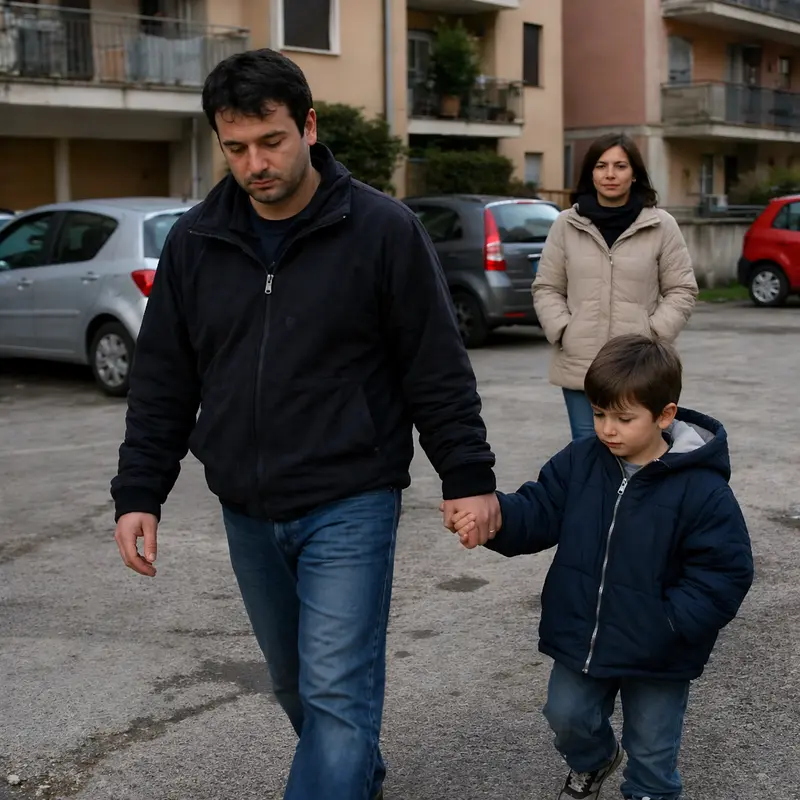
Then one afternoon, after school, as we crossed the parking lot, he took my hand.
Just like that.
Without saying a word.
His hand was small, warm, light.
But in that gesture was something enormous.
I was not his father. I didn’t want to pretend I was. I didn’t want to take a place that wasn’t mine.
And yet, in that moment, I understood something simple: a child does not give trust out of politeness. He gives it only if he feels safe enough to do so.
One evening, we were all at the table together. Beatrice had stepped away for a moment. Tommaso was distracted, mashing potatoes with his fork. Then he looked up at me.
“Will you still be here tomorrow?”
He said it almost casually, as if it were just another question.
I answered right away.
“Of course. Why?”
He shrugged.
“Just because.”
But children don’t ask “just because.”
That night I slept little. I thought about all the times I had walked away from things as soon as they became uncomfortable. How smart and free I had felt. How light.
And yet, looking back, there had been fear in that lightness too.
The next morning, I got up early. I bought fresh bread and a few pastries. Then I rang Beatrice’s doorbell.
Tommaso opened the door.
Messy hair. Crooked pajamas. Sleep still on his face.
He looked at me, then at the bag in my hand.
“You really came back,” he said.
That sentence caught in my throat.
I bent down a little.
“Yes,” I told him. “I’m here today.”
No huge promises. No words bigger than a man can keep. Just the truth.
At breakfast, Tommaso took a sheet of paper and drew three figures: one big, one medium, one small. Then he slid it toward me.
“This is us,” he said.
I looked at the drawing for a long moment without speaking.
It wasn’t beautiful in the usual sense.
But it was honest.
And honest things leave a deeper mark than everything else.
I am not Tommaso’s father.
Maybe I never will be in name.
But I take him to school. I read him stories at night. I hold his hand in parking lots. I stay when he looks for me.
And every day, I learn something new about patience, responsibility, tenderness, and above all, love.
The real kind does not always arrive alone. Sometimes it comes with a child by the hand, with a life already full, with quiet wounds, and with the silent request not to be only halfway there.
And when you choose to stay, even while afraid, you finally understand this:
It isn’t more complicated.
It is simply more real.
Summary: Sometimes the most important promise is not made with grand words, but with a steady presence. Love, when it is real, asks only that you show up again tomorrow.