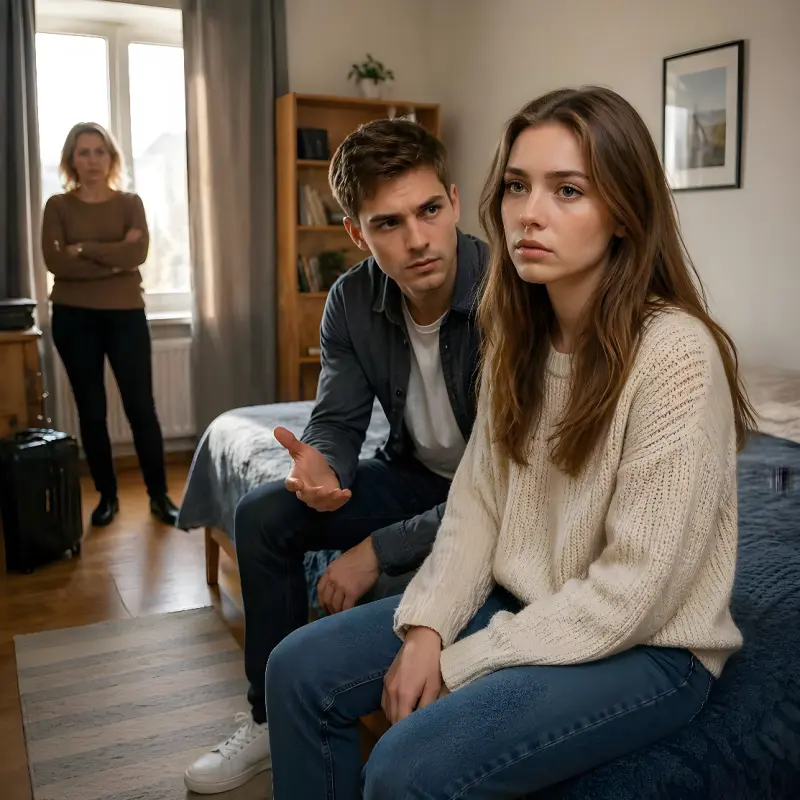
“What did you say?” Olga asked very quietly.
Maxim sat at the kitchen table with the top button of his shirt undone. In front of him was a plate of half-finished buckwheat, and beside it, his phone, which he kept turning face down every time a message appeared. His expression was irritated, but not heated. Worse than that: certain.
“You heard me. I’m tired of living in this madhouse. There’s a child always underfoot, you’re completely absorbed in her, and the apartment still isn’t properly sorted out. Are we a family or what?”
Olga slowly turned down the burner. Carefully. So the milk wouldn’t boil over. So her hands wouldn’t tremble. So she wouldn’t lose control before she was ready.
“And what does ‘properly sorted out’ mean?” she asked. “Hand the apartment to you and send my daughter away?”
Maxim’s cheek twitched.
“Not ‘send away’—place her somewhere suitable. There are special schools, boarding schools, and residential programs. They have order there. Discipline. You can see it yourself—the girl is difficult, withdrawn, always staring like a little wolf. She needs stricter treatment.”
From the children’s room, there was no more rustling. Olga heard that immediately.
“Liza is home,” she said.
“So what? Then she should also understand that the world doesn’t revolve around her.”
Olga turned and looked at him directly. She stayed silent for several seconds, long enough for the confidence to begin slipping from his face. Only a little. But enough.
“Say that again,” she said. “Slowly. I want to remember it well.”
He gave a short, uneasy laugh, as if he already regretted his bluntness, but he had no intention of backing down.
“I said I don’t want to live like this anymore. The apartment needs to be transferred to me so things can be done properly. And Liza needs to be placed somewhere where she belongs. We can’t build a family with a stranger’s child in the middle of the room.”
The word “stranger” hit harder than anything else. Not even Olga herself at first. It struck the silence behind the wall.
For a moment, she pictured Liza sitting at the table in her gray school sweater, a pen in her fingers, hearing every word. Not for the first time, maybe. But this time, without any protection.
“Ponder this carefully,” Olga said at last. “Because after what you just said, nothing in this house will stay the same.”
Maxim smirked, assuming she was bluffing. He leaned back in his chair, as though the conversation was already over. But Olga had already made her decision. Her face was calm, almost still, and that was what frightened him most.
- She would not shout.
- She would not beg.
- She would not let her daughter hear a single word of fear.
- And she would not allow anyone to decide Liza’s fate with such cold ease.
Without another word, Olga moved toward the hallway. She opened the closet, took down Maxim’s suitcase, and began packing his things with deliberate precision: shirts folded, toiletries gathered, charger wound neatly, documents placed on top. Each motion was quiet. Controlled. Final.
Only then did Maxim understand that she was not preparing for a compromise. She was preparing for his departure.
When he stood up too late and asked, “What are you doing?” Olga did not turn around.
“Making sure,” she said, “that the person who called my daughter a problem doesn’t spend another night in this apartment.”
And in that moment, the kitchen felt smaller, the air heavier, and the future suddenly very clear. Sometimes the strongest answer is not a scream, but a suitcase packed in silence.