A stranger at the gate
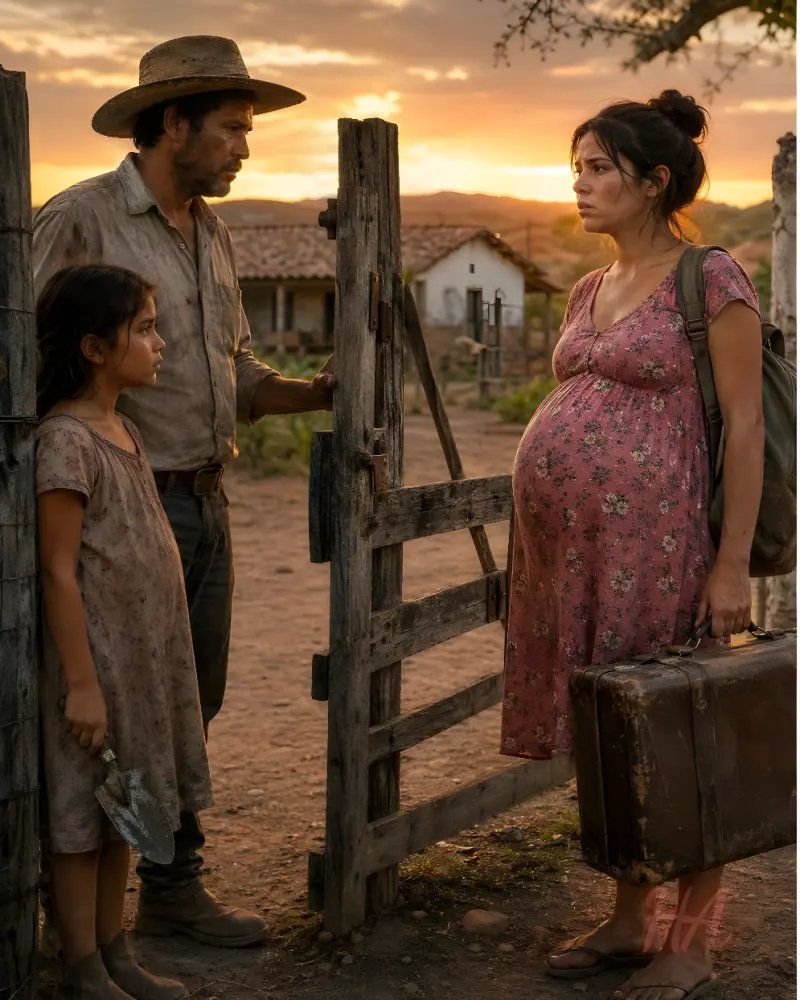
The woman stood at the gate with an old suitcase in one hand, a heavy backpack over one shoulder, and dust clinging to her sandals. She looked as if she had walked for miles with nowhere left to go. Mateo was ready to send her away.
But then he looked at her more closely.
The sun was sinking behind the hills of Jalisco when he stopped mid-swing with his hoe. Not because he was tired, but because his ten-year-old daughter, Lucía, had gone completely still beside the fence.
“Dad,” she said softly. “There’s someone at the gate.”
A young pregnant woman stood alone outside the farm. She did not step forward, and she did not retreat. One hand rested beneath the weight of her belly, as if she were holding herself together by force of will.
Mateo walked toward her, already thinking of every reason to refuse. The farm was small, the house was modest, and money was always tight. He had animals to feed, corn to tend, bills to manage, and a daughter to protect. There was no room for trouble.
When he reached the gate, the woman lifted her chin.
“Good evening, sir,” she said.
“Good evening.”
Then she spoke plainly, with no plea in her voice.
“If you let me stay,” she said, “I’ll work for it. I can cook.”
Mateo should have said no. He wanted to say no. But something in the way she stood there stopped him.
She was exhausted, but not broken. She asked for shelter like someone offering value, not begging for mercy.
“What’s your name?” he asked.
“Ana.”
He held her gaze for a moment, then opened the gate.
“Come in.”
Lucía watched quietly as Ana stepped inside, gripping the suitcase with both hands. The three of them walked to the house in silence, passing the jacaranda tree Lucía loved to climb and the plain porch where the evening light gathered softly.
One night becomes something more
Inside, Mateo pointed to the back room. “There’s a bed and a dresser. It’s nothing special.”
Ana glanced at the doorway and answered gently, “It’s more than I need.”
That night, she cooked with almost nothing: tomatoes, onion, garlic, rice, beans, and a small piece of meat from the freezer. Yet the kitchen smelled warm and full, as if the house had remembered how to breathe again.
- Lucía “accidentally” appeared in the kitchen three times before staying for real.
- Ana noticed everything without making a fuss.
- Mateo found himself listening more than speaking.
The next morning, Ana made cinnamon coffee and warmed tortillas. Lucía entered barefoot, cautious as always, testing whether a new person would stay kind after sunrise.
“Good morning, Lucía,” Ana said.
Lucía frowned. “How did you know it was me?”
“Your dad wears boots,” Ana replied. “You don’t.”
Lucía looked down at her feet, then sat at the table. Ana placed a mug in front of her with more milk than coffee.
Lucía took a sip, said nothing, and then took another.
A house beginning to feel like home
Over the next few days, the rhythm of the farm quietly shifted. Mateo worked the fields and cared for the animals. Ana cooked, washed clothes, and placed small wildflowers in the window. Lucía did homework at the table and found reasons to stay near Ana.
One morning, while hanging sheets beneath the mesquite tree, Lucía said, “My mother died when I was born.”
Ana paused, her hands still on the damp fabric. “I’m sorry.”
Lucía looked down. “My dad keeps one picture of her in a drawer.”
Ana answered softly, “It probably still hurts him.”
Lucía nodded. “Yeah.”
Then, with the directness only children have, she asked, “What about your baby’s father?”
Ana’s shoulder tightened. “He’s gone,” she said.
That was all, but it was enough. Some truths are too heavy to explain in full.
By the end of the week, Mateo found something in Ana’s suitcase that made his blood run cold.
In that instant, he understood she had not arrived at his gate by accident.
Summary: What began as one night of shelter slowly became something deeper, but a hidden secret in Ana’s suitcase suggested her arrival was tied to a far more dangerous truth.