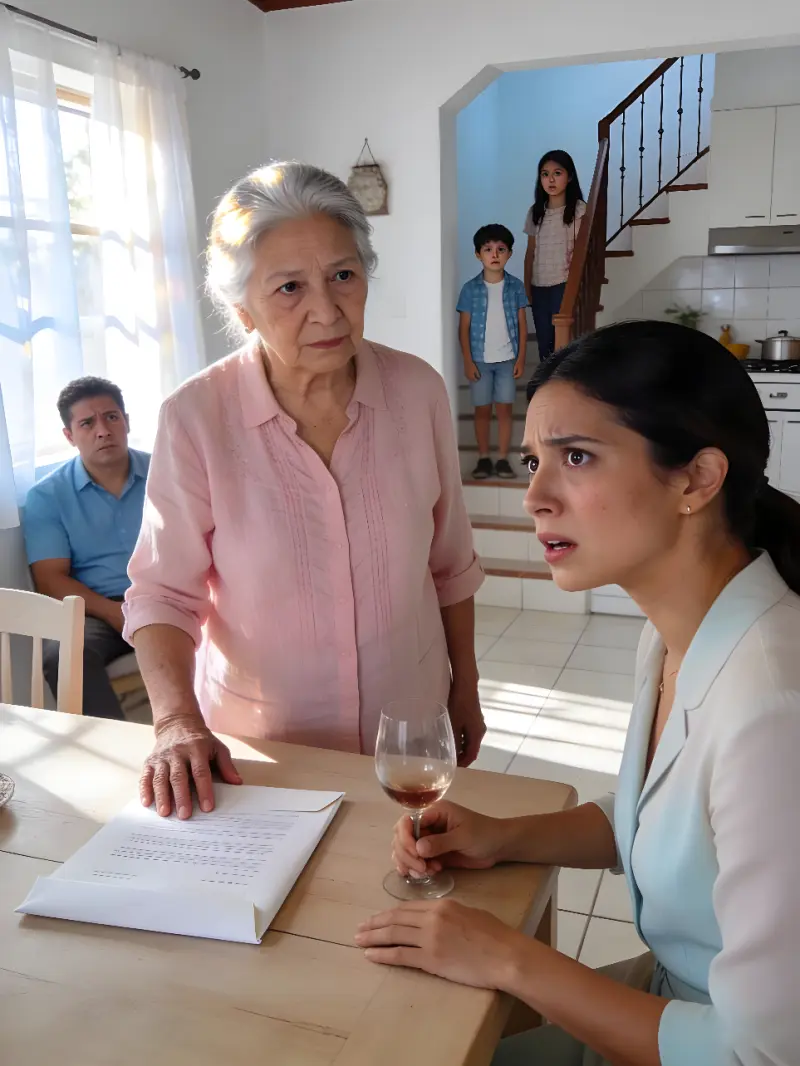
The dinner that changed everything
When my daughter-in-law lifted her wineglass and said, with a smile sharp enough to cut glass, “Thank you for living here all these years without paying anything. Now we’ve finally bought our own house, and we don’t need you anymore,” the table fell into a silence so sudden that even the sound of the silverware felt like an insult.
My son, Tomás, lowered his eyes and kept cutting his food as though he had heard nothing at all. My grandchildren, Emiliano and Valeria, froze in place, wearing the quiet alarm children get when they sense something important has just broken.
I did not cry.
I did not even want to.
Instead, something else stirred inside me. Beneath the hurt, an old strength woke up—one that had been sleeping for far too long. I placed my napkin neatly on my lap, looked up, and smiled slowly. It was a calm smile. Almost kind.
That unsettled Verónica.
She had expected tears. She had expected shame. She had expected me to beg for time, pity, or a corner to fade away in. But I only looked at her and said, “That’s wonderful, Verónica. I’m glad you finally want a life of your own. Because I have news too.”
The knife slipped from her hand and struck her plate.
Tomás looked up for the first time. Emiliano watched me with the uneasy eyes he had inherited from his grandfather. Valeria held her glass with both hands.
“What news?” Verónica asked, and the stiffness in her voice was no longer pride. It was fear.
I took a deep breath.
I had waited too long to speak, but sometimes truth must choose the exact moment to land.
“A piece of news that concerns you more than anyone else at this table.”
I could see her tighten first in the neck, then in the jaw, then in that familiar way she had of breathing as if the air owed her obedience. I let her sit with that discomfort for a few more seconds. She had earned it. So had I.
Just before dinner, while I was finishing the rice, I had heard her on the phone in the kitchen. She believed I couldn’t hear her.
“At last,” she had said. “At last she’ll be out of here. You have no idea how much I despise her. She acts like she owns everything. Tomorrow we’ll speak with the lawyer. Tomás will sign. And if necessary, I’ll make sure she signs too without understanding a thing.”
Without understanding a thing.
As if I were a useless old woman—half blind, half foolish, just an old shadow taking up one room too many.
She did not know who I was.
She did not know what I had buried to keep that house standing.
She did not know what I had promised.
I leaned slightly toward the table and said in a steady voice, “Your years here have not been free, Verónica. But neither have mine. And this house… this house is not yours.”
Tomás set down his fork.
“What are you saying, Mom?”
I looked at him with tenderness. My son had the face of a worn-out man, someone who had been carrying a burden for months without fully understanding it. I wanted to embrace him then, but not yet.
“I’m saying,” I continued, “that this house was never in your name. Not in your father’s name either. And certainly not in your wife’s. This house has been registered only in my name for twelve years.”
Verónica did not move.
But the real shock was not only that the house was not hers. It was what I had heard her say in the kitchen minutes earlier—and what she still did not know I was prepared to reveal.
- She had underestimated me for years.
- She had mistaken my silence for weakness.
- And now, at last, the truth was ready to speak for me.
That night, I finally understood something important: patience is not surrender. Sometimes, it is simply the way victory waits.