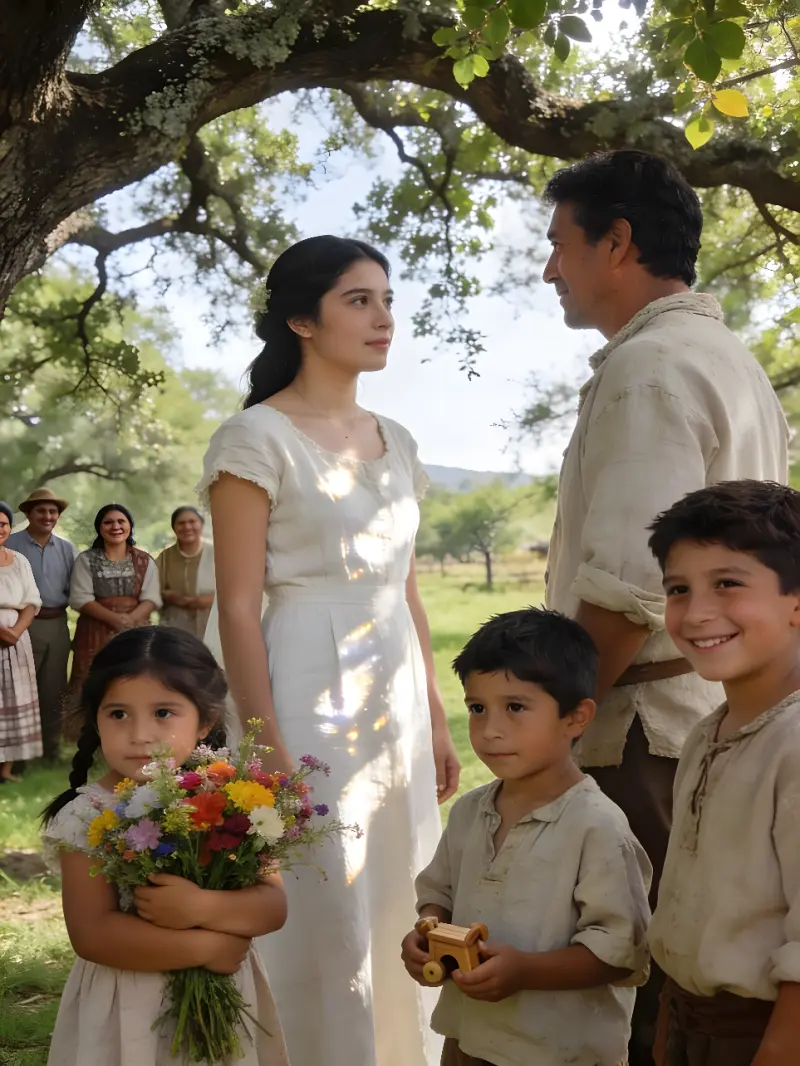
A Marriage Arranged by Need
At eighteen, in the winter of 1878, Luz Robles was given in marriage to a widower with three children in the mountains of Durango. In the remote ranches of the Sierra Madre Occidental, a woman’s heart was not always what guided her future. More often, survival made the choices.
The wind moved through the pines like an old sorrow. Snow covered the dirt roads, hiding every track as if the land itself wanted to erase the path ahead. Luz stood on the porch of her uncle Prudencio’s house, clutching her mother’s gray shawl against her chest. She did not cry. Since her mother had died six years earlier, she had learned that tears could not change the direction of a wagon.
Inside, near the hearth, the bargain was being sealed. Her uncle spoke without shame. Luz was strong, hardworking, and, in his words, “not delicate.” Across the table stood Cayetano Guerra, a rancher of thirty-six, widowed for three years. He was tall, broad-shouldered, and tired in a way that had nothing to do with age and everything to do with loss. A bag of silver coins landed on the table beside a document for a fine young calf, and just like that, the agreement was made.
Luz climbed into the cart without looking back. Snow began to cover her footprints almost at once, as if the world had already decided she no longer belonged there.
The House at El Encino
El Encino, on the edge of Nombre de Dios, stood white and silent against the winter landscape. The house resisted the wind with worn dignity. In the barn, tools still hung in the places where Clara, Cayetano’s late wife, had once kept them in order. The children watched Luz from the hallway: Rosita, only three, hiding behind her brother Elías; and Matías, eight years old, with his arms crossed and a guarded look that seemed older than he was.
The first days were clumsy and difficult. The stove would not cooperate. The griddle burned. The water from the well cut through her hands like ice. She did not know how to braid Rosita’s hair or soothe Elías when he cried at night. Still, she did not give up.
Every morning, she found small notes near the hearth:
“Use oak wood. It lasts longer.”
“Elías likes beans with epazote.”
“You do not have to be perfect. Just do not quit.”
Those words warmed her more than the fire ever could. At night, if she left the dishes undone, they were washed by morning. If she forgot the firewood, it appeared stacked and ready. No one spoke of these quiet gestures, but the cold between them slowly began to crack.
When Grief Finds a New Voice
Then illness arrived the way hardship often does in the countryside: without warning. Rosita stopped eating and burned with fever. In her sleep, she called for her mother. Luz prepared herbal teas, changed cloths, and held the little girl close for warmth through three sleepless nights, inventing prayers she had never been taught.
On the third night, Cayetano stood outside the room that had once belonged to Clara. He did not knock. Through the fogged window, he saw Luz singing softly while holding his daughter as if she had always been hers. When Rosita woke the next morning and whispered, “Thank you, Mama Luz,” it was not a small moment. It was a quiet turning of the earth.
Later, Luz found Clara’s simple grave behind the house and placed wildflowers there. She whispered that she had not come to take anyone’s place, only to make sure the children would not be left alone again. Matías listened, and though he did not love her yet, he no longer turned away.
- She cared for the children as if they were her own.
- He watched her, silently learning to trust again.
- The house became less empty, little by little.
But grief does not disappear without leaving marks. One night, Luz overheard Cayetano in the barn saying she had been taken on out of convenience, someone needed to manage the house. The words struck her deeply because they sounded like a truth she feared: that she was useful, but not valued. In the dark of morning, she left a letter on the table and walked into the snow, wrapped in her coat and wounded pride.
When Cayetano found the note, he followed her tracks through the wind-blown drifts until he found her beside a frozen creek, trembling and small against the winter vastness. He knelt before her and admitted what he had never said aloud: that after Clara died, he had shut his heart away and mistaken silence for safety. Luz answered with quiet dignity that she had never asked for perfect love—only to matter.
He told her she mattered more than she knew. It was not polished. It was not easy. But it was real. They returned together to El Encino, carrying with them the beginning of something neither of them had expected.
And yet, forgiveness was not the end of the story. It was only the start of a harder test, one that the winter had not destroyed and the spring would soon reveal. Summary: Luz arrived at El Encino as part of an arrangement, but through patience, pain, and quiet devotion, she began to transform a house of loss into a place where healing could begin.